
Diet Calorie Apps: Tracking & Tips

Table of Contents
When starting a diet, we often wonder, "How many calories did I actually eat today?" In my practice, I frequently hear patients say, "It's too difficult to track accurately." That's why I recommend using a calorie app, but the sheer number of options can be overwhelming.

Why You Need a Calorie App
The starting point of any weight management journey is understanding how much you consume versus how much you burn. Relying on rough estimates often leads to skipping meals or underestimating the calories in snacks and drinks.
Most calorie calculators work similarly: they calculate your Basal Metabolic Rate (BMR) and factor in your activity level to determine your Total Daily Energy Expenditure (TDEE). Then, they set a daily goal by subtracting 300-500kcal based on your weight loss target. These apps handle all calculations and consolidate your food and exercise logs in one place, making the process much more manageable.

User-Friendly Apps for Koreans
The key factor is how well the app recognizes Korean foods. Popular domestic options include Dasin, InOut, and Milligram, while FatSecret and YAZIO are frequently mentioned globally.
Dasin: Calculates obesity level based on BMI, then prescribes daily calorie needs based on target weight and timeline. Includes diet/exercise/weight diary, statistics, and community features. 100% free for basic functions.
InOut: Automatically calculates calories and macronutrients with just a photo or simple search. Features AI coaching, gamification, and community support. Has approximately 1.4 million downloads in Korea as of 2024.
Milligram: Comprehensive management of diet, exercise, weight, water intake, sleep, and condition. Great for group sharing of meal plans.
Understanding the Calorie Calculation Process
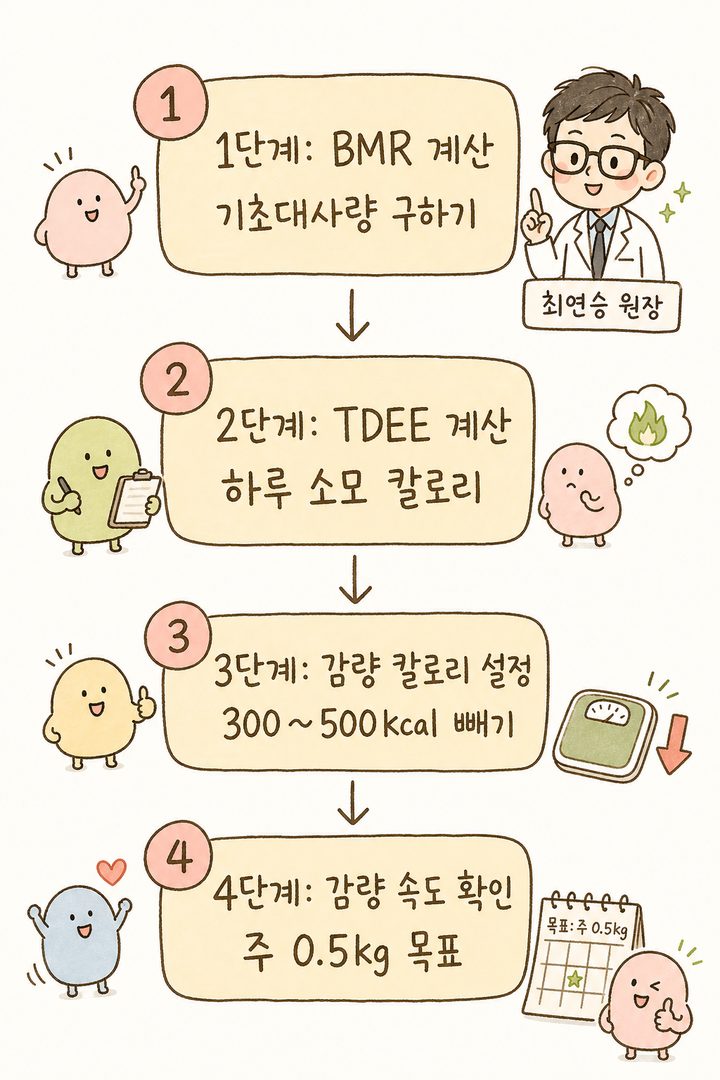
Even though apps handle the calculations, understanding the principles helps you avoid being overwhelmed by numbers. The process typically involves four steps:
Step 1: BMR Calculation - Determines energy used at complete rest.
Step 2: TDEE Calculation - Multiplies BMR by activity factor for total daily calorie expenditure.
Step 3: Setting Calorie Deficit - Subtracts 300-500kcal from TDEE for target intake.
Step 4: Monitoring Weight Loss Rate - Samsung Medical Center recommends 0.5kg per week, roughly equivalent to a 500kcal daily deficit.
Activity factors: Sedentary (BMR × 1.2), Lightly active (× 1.375), Moderately active (× 1.55), Very active (× 1.725). Korean medical standards suggest 25-30 kcal/day per kg of ideal body weight for light activity, 30-35 for moderate, and 35-40 for intense activity.

Real Changes You'll Notice
Patients who track calories for about a month often show changes in eating habits before the scale moves. Seeing the calorie count of a late-night meal makes you pause before reaching for it next time. Apps with photo recognition make it easier to maintain consistency, even when eating out.
The first few days might feel tedious, but after a week, frequently eaten meals are saved in favorites, making logging take less than a minute per meal. Weight changes follow gradually, and those who maintain a steady, recommended deficit typically see more sustainable results than those who cut calories too drastically.

Baekrokdam's Perspective on Calorie Apps
In Korean medicine, we don't focus solely on calorie numbers. The same amount of food affects people differently - some retain water, others have slow digestion, and some experience nighttime binge eating. This is why we consider individual constitution and lifestyle patterns.
I recommend using calorie apps as constitution-reading journals. Beyond just recording "1,500kcal today," note when, in what situations, and what foods you craved. These patterns - peak hunger times, meals causing water retention, stress-induced binge eating - become clear during consultations, allowing for personalized herbal prescriptions and lifestyle guidance.

Action Points to Start Today
Small habits last longer than grand resolutions. Start with just one:
Choose one app you like: Dasin for comprehensive features, InOut for photo logging, or Milligram for clean interface.
Focus on consistency over accuracy in the first week. Just writing down menu names is enough.
Set a goal of 300-500kcal below your TDEE. Cutting too much too soon is unsustainable.
Weigh yourself weekly. 0.5kg per week is good progress.
Save 5-10 frequently eaten meals as favorites to reduce logging time.
Remember, calorie apps are just tools. Use them as mirrors reflecting your eating habits rather than becoming obsessed with numbers. If you're losing weight slowly after a month or experiencing issues like water retention, digestion problems, or appetite fluctuations, it might be time to examine your constitution. The Baekrok Gambi-jung program reviews your app data during consultations to create personalized Korean medicine prescriptions and lifestyle guidance. If you're struggling alone, feel free to schedule a consultation.