
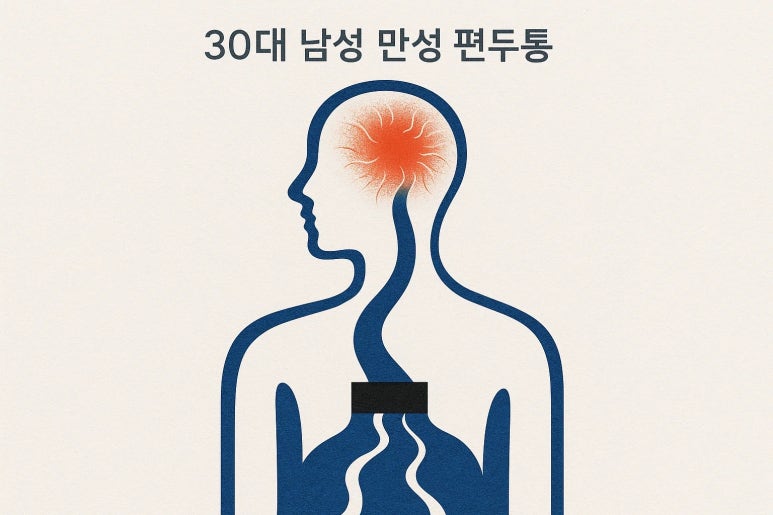
30s Male Chronic Migraine | Incheon Migraine

Table of Contents
Chronic Migraines in Men in their 30s: Beyond 'No Abnormalities,' Listening to the Body's True Signals
Medical Insight
To all men in their 30s struggling amidst breathless competition and intense work, are you perhaps experiencing such a desperate situation?
Just before an important presentation, or when your body and mind are exhausted from successive late nights, a pain begins to weigh down your head like an uninvited guest.
The throbbing and pounding pain robs you of your work concentration, ultimately causing productivity to plummet. Has it become a bitter daily routine to barely get through the day, holding stimulating coffee in one hand and painkillers in the other?
Within this endless cycle of pain, what does your body truly want to tell you?
| "My head hurts so much I can't concentrate at all. It's frustrating and makes me feel helpless to find myself reaching for painkillers even before an important meeting." |
This story, recounted by a male reader in his 30s, is likely not just his personal cry. According to statistics, the prevalence of migraines among men in their 30s is not insignificant, and many suffer from this chronic pain.
Indeed, there are survey results indicating that a significant number of migraine sufferers in Korea take painkillers more than once a week, experiencing a decline in their quality of life. This situation is a critical 'health warning signal' from our bodies that should not be taken lightly. It's time to properly respond to this signal.
You have probably visited the hospital for frequent migraines and undergone precise examinations such as MRI or CT scans.
However, in most cases,
| "There are no particular abnormalities." |
along with the diagnosis, a prescription for painkillers might have been all you received.
| The diagnosis of 'no abnormalities,' which means nothing is found even with precise machinery, can, ironically, plunge patients suffering from pain into deeper frustration and helplessness. This disconnect, where your body clearly screams pain but medical tests say 'normal,' leads to the frustration of not being able to find the root cause. |
While there might be temporary pain relief, the recurrence of pain as if it had never left once the medication wears off often leaves many with anxiety about drug dependence and deep skepticism.
Here, we encounter a very important question.
Can the diagnosis of 'no abnormalities' truly explain all your pain?
And are painkillers the only answer to resolving the root cause of the pain?
Many of you would probably ponder these questions. This is because body pain is not merely discomfort, but always 'the body's language' that carries meaning in some form. Now is the time for us to interpret those hidden meanings from a different perspective, more deeply.
Traditional Korean Medicine: Listening to the Body's Imbalances and Deciphering the Hidden Language of Migraines
Traditional Korean Medicine does not limit migraines to being merely a localized problem of the head.
Rather, the pain appearing in the head is interpreted as a 'warning signal' and a 'symptom of imbalance' that arises when the harmony and balance of our entire body are disrupted.
An imbalance latent within the body is believed to cause dysfunction in specific internal organs or stagnate the flow of Qi and Blood circulation, which transports vital energy, resulting in the manifestation of pressure and pain in the head.
This is akin to a river whose flow is obstructed, where a dam at a specific point for a long time causes pressure to build up, the effects reaching upstream, creating strong currents and even pain so intense it feels like it might burst.
Head pain, in this sense, is the scream from upstream caused by this 'dam.'
This holistic perspective
| the chapter "Headache (頭痛)" in "Donguibogam (東醫寶鑑)" |
can also be found in its profound context.
The Donguibogam classifies the causes of headaches into various internal and external factors such as Wind (風), Cold (寒), Summer-Heat (暑), Dampness (濕), Phlegm (痰), Qi (氣), and Blood (血), emphasizing the need for a delicately varied approach based on each patient's individual body condition and the dysfunction of their Zang-Fu organs.
In other words, beneath the outwardly apparent phenomenon of 'headache,' countless different 'causes' may be hidden, offering a profound insight that modern medicine often overlooks.
Your migraine is not just a simple pain, but perhaps the most powerful and important language your body conveys. How deeply do we truly understand this language, and how wisely are we responding to it?
Chronic Migraines in Men in their 30s: Types and Customized Approaches from a Traditional Korean Medicine Perspective
The frequent occurrence of chronic migraines in men in their 30s, who are at the peak of their professional lives, is deeply linked to the characteristics of modern society.
Excessive work stress, frequent work-related dinners, irregular eating habits, and severely insufficient sleep continuously affect the functions of our vital internal organs, often manifesting as specific types of migraines.
In Traditional Korean Medicine, we comprehensively analyze each individual's unique symptoms, lifestyle habits, and innate constitution to accurately diagnose the body's imbalance patterns and seek customized approaches that precisely fit them.
We call this the principle of 'Byeonjeung Shichi (辨證施治),' or 'pattern differentiation and treatment.' Now, let's look closely at some common types.
| First, 'Liver Qi Stagnation (肝氣鬱結) type' migraines caused by social responsibility and stress. |
Excessive stress and suppressed emotions from being a breadwinner or a member of an organization stagnate the Qi of the 'Liver,' disrupting circulation, and this rises to the head, causing headaches.
Symptoms typically include a tight, constricting feeling in the head or throbbing pain in the temples, accompanied by easily fatigued eyes and indigestion. In such cases, the approach is to gently alleviate the stagnant Liver Qi and regulate Liver function, helping to clear blocked channels so that the river water can flow vigorously again.
| Second, 'Phlegm-Dampness (痰飮) type' migraines arising from frequent work-related dinners and irregular eating habits. |
Frequent work-related dinners, late-night meals, and irregular eating habits place an excessive burden on digestive functions and cause 'Phlegm-Dampness,' undigested waste products, to accumulate in the body. When this Phlegm-Dampness rises to the head, it can manifest as dizziness, a heavy and unclear sensation in the head (as if in a fog), nausea, and migraines.
This is similar to stagnant water in a neglected puddle becoming turbid and even polluting the surrounding air. For this type, an approach that eliminates Phlegm-Dampness and fundamentally strengthens digestive function can be considered.
| Third, 'Qi and Blood Deficiency (氣血虛弱) type' migraines caused by long working hours and lack of sleep. |
Due to ceaseless long working hours and chronic lack of sleep, etc., when the body's fundamental energy, Qi and Blood (氣血), is depleted, the brain lacks nourishment and vital energy, leading to headaches. This signifies a state where the body's fundamental energy is exhausted, similar to a rice paddy cracking and losing vitality due to a long drought.
It is often accompanied by chronic fatigue, dizziness, and decreased concentration. In this case, the approach is to replenish Qi and Blood and enhance the body's overall recovery ability to restore fundamental vitality.
A Step Towards New Hope
Up to now, we have deeply explored, from a Traditional Korean Medicine perspective, that chronic migraines in men in their 30s are not merely a problem of the head, but a profound signal sent by complex imbalances throughout the entire body.
Beyond the temporary reprieve from pain that painkillers offer, restoring our body's fundamental balance is indeed the true journey towards sustainable health.
This journey goes beyond merely relying on specific herbs or treatment methods. It exerts a more powerful healing force when accompanied by efforts to understand the subtle signals your body sends and proactively identify and improve factors that cause imbalance amidst busy lifestyle habits. Seemingly minor changes, such as learning stress management techniques, re-establishing regular sleep habits, and maintaining a balanced diet, will accumulate to play a decisive role in restoring the body's harmony.
Traditional Korean Medicine can be an excellent and wise guide. This is because it can comprehensively interpret each individual's unique constitution, lifestyle patterns, and symptom patterns to diagnose bodily imbalances and propose perfectly tailored solutions. Now
are you ready to go beyond simply suppressing the signals your body sends and actively respond to these signals to seek new balance and true hope?
Your body may already know the answer.
May your suffering not be an end, but a new beginning.