
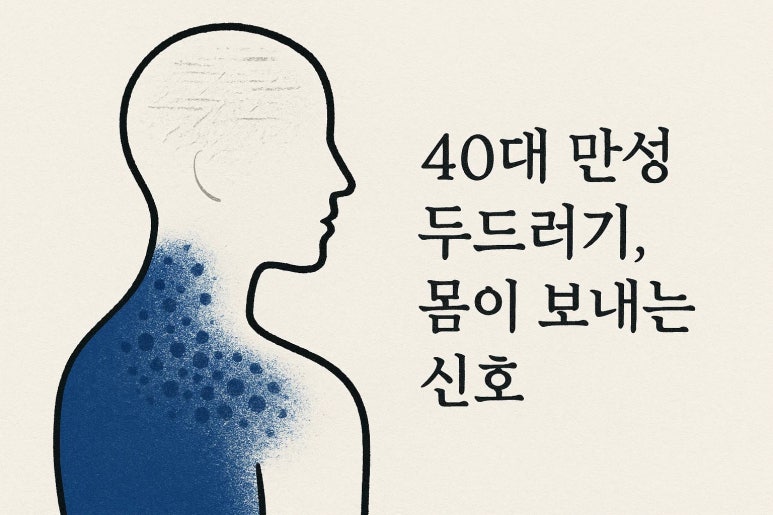
Chronic Urticaria in Your 40s, Suddenly Worsening

| “Doctor, why has my urticaria suddenly gotten so severe? The medication only helps temporarily… now I can't even sleep properly at night.” |
When I meet patients who visit me in the clinic for chronic urticaria, they often ask questions like this.
Especially, many patients in their 40s suffer from skin symptoms they've never experienced before.
Whenever I hear such questions, I try to look beyond the red rashes or itching on the skin and read the earnest signals and messages that the body is sending from within.
Chronic urticaria, which persists for months or even years, is not merely a skin problem.
This persistent skin condition, which is rarely brought under control by temporary itch-suppressing medications, constantly recurs and erodes our daily lives. Where exactly does it originate from?
Chronic Urticaria After Age 40: Complex Changes Within the Body
Many patients in their 40s and beyond whom I encounter in clinical practice invariably express, "I'm extremely fatigued, and I'm under a lot of stress."
Perhaps the key to understanding urticaria lies hidden in these very words.
The 40s are a period of significant physical and mental changes.
Responsibilities at work and home increase, and as hormonal changes begin, the body's resilience to recovery tends to decline.
This chronic stress leads to disturbances in our body's autonomic nervous system.
It's as if the autonomic nervous system, which should maintain the body's balance, malfunctions like a broken GPS.
From years of clinical experience and an academic perspective, I interpret chronic urticaria in individuals over 40 as the cumulative result of complex internal changes: immune imbalance, chronic stress and autonomic nervous system dysfunction, and worsened gut health.
An imbalance in the autonomic nervous system ultimately causes confusion in our body's immune system.
Immune cells, which should ward off external invaders and maintain internal order, become disoriented, unable to distinguish between friend and foe.
Furthermore, worsening gut health also serves as an important clue to immune imbalance.
When I listen to those who say, "I never have a comfortable stomach," I realize once again how closely connected the gut, immune system, and skin truly are.
B's Story: Unraveling the Persistent Urticaria
| B, whom I met in the clinic, was a working professional in her mid-40s. For two years, she had suffered from full-body urticaria. Initially, taking antihistamines prescribed by a dermatologist seemed to calm it down, but without fail, the urticaria would flare up every night when she stopped the medication, disrupting her sleep. Her symptoms worsened especially when she was overworked or stressed, and she also experienced poor digestion and constant fatigue. B sighed deeply, asking, “Doctor, I think I’ve developed a tolerance to the medication. Should I just keep taking these pills? Is there no fundamental cure?” |
Beyond Symptom Suppression: The Path to Fundamental Recovery
Like B, many people feel limited by existing treatment methods and become frustrated.
An approach focused solely on symptom suppression is like temporarily extinguishing a fire; as long as embers remain, it's bound to flare up again at any time.
So, how can we break free from this persistent chronic urticaria?
I believe it's most crucial for patients to deeply understand their own bodies and stand as the primary agents of their recovery.
A shift in perspective is needed, to view urticaria as a signal indicating an overall bodily imbalance.
And to correct this imbalance, a customized approach must be adopted.
Korean Herbal Medicine Treatment: A Customized Approach to Restoring Bodily Harmony
This is precisely why I recommend Korean herbal medicine treatment to patients with chronic urticaria.
Korean herbal medicine isn't just about symptom suppression; it's a process of changing the body's environment and restoring the balance of nerves and constitution.
It aims to fundamentally transform our body's internal environment by balancing the autonomic nervous system, improving the gut environment, and correcting immune system disturbances.
By comprehensively considering each patient's constitution, lifestyle, and current symptom patterns, it helps the various "instruments" within the body produce harmonious sounds, much like an orchestra conductor.
If lifestyle improvements such as a healthy diet, regular exercise, and adequate sleep are added, our body can regain its self-healing power and establish a strong foundation for preventing recurrence.
The Body's Signals: An Opportunity for Change
Chronic urticaria is a precious warning and an opportunity for change sent by our bodies.
Only when we look beyond the superficial symptoms and adopt an integrated approach to uncover the complex underlying causes can we truly embark on the path to genuine recovery.
Even if it's not with me, I sincerely hope you find medical professionals who will carefully examine your entire body and become reliable companions on your recovery journey.