
I'm Hungry, But 'My Stomach Is Bloated Even Though I Haven't Eaten!' | Incheon Bloating

Table of Contents
"I'm Hungry, But My Stomach Feels Bloated Even Though I Haven't Eaten Anything" - Why Is Your Gut Full of Gas?
| "Doctor, I've eaten very little, and I even skip meals often, but my stomach keeps getting bloated. I keep burping from deep inside, and my chest feels tight." |
Mr. A, a developer in his mid-30s, said with a deep sigh. He mentioned that these symptoms began right after the deadline for a project he had been working on for several weeks. Initially, he thought it was simple indigestion and drank a digestive tonic or took digestive aids, but the relief was only temporary. Instead, the tightness in his chest, which seemed to rise up, led to more sleepless nights, and he also provided an unexpected clue: he had lost 2kg in the past three months.
The Irony of a Bloated Stomach with Weight Loss: The Clue
His symptoms were not simply caused by an excess of gas in the intestines. If that were the case, he should have responded to the digestive medicines he took, but he only experienced temporary symptom relief. So, what could be the real cause of this strange phenomenon where his stomach feels bloated despite not having eaten?
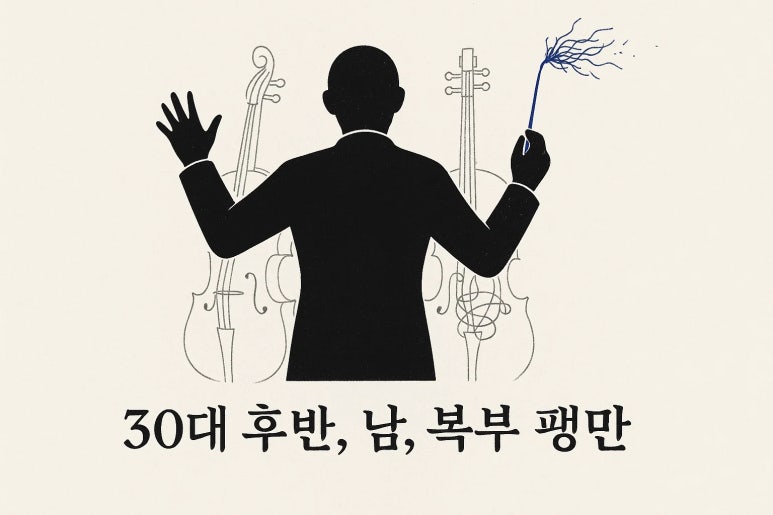
| This is like a complex orchestra whose conductor has suddenly disappeared. The organs, having lost their conductor – the nervous system – play erratically, creating disharmony. In traditional Korean medicine, if 'Sikche (食滯)' refers to a state of digestive stagnation due to food intake, this patient's symptoms are closer to 'Giche (氣滯).' In other words, it is viewed as a problem arising from the blockage of 'Gi (Qi)' flow. |
When our body is under stress, it activates the sympathetic nervous system to respond to external threats. In this process, the brain suppresses the function of the parasympathetic nervous system, which is responsible for digestion. Since the brain's priority is 'survival,' 'digestion' is put on hold. This is like having to run at full speed in an emergency, while putting engine fuel efficiency on the back burner.
When intestinal movement slows down like this, the food we eat is not sufficiently absorbed in the small intestine and passes into the large intestine. The food that passes into the large intestine becomes fodder for intestinal microbes, and these microbes produce excessive gas during the process of breaking down the food. Nutrients that should have been absorbed in the small intestine transform into a 'feast' for large intestinal microbes. Indeed, Mr. A had a recurring pattern of drinking more than two cups of coffee just before leaving work on days he frequently worked overtime. Caffeine, in this way, stimulates the sympathetic nervous system and further suppresses intestinal peristalsis.
| 💡 What's making your stomach bloated might not be 'food,' but a 'signal.' If you, like Mr. A, feel bloated without having eaten much, and your stomach feels hard to the touch, instead of just reaching for digestive aids, you need to examine the state of your 'body's conductor,' the autonomic nervous system. |
Your Body Is Speaking to You Through Your Gut
Abdominal bloating, frequent burping, and chest tightness are not just uncomfortable symptoms. They are like 'warning signals' that your body, amidst the busy and unstable modern society, is communicating an imbalance in your autonomic nervous system through your gut. Digestive aids are only temporary solutions for symptoms; they do not address the real problem of 'signal disruption.' Therefore, instead of simply blaming food when you have indigestion, it's important to reflect on your lifestyle patterns: whether you've had enough sleep, and how you're managing stress.
Of course, not all cases of abdominal bloating fit this pattern. However, if you are tired of recurring symptoms, it's time to have the courage to look for the 'real cause' beyond just 'food.' Your gut is your closest friend and your most honest warning system.