
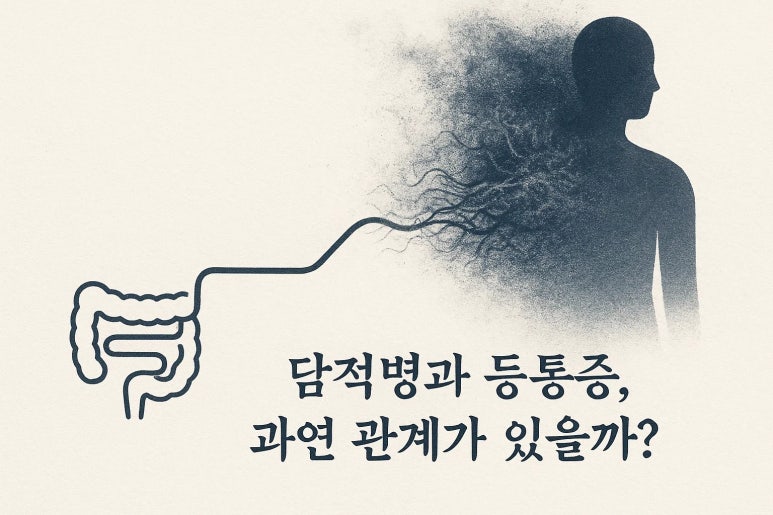
Why Damjeok Syndrome is Often Accompanied by Back Pain

When I hear complaints like, “My back feels stiff and it’s hard to breathe,” the faces of many middle-aged patients come to mind.
Why does pain that was thought to be just simple muscle soreness or fatigue persist like this and diminish the quality of life?
Have you ever considered that chronic indigestion and back pain might be deeply related?
A significant number of the patients I see in my clinic assume their digestive discomfort is just ‘the way it is’ and seek help only after exhausting themselves trying to resolve their back pain separately.
However, our body never exists as merely isolated symptoms.
In particular, Traditional Korean Medicine (TKM) focuses on an important mechanism where chronic digestive issues lead to systemic discomfort, and specifically highlights musculoskeletal symptoms such as back pain.
This is precisely the condition commonly known as ‘Damjeok-byeong’ (Accumulated Phlegm-Dampness Syndrome), and a story deeply related to its symptoms.
Damjeok-byeong and Back Pain: What is the connection?
| “My back feels as stiff as a rock, and it’s hard to breathe. I also have indigestion and always feel bloated, but what does that have to do with my back pain?” |
The voice of a middle-aged female patient, expressing her frustration, is still vivid in my mind.
I often see patients who complain of digestive symptoms along with back discomfort.
In Traditional Korean Medicine, as a concept encompassing digestive issues and systemic symptoms, we focus on the pathological entities of ‘Dam (Phlegm)’ and ‘Jeok (Accumulation)’.
When this stagnation occurring in the digestive system becomes chronic, we collectively refer to it as Damjeok-byeong. These Damjeok-byeong symptoms are not limited to digestive issues alone.
It’s like the water in an old fish tank becoming cloudy and sticky foreign matter accumulating at the bottom, making it difficult for the fish to thrive.
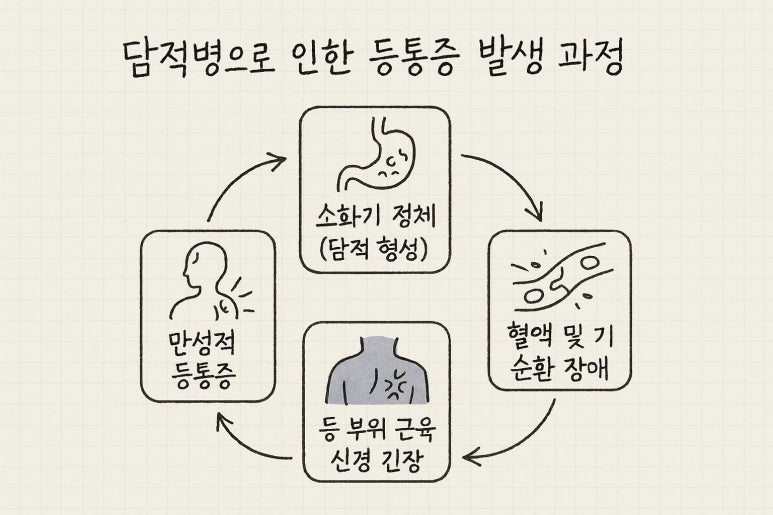
When undigested food or metabolic waste products accumulate stickily like mucus in the body and become stagnant, this hinders the circulation of blood and ‘Qi’ (vital energy).
Such circulatory dysfunction does not merely remain as impaired gastrointestinal function.
It can disrupt the body’s overall metabolic balance and impede nutrient supply to specific muscles and tissues, leading to stiffness and pain.
The back is a region where important meridians (energy channels) pass through, and it is also a sensitive area that reflects the health of internal organs.
Chronic indigestion and abdominal discomfort arising from weakened digestive function continuously strain the nerves and muscles around the gastrointestinal tract.
When this tension becomes chronic, it causes stiffness and tightness in the back muscles, and even lower back pain, thus becoming a cause of back pain.
| Digestive Stagnation (Damjeok) → Impaired Blood and Qi Circulation → Muscle and Nerve Tension in the Back → Chronic Back Pain From the Traditional Korean Medicine perspective that our body is an interconnected organism, gastrointestinal problems do not merely stay as digestive issues but affect the entire body. |
Case Study: Damjeok-byeong and Back Pain in the Clinic
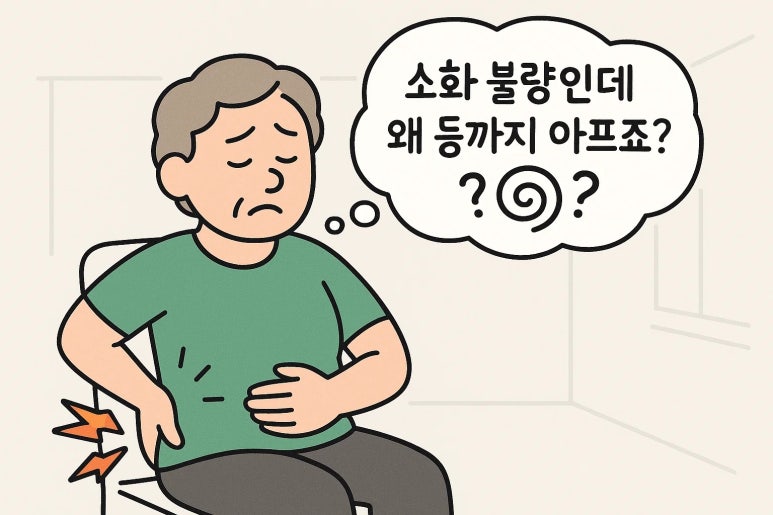
The case of Ms. Kim Seon-young (a pseudonym), a 50-year-old woman I recently treated, would be a good example.
Ms. Kim had been experiencing recurrent chronic indigestion for several years, along with a constant heavy feeling in her back and severe back aches.
“Even after waking up, I don’t feel refreshed, and especially my solar plexus feels heavy, and my back hurts so much.
It’s uncomfortable even to breathe, you see.
Orthopedic doctors said there was no specific cause, and digestive aids only provided temporary relief,” she complained.
Upon palpating Ms. Kim’s abdomen, I confirmed severe induration and tenderness in her upper abdomen and solar plexus.
Furthermore, examining her tongue, I observed a thick and sticky tongue coating.
These clinical clues suggested the formation of ‘Damjeok’ (Accumulated Phlegm-Dampness) in her digestive system.
In Ms. Kim’s case, excessive stress and irregular eating habits gradually weakened her gastrointestinal function, leading to the accumulation of undigested waste products and the formation of Damjeok, which in turn hindered circulation in the back region, ultimately resulting in chronic back pain.
About a month after starting herbal medicine treatment with me to resolve the Damjeok and restore digestive function, Ms. Kim smiled brightly and said, “Amazingly, as my digestion became more comfortable, my back pain also significantly lessened.
I feel like I can finally live again.”
| Ms. Kim Seon-young (a pseudonym), a woman in her 50s, suffered for three years from chronic indigestion, solar plexus discomfort, and back pain that felt like her back was stiffening like a rock. Despite numerous examinations, no cause was found, but through examination, severe induration (硬結) around the upper abdomen and solar plexus, along with a tongue coating, led to a diagnosis of Damjeok-byeong. Through treatment to improve digestive function and resolve Damjeok, both her indigestion and back pain improved. |
Damjeok-byeong: How to manage and treat it?
Managing back pain caused by Damjeok-byeong does not merely involve treating the painful area, but focuses on fundamentally improving the digestive environment and restoring systemic balance.
I provide treatment tailored to each individual’s constitution and severity of symptoms, using herbal medicine prescriptions to resolve Damjeok and strengthen gastrointestinal function. However, it is also important to understand that this journey of recovery varies among individuals and requires consistent time and effort.
In particular, based on the principles of the classical medical texts Shanghan Lun and Jingui Yaolüe, I carefully select prescriptions that regulate the body’s internal environment and foster its self-healing capabilities.
In addition, lifestyle improvements are also very important.
| Dietary guidelines for managing Damjeok-byeong and promoting digestive health are as follows: They are based on balanced meals and moderation, and it is advisable to reduce processed foods and sugar intake while increasing whole grains, legumes, and fresh vegetables. It is wise to avoid fatty foods, alcohol, smoking, and carbonated drinks that strain digestion. On the other hand, antioxidant-rich nuts (walnuts, Brazil nuts), berries (blueberries, blackberries), leafy greens (spinach, kale), green tea, etc., can be beneficial for digestive health. Furthermore, for gut health, I recommend considering fermented foods, especially fermented vegetables (such as kimchi, doenjang, etc.). |
It’s important to eat regularly, `small amounts frequently, and chew food thoroughly`.
Moreover, since stress significantly impacts digestive function, finding your own stress-relief methods is also an indispensable part of the treatment process.
The Journey to Recovery: Listening to Your Body’s Signals
Ultimately, treating Damjeok-byeong is not about temporarily suppressing symptoms, but a long journey to fundamentally change your body’s digestive environment and restore the balance of your nerves and constitution.
On this journey, I wish to be your companion guiding the way.
If you have been suffering from chronic indigestion and back stiffness for a long time, I encourage you to deeply consider, at least once, whether it might be due to ‘Damjeok’ (Accumulated Phlegm-Dampness) accumulated within your body.
Even if it’s not with me, I sincerely hope you meet a medical professional who can find the root cause of your symptoms and break free from the cycle of persistent pain.
Your body sends honest signals more than we realize.
Listening to those signals is the first step toward recovery.