
What if you see mucus in your stool with Irritable Bowel Syndrome?

“I See Mucus Every Time I Go to the Bathroom” | Irritable Bowel Syndrome in a 30-Something Professional
Have you ever been startled to find slippery mucus around your stool in the toilet after a bowel movement?
Especially if you are a professional in your 30s experiencing Irritable Bowel Syndrome (IBS), this mucus in your stool can easily cause significant anxiety and make you wonder, "Could this be a serious illness?"
Many of the patients I see in my clinic come to me with precisely these worries.
Today, I'd like to speak candidly about mucus in stool associated with Irritable Bowel Syndrome, much like sharing my own clinical notes that I've personally recorded and interpreted.
Mucus in Stool: Why Does It Occur with Irritable Bowel Syndrome?
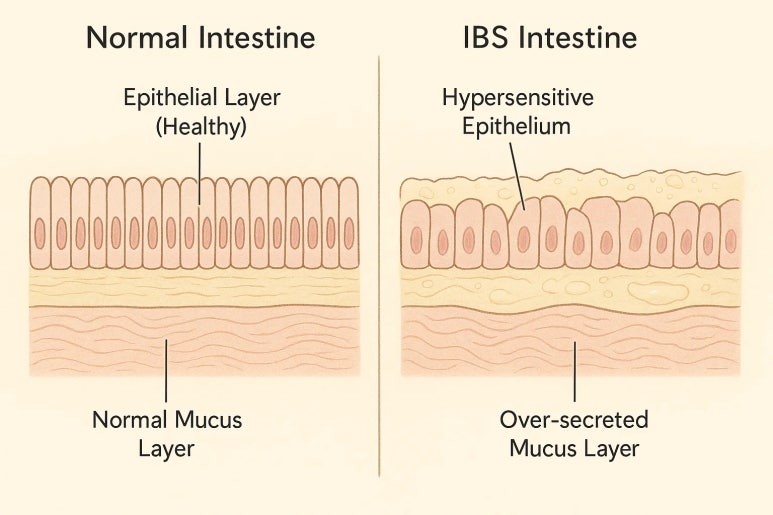
Just as water is needed on a slide for a smooth descent, the mucous membrane of our intestines constantly secretes a small amount of mucus. This mucus serves to protect the intestinal wall and facilitate the smooth passage of stool. It coats the intestinal lining and acts as a lubricant, forming a vital protective barrier that ensures the smooth movement of food waste.
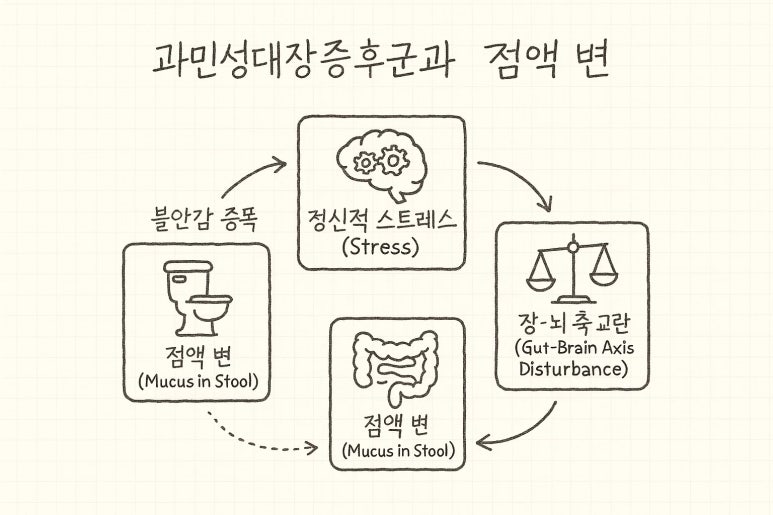
However, for individuals with Irritable Bowel Syndrome, the intestinal mucus secretion system is prone to disruption due to factors such as stress, intestinal inflammatory responses, or changes in bowel motility.
A hypersensitive bowel reacts excessively to external stimuli. This acts as a type of defense mechanism, leading the intestinal wall to produce or secrete more mucus than usual.
This is then observed mixed with or as a slippery substance around the stool.
Particularly for patients with diarrhea-predominant Irritable Bowel Syndrome (IBS-D), as intestinal transit time accelerates, mucus often doesn't mix thoroughly with the stool and appears separated.
This mucus-laden diarrhea can be considered one of the intestine's responses to irritation.
To help you understand, I'd like to share the story of a patient I recently encountered.
Mr. Kim Ji-hoon (pseudonym), a professional in his 30s, had been under extreme stress for several weeks leading up to an important project.
He constantly experienced abdominal pain and diarrhea due to endless overtime and tension. Then, one day, he began to notice sticky mucus in his stool every time he went to the bathroom.
He frankly confessed to me that, initially, he lost sleep at night due to anxiety, fearing it might be a serious illness.
In the examination room, Mr. Kim Ji-hoon told me, 'Every time I see mucus, my heart sinks, and the thought, 'Could I have cancer?' keeps nagging at me.'
I explained to Mr. Kim Ji-hoon that for patients with Irritable Bowel Syndrome, mucus in stool is a not uncommon phenomenon, and it can be understood as a type of 'stress signal' from the intestines.
I also informed him that stress, in particular, can affect the gut-brain axis, leading to changes in bowel motility and mucus secretion.
Seeing the anxiety significantly lift from Mr. Kim Ji-hoon's face after hearing this explanation, I, too, felt relieved.
Mucus in Stool: Reduce Unnecessary Worry and Respond Wisely
Many people often harbor the misconception that mucus in stool indicates 'the intestines are completely ulcerated and shedding.'
However, mucus in stool associated with Irritable Bowel Syndrome differs from inflammatory changes where the intestinal mucous membrane is damaged and blood is present.
Generally, it is simply excessively secreted mucus resulting from a hypersensitive bowel reaction.
Nevertheless, if you remain concerned, it's best to first calm your mind and try implementing the following strategies.
Maintain regular eating habits and try to reduce intestinal irritants such as greasy foods, caffeine, and alcohol.
Along with adequate hydration, moderately consuming fiber-rich vegetables and fruits also contributes to improving bowel function.
It's also crucial to find your own stress relief methods, such as regular exercise and meditation.
When Should You Seek Professional Help?
Mucus in stool caused by Irritable Bowel Syndrome is generally not a serious sign for concern.
However, if the following symptoms appear alongside mucus in your stool, you must consult a medical professional for an accurate diagnosis. This includes sudden weight loss, fever, or symptoms of anemia. The same applies if you notice bloody stools, such as bright red blood or black, tarry stools, or if pus is present. It is especially important not to overlook severe pain during bowel movements or abdominal pain intense enough to wake you from sleep at night. Furthermore, if you experience symptoms suggestive of inflammatory bowel disease with a family history (e.g., Crohn's disease, ulcerative colitis), you should promptly visit a healthcare provider.
This is because such symptoms could be signals of other digestive disorders, not merely Irritable Bowel Syndrome, but potentially more serious conditions like inflammatory bowel disease, colon polyps, or even, albeit rarely, colorectal cancer.
A Journey to Understanding Your Gut, Your Body
Mucus in stool caused by Irritable Bowel Syndrome is a message from our body.
Especially for busy professionals in their 30s, it can be a powerful signal meaning 'pause and take care of yourself.'
This intestinal imbalance can be interpreted not merely as an issue with the gut itself, but as a sign that the equilibrium of our body's entire complex biological system has been disrupted.
As classical medical texts like the *Shanghan Lun* and *Jingui Yaolue* have emphasized for thousands of years, the body is organically interconnected, and the mind and gut share a profound relationship.
In my clinical practice, I consistently emphasize that the journey to restoring gut health transcends mere symptom suppression; it is a holistic process of transforming the body's internal environment and re-establishing the balance of the nervous system and constitution.
On this journey, please do not struggle alone.
If not with me, find a healthcare professional who will carefully assess your entire body.
When we alleviate anxiety and embark on the path to recovery armed with accurate information, we will truly be able to reconnect with our own bodies.