
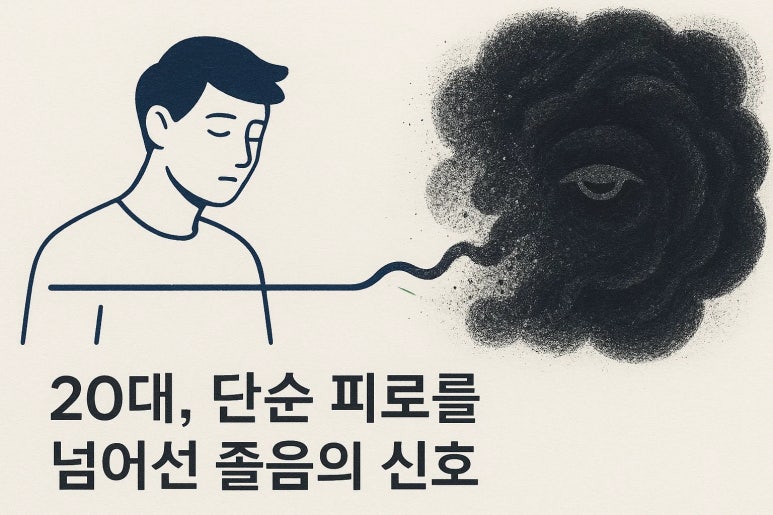
Why Am I So Sleepy? More Than Just Fatigue: Your Body's Signal | Narcolepsy in Your 20s

Twenties, ‘Why Am I So Sleepy?’ A Body Signal Beyond Simple Fatigue
Among the many young patients I see in my clinic, a significant number specifically complain of excessive daytime sleepiness.
Especially young people in their early to mid-twenties often say things like this:
| “Doctor, I get enough sleep, but I don’t know why I’m so sleepy. I even doze off while driving, which is often very dangerous.” |
This severe drowsiness while driving creates a situation too threatening to dismiss as simple fatigue. We often easily think, ‘Is it because I’m young that my stamina has weakened?’ or ‘Is it because I look at my smartphone late into the night?’
I, too, initially looked for clues in such lifestyle habits. However, as consultations continued, I often gained the intuition that the essence of this problem might transcend simply being ‘tired.’
To be frank, in such cases, I cannot help but suspect specific sleep disorders, such as narcolepsy.
If a seemingly healthy young person is struggling with overwhelming sleepiness, it is clearly an important signal from the body.
The Brain’s Baton: A Subtle Imbalance in Wake-Sleep Regulation Function
So, why does this happen? When exploring the fundamental principles of sleep disorders, especially narcolepsy, we turn our attention to the deep parts of the brain, specifically the ‘brain’s wake-sleep regulation function.’
Our brain is like an orchestra conductor. It delicately orchestrates the rhythm of falling asleep and waking up, that is, the sleep-wake cycle. If this conductor loses balance among the neurotransmitters responsible for wakefulness and sleep in the brain, a situation arises where the instruments on stage play drowsiness at will, even during daytime hours when one should be awake.
This subtle imbalance can cause extreme daytime sleepiness, and in severe cases, may lead to symptoms like emotional changes or 'cataplexy,' where there's a sudden loss of muscle tone.
What I focused on was how this brain structure and system reacts and changes within each individual's constitution and lifestyle context.
The Boundary Line Between “Simple Fatigue” and “Sleep Disorder”: How to Read the Body’s Signals
Many people ask, ‘How do you distinguish between just being tired and a sleep disorder?’
That’s a good question. Based on the clues I've gathered in clinical practice, here are a few patterns I can tell you about:
Sleep Satisfaction: Even if you’ve slept enough at night, if you don't feel refreshed during the day and constantly feel sleepy, it’s highly likely it’s not just simple fatigue.
Intensity of Drowsiness: If you fall asleep even during a conversation or meal, or if excessive daytime sleepiness repeatedly occurs to the point where it’s difficult to stay alert in important situations, you should pay close attention.
Timing of Drowsiness: This is especially true if it worsens in low-stimulation situations (e.g., driving, using public transport, during lectures). Particularly in younger age groups, drowsiness while driving can lead to fatal consequences and should never be overlooked.
Accompanying Body Signals: If you experience vivid hallucinations like dreaming, or frequently experience sleep paralysis where you cannot move your body upon falling asleep or waking up, these are clearer clues of a sleep disorder.
These body signals are warning signs that there might be an abnormality in our brain’s wake-sleep regulation function.
The Path to Recovery: Close Observation and Accurate Diagnosis
In conclusion, despite being in your twenties, a young age, if you are experiencing extreme sleepiness that interferes with daily life, it might not be simple fatigue. Rather, it is highly likely to be a very important message sent by our body.
The first thing to consider is to closely observe and record your own body's signals. When, where, and with what intensity drowsiness comes, and whether there are any other discomforts – simply recording these details can provide valuable information.
And most importantly, it is to get an accurate diagnosis from a specialist.
Sleep disorders are problems that cannot be resolved with simple rest alone, requiring a medical approach.
I, too, respect patients’ vivid sensory descriptions, and go through the process of connecting the hidden clinical clues with academic principles to form and test hypotheses. This is because only by unraveling a tailored narrative that fits an individual’s constitution and lifestyle context can we truly find the key to recovery.
If, right now, the brain of the person reading this article is still engaged in a ‘battle with sleep,’ do not simply dismiss it as fatigue. Your body is surely conveying a very important message.
Listen to that voice, and I sincerely recommend meeting a partner to walk the path to recovery with you—that is, a medical professional who will carefully examine your entire body.