
Stool as Hard as Goat Droppings – Are You Experiencing This Too? How to Break Free from Stubborn Chronic Constipation

Table of Contents
Hard, Goat-Pellet-Like Stools – Are You Suffering Too? Your Guide to Overcoming Stubborn Constipation
"Even after sitting on the toilet for a long time, nothing happens…"
"And even when you strain to pass stool, it's small and hard like goat pellets, leaving you feeling completely unsatisfied, right?"
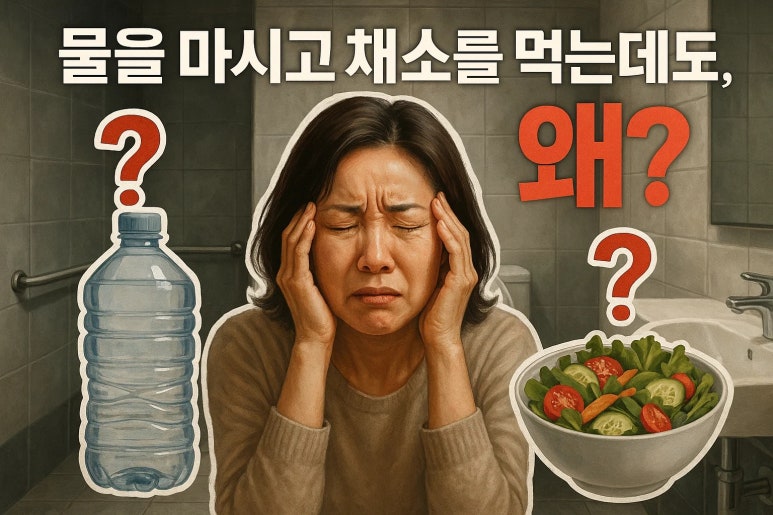
Many people suffer from persistent constipation that doesn't seem to improve, even after drinking two liters of water and eating plenty of vegetables and sweet potatoes.
They often feel frustrated, believing they've tried everything.
Hello, I'm Choi Yeon-seung, a Traditional Korean Medicine doctor who has treated numerous patients with intractable constipation for 15 years.
Many people visit me with similar concerns.
If you read this article to the end today, you'll discover the fundamental reasons why your stools have become hard like goat pellets, along with an unexpected solution to break free from this stubborn constipation.
It's easy to assume that hard stools are always due to insufficient water intake.
However, if drinking enough water doesn't resolve your constipation, the real cause lies elsewhere.
Slow-Moving Bowels (Slow Transit Constipation)
Slow Transit Constipation, where your bowels move too slowly, can be a primary cause.
When bowel movements become sluggish, and stool remains in the intestines for too long, the large intestine absorbs more water from the stool than necessary.
As a result, the stool becomes progressively smaller and harder, like pebbles [1].
In this state, simply drinking water is unlikely to soften hardened stools.
Depleted Internal Lubricants (Deficiency of Jin-yeok)
In Traditional Korean Medicine, the fundamental body fluids that keep our bodies moist are called 'Jin-yeok (津液).'
It's like the 'engine oil' for your body.
If Jin-yeok becomes deficient due to excessive stress, lack of sleep, or aging, your intestines, just like your skin, can become parched.
A lack of this 'lubricant' that helps the intestines move smoothly and keeps stools moist leads to the hardening of stool.
Unexpected Habits That Turn Your Intestines Into a 'Desert'
So, what makes our intestines slow and dry?
Unexpected habits might be the culprits.
Habit 1: Excessive Dieting and Undereating
If your food intake is too low to provide bulk for stools, your intestines don't receive enough stimulation, causing peristalsis to become 'sluggish.'
This prolongs the time stool remains in the intestines, creating a vicious cycle of water loss.
Habit 2: Incorrect Fiber Intake
It's common knowledge that fiber is good for constipation.
However, this applies when stools are soft.
If a 'Slow Transit Constipation' patient, already experiencing hard stools, excessively consumes only insoluble fiber (such as brown rice, beans, raw vegetables, etc.) without adequate water intake, it can be like adding more sand to dry cement.
Rather, it can make the stool even harder and bulkier, exacerbating the situation.
Habit 3: Stress and Chronic Tension
When our bodies are tense and stressed, the sympathetic nervous system, responsible for 'fight or flight,' becomes activated.
At this time, the function of the parasympathetic nervous system, which manages digestion and defecation, is naturally suppressed.
Chronic stress acts like an invisible brake, stopping bowel movements.
3 Top Solutions to Overcome 'Goat-Pellet' Constipation
What we need now is not more dry fiber, but to make the intestines 'moist' and 'active.'
Solution 1 (Replenishing Jin-yeok): Eat 'Seeds'
Instead of just plain water, try leveraging the power of seeds that absorb water and swell. Flaxseed, chia seeds, and psyllium husk, which turn into a jelly-like substance when mixed with water, are excellent solutions that supply moist mucilage to the intestinal walls and gently increase stool volume.
Solution 2 (Intestinal Lubrication): Consume 'Good Oils'
Just as dry machinery needs lubrication, our intestines also need lubricants. A tablespoon of olive oil taken on an empty stomach in the morning, or generously drizzling perilla oil on seasoned vegetables, can coat the intestinal walls, helping hard stools pass smoothly.
Solution 3 (Intestinal Massage): Actively 'Move' Your Body
Physically stimulating the intestines from the outside is also an effective method. Gently massaging around the navel in a clockwise direction, or performing exercises such as lying down, holding your knees, and gently rocking your lower back from side to side, can be an effective switch to awaken intestinal peristalsis.
While today we focused on the causes of constipation and lifestyle management, in cases of severe Jin-yeok deficiency or significantly reduced intestinal motility, Traditional Korean Medicine treatment can be very helpful.
I will delve deeper into this aspect if the opportunity arises soon.
Stubborn constipation is not a matter of willpower. It's crucial to accurately understand your body's condition and apply the correct solutions that 'moisturize and move' rather than just 'filling up.'
[This content was directly written and reviewed by the medical staff of Baengnokdam Korean Medicine Clinic.]
#ChronicConstipation #GoatPellets