Konnyaku — From the Root Vegetable to Glucomannan and Low Calories

Table of Contents
During diet consultations, I very often receive the question, "Doctor, I heard konjac is so good, but what on earth is it made of?" I remember that when I first studied traditional Korean medicine, I lightly brushed it off, thinking, 'Isn't konjac just something like jelly?' However, when I looked through materials to explain it to patients, the journey of this food from a plant root to our table was quite interesting. Today, I will explain it step by step, starting from the word konjac itself.
What is Konjac?
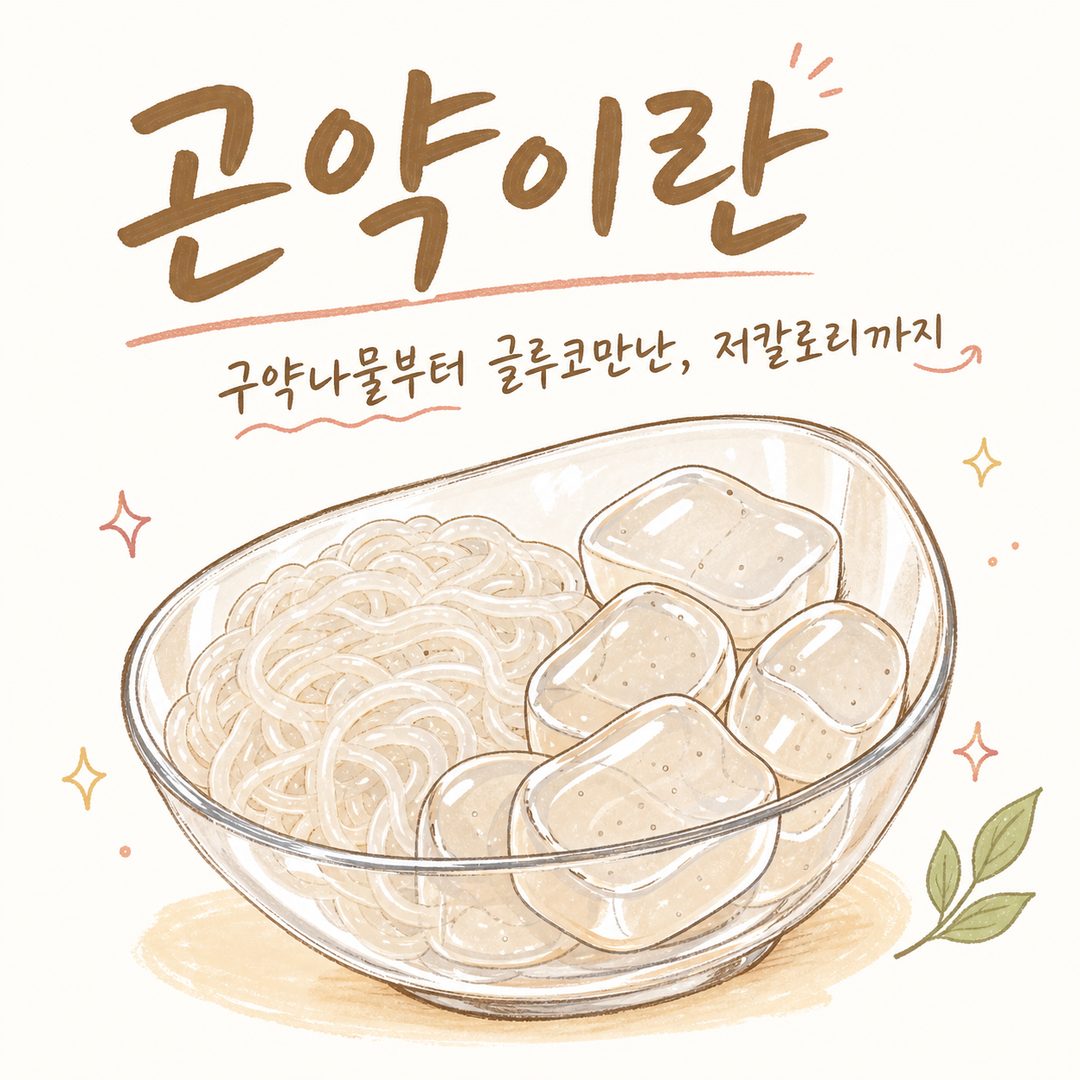
To summarize in one line, konjac is a jelly-like processed food made from the corm of the konjac plant (Amorphophallus konjac). It uses the tuberous root of a perennial herb belonging to the Araceae family as a raw material, and this root itself is commonly called the konjac potato. In Chinese characters, it is written as 菎蒻 (konjac) or 蒟蒻 (guyak). It is known to be a word that came from the Japanese こんにゃく (konnyaku). Since it is called konjac in English-speaking regions as well, you can consider it the same ingredient even if you encounter it on foreign food labels.
The manufacturing method is also relatively simple. The roots of the konjac plant are dried and ground into powder, then dissolved in water, and an alkaline coagulant (mainly calcium hydroxide, traditionally lime water) is added and boiled to harden, resulting in the translucent jelly or noodle form we know. In purified Korean terms, expressions such as umu, guyak-namul, or guyak-gamja are used.
Where and How Did It Come In?
According to data, the place of origin is considered to be the Indochinese Peninsula and the monsoon regions of Southeast Asia. From there, cultivation spread to Japan and some southern regions of Korea, and as it became established as a food culture in Japan, the name 'konjac' became fixed in Korea as a transliteration of the Japanese word. When I ask elderly patients in the clinic, "Do you know the konjac potato?", there are often those who understand, while most young patients are surprised, asking, "That's konjac?" It is the same plant, but the names have flowed in two different directions.
As a food, konjac has established itself as a low-calorie, satiety-inducing supplementary food rather than a source of nutrition. According to one source, it contains only dietary fiber and a small amount of calcium and iron, so the expression "a material that fills volume and texture rather than a nutritional source" is more accurate.
Please Remember This
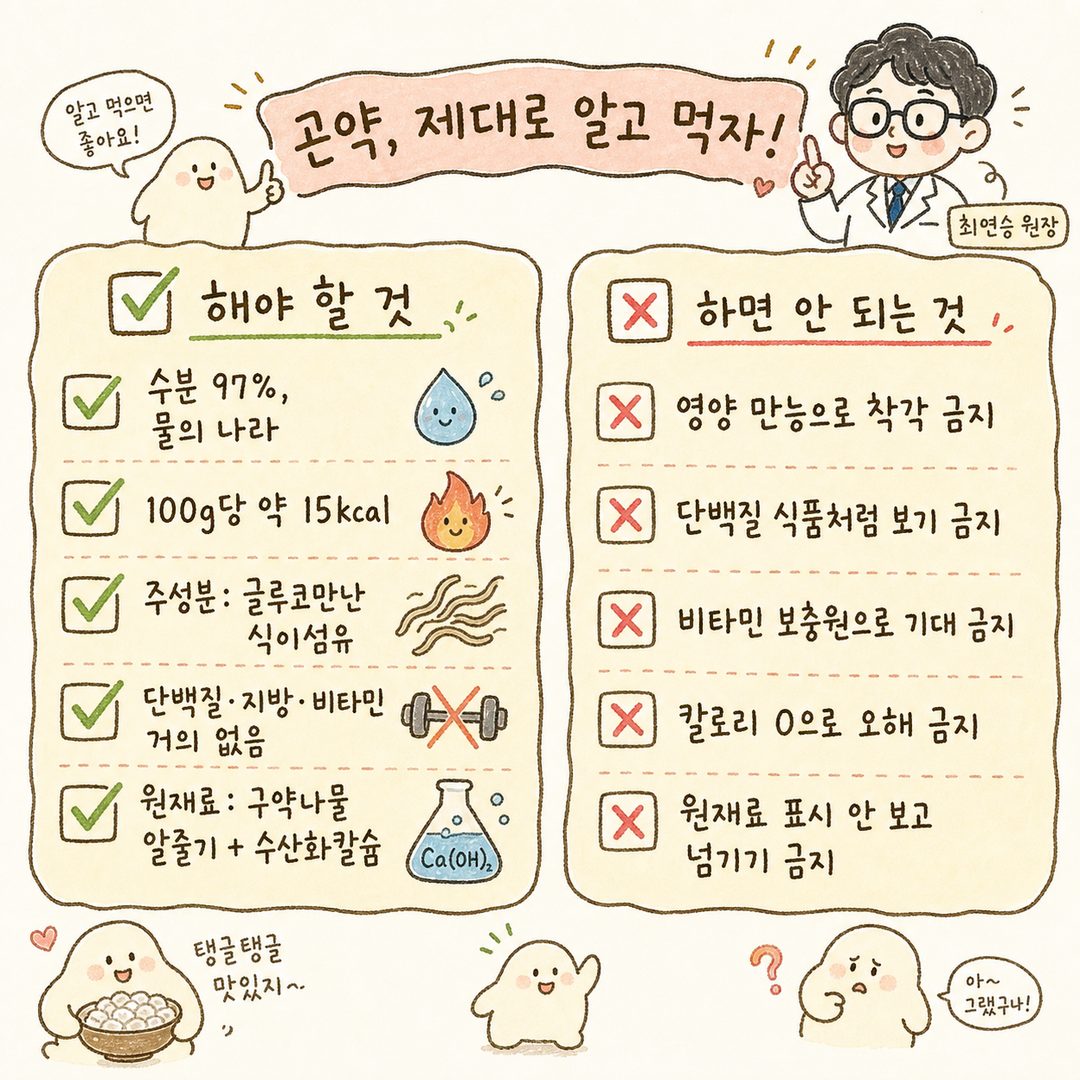
These are the points I always emphasize to patients when recommending the use of konjac in the clinic.
The proportion of moisture is overwhelming. Based on 100g of finished noodle-type konjac, moisture is about 96.5g, meaning about 97% of the total is water. Depending on the data, it is reported in the range of 95-97%.
The calories are very low. It is approximately 10-15kcal per 100g, and domestic data introduces noodle-type konjac as about 15kcal per 100g.
The main component is a dietary fiber called glucomannan. It is hardly digested or absorbed and goes straight down to the intestines.
There are almost no proteins, fats, vitamins, or minerals. Therefore, if you replace a meal entirely with konjac, the nutritional balance is easily disrupted.
The raw material is the corm of the konjac plant, and an alkaline substance is used as a coagulant. This point creates the texture and preservation properties.
If you keep these five things in mind, you will be able to read the labels of any konjac product at the mart at a glance.
Commonly Misunderstood Parts
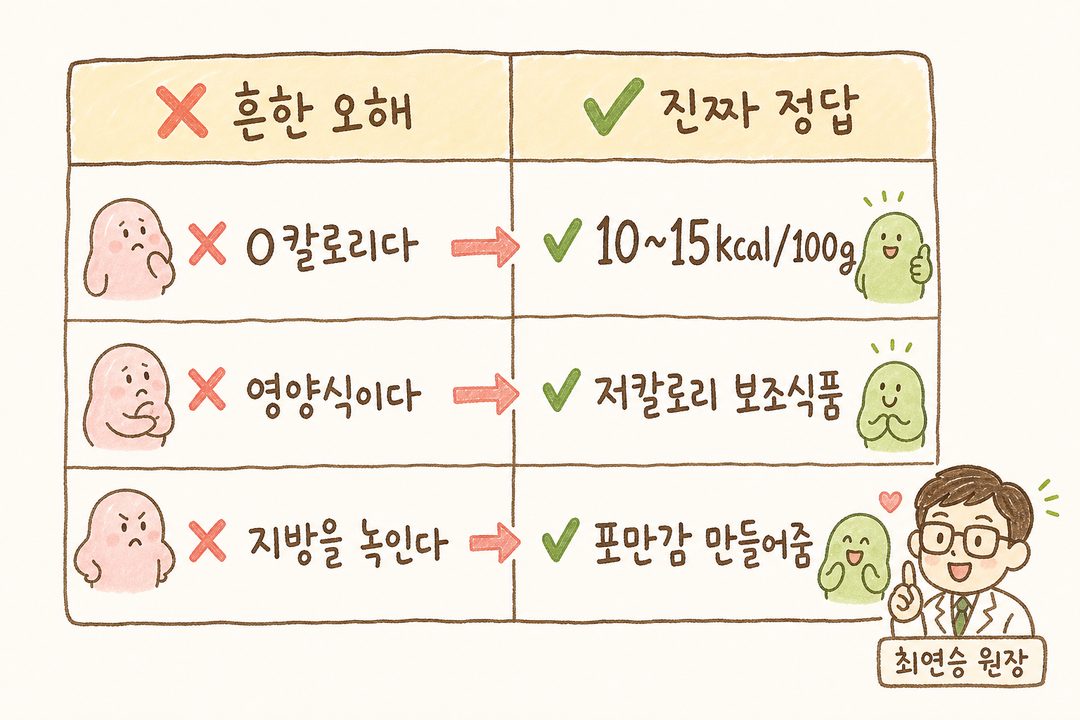
Let's start by clearing up the misconceptions I hear most often during consultations. First, many people ask, "Isn't konjac 0 calories?", but strictly speaking, it is not 0, but about 10-15kcal per 100g. While the expression that it is close to 0 is correct, if you eat a whole bag of 200-300g in one meal, you still consume 30-45kcal. Even at a low estimate, calories exist.
Second, there is also a misconception that "konjac is a nutritional food." This is a point repeatedly emphasized in the data; it is more appropriate to classify konjac as a low-calorie, satiety-inducing supplementary food rather than a nutritional source. There are few nutrients to fill other than dietary fiber.
Third, I often hear expressions like "glucomannan melts fat," but this is far from the facts. Glucomannan only plays the role of dietary fiber that absorbs water and swells to create a feeling of fullness; it is not a component that directly decomposes body fat. Clearly distinguishing this difference is much more helpful in designing a diet plan.


Is It Really Helpful from a Dieting Perspective?
Now, let's dive into the dieting topic. This is what patients are most curious about. First, I'll say that konjac is quite a useful ingredient as a diet 'volume tool.' If you replace some rice or noodles with konjac noodles of the same volume, you can naturally lower the total calories per meal. The figure of approximately 15 kcal per 100g is remarkably low.
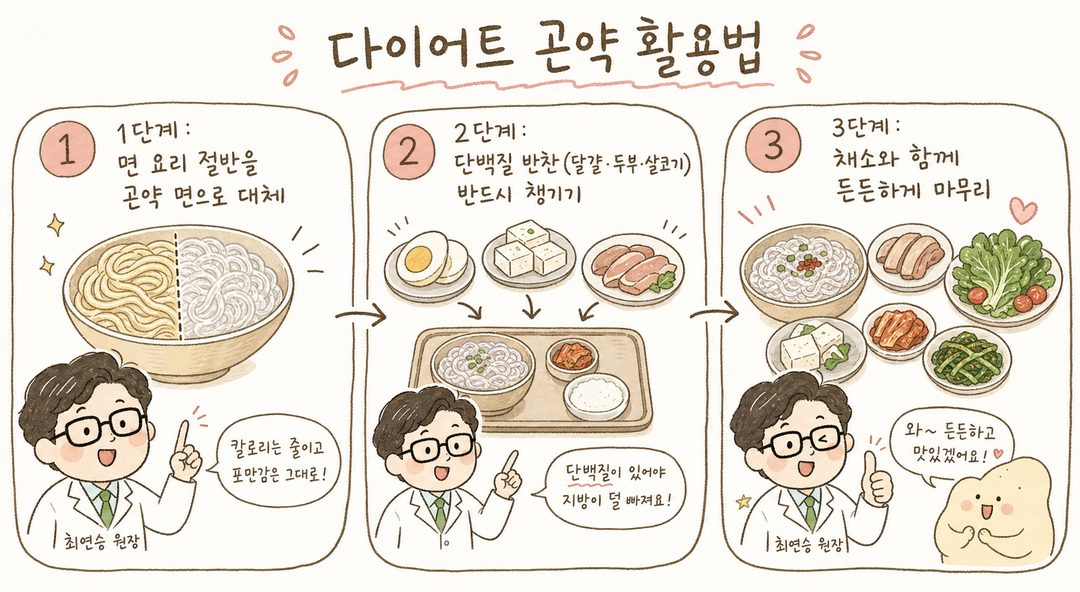
However, I wouldn't recommend the simple picture of losing weight just by eating konjac alone. Since it contains almost no protein, replacing an entire meal with konjac can lead to muscle loss or insufficient satisfaction, which carries the risk of binge eating afterward. The usage method I recommend in clinical practice is as follows: replace half of your usual noodle dishes with konjac noodles, and make sure to eat protein side dishes (egg, tofu, lean meat, etc.) along with them. This way, satiety is maintained while total calories tend to decrease noticeably.
Additionally, thanks to the glucomannan dietary fiber, there can be auxiliary benefits for those suffering from constipation. It absorbs water and swells, creating bulk in the intestines. However, if you don't drink enough water along with it, you may actually end up feeling more bloated, so I recommend drinking at least one more glass of water than usual on days you consume konjac.
Reactions also vary slightly by body constitution. For those who typically have a cold stomach and weak digestion, eating konjac noodles cold may feel burdensome. In such cases, I guide them toward using konjac in warm soup dishes instead.
Konjac is not a magic diet food but rather 'a tool for filling volume and satiety.' When you understand the tool's proper use, it becomes a reliable ally in managing your diet. While herbal prescriptions help regulate appetite and metabolism, in daily meals, combining low-calorie ingredients like konjac to fill volume is a strategy I design together with patients. At Baekrokdam Korean Medicine Clinic, we refine such daily diet strategies together, including prescriptions tailored to your constitution and lifestyle, such as Baekrok Gambi-jung. So if you're unsure about how to incorporate konjac into your diet, feel free to come in for a consultation.