
Is Simply Eating Less the Answer? Fiber Maxing: Diet Strategy Filling Up with Dietary Fiber

Table of Contents
Is eating less simply the answer? Diet strategies to fill up with Fibermaxxing dietary fiber
Have you ever looked closely at the back of a convenience store lunch box or a salad pack? While we meticulously check the sugar and protein content, we often overlook the 'dietary fiber' section. Many people focus only on 'what to remove' when dieting. By becoming preoccupied with reducing carbohydrates and cutting out sugar, it is easy to miss the area of 'filling' that our bodies actually need.
Fibermaxxing, which has recently become popular on SNS, addresses this exact point. It is a movement to regain the body's rhythm by maximizing dietary fiber intake, rather than simply starving or restricting. In this article, I will summarize what role dietary fiber actually plays in our bodies and how you can strategically fill your diet in daily life.
Why we need to pay attention to dietary fiber again
Many people think of dietary fiber simply as a 'component that solves constipation.' However, the core of dietary fiber lies in the fact that our bodies cannot digest it. Non-digestible substances that are not broken down by enzymes in the gastrointestinal tract perform various tasks as they pass through the intestines.

According to one study, dietary fiber is known to affect the bioavailability of macronutrients, the digestion process, and postprandial metabolism. Simply put, it acts as a brake that regulates the speed so that the food we eat is not absorbed too quickly. This brake must function properly to prevent blood sugar from spiking rapidly and to maintain satiety for a longer period.
Unfortunately, our reality is not like that. According to the Korea Disease Control and Prevention Agency's National Health Statistics, the average daily dietary fiber intake of adults decreased by 8.8% over 5 years, from 25.1g in 2019 to 22.9g in 2024. Although the amount of food eaten may have increased, the sophisticated nutrients the body actually needs are decreasing.
Fibermaxxing: A simple trend or a practical strategy?
Terms like 'Fibermaxxing' or 'Poopmaxxing' trending on TikTok may seem somewhat lighthearted. However, their essence lies in securing regularity of bowel movements and creating healthy habits that aid weight loss.
When applying this to real life, the most important thing is to avoid 'sudden increases.' If a person who normally eats almost no dietary fiber suddenly increases the amount, they may suffer from abdominal bloating or gas. Here, we must know the baseline that is right for us.
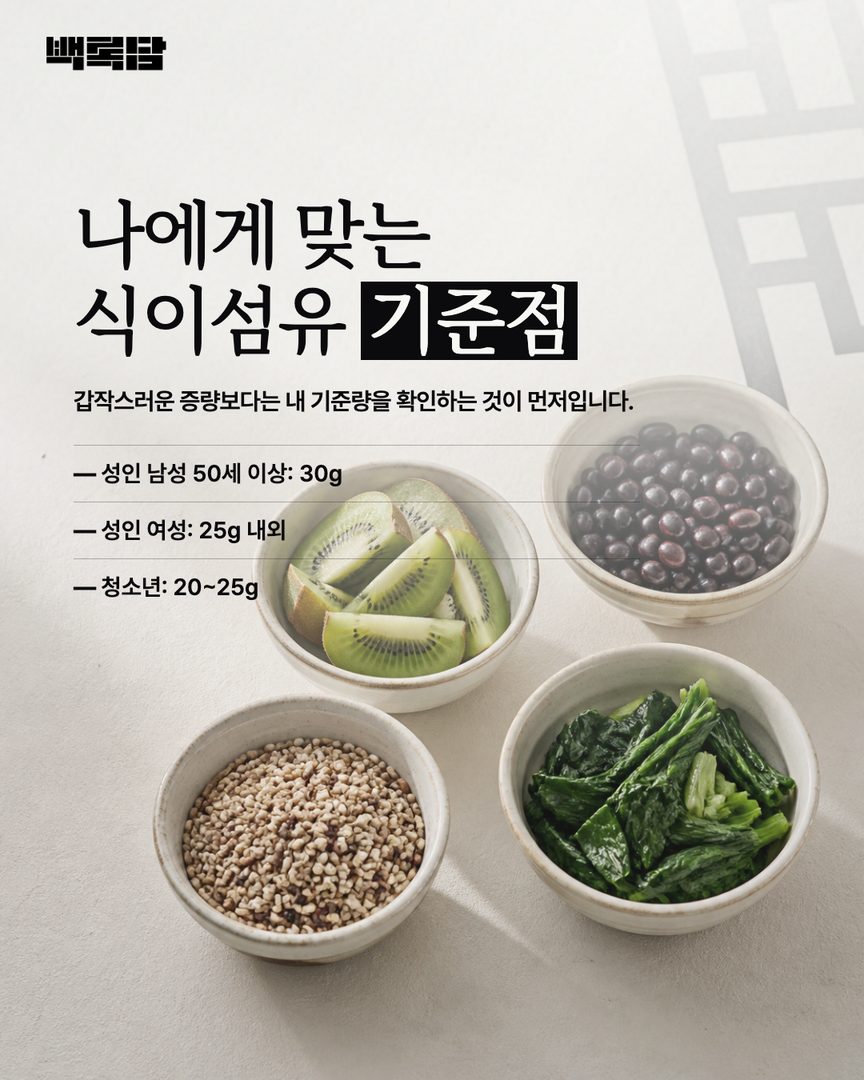
The general recommended amount is about 25~38g per day for adults. For men aged 50 or older, 30g is recommended, and for women, a slightly smaller amount is recommended. For adolescents, about 20~25g per day is appropriate[1]. Just checking whether you have met this figure in the diet you ate today can completely change the quality of your meals.
Dietary fiber and metabolism from an Oriental medicine perspective
When meeting patients in the clinic, I see many people who feel hungry particularly often or experience sudden drowsiness after meals. In Oriental medicine, this is sometimes viewed as a state where the flow of energy is stagnant or metabolic waste is not processed properly.
Dietary fiber is like a 'cleaner' that helps this flow. The intestinal environment must be kept clean for the circulation of Qi and blood to be smooth and to prevent unnecessary dampness-phlegm (濕痰) from accumulating in the body. In particular, if dietary fiber is lacking, intestinal motility decreases, which often leads to a decline in overall physical condition beyond simple bowel movement issues.
During consultations, I ask those who record their diets "how diverse the colors and textures of the vegetables were" rather than "what was removed." This is because meals centered on refined grains add heavy moisture to the body, while coarse dietary fiber pushes this out and helps circulation.
Dietary fiber filling routine to start today
Changing your diet entirely is too difficult. Instead, try approaching it by adding a 'small touch' to the foods you usually eat. The specific methods I recommend are as follows:
Make your staple foods a bit coarser: Try using multigrain rice or oatmeal instead of white rice. Recently, high-fiber instant rice products have been well-made, making them useful for busy mornings.
Change the definition of snacks: Try having one kiwi instead of cookies or bread. One kiwi contains about 2g of dietary fiber and is rich in antioxidant components.
Creating a Pre-meal Routine: In a 6-week nutritional trial conducted by researchers, 19 healthy adults were observed while supplementing their basic diet with 10g or 40g of dietary fiber; in another case, a method of consuming a 5g supplement before meals was utilized. As such, consuming dietary fiber immediately before a meal helps slow down the absorption rate of the food that follows.
Precautions When Using Supplements: Among the dietary fiber powders on the market, there are products containing approximately 6g of dietary fiber per small spoon. However, it is recommended to prioritize intake through natural foods over supplements.
A Sustainable 'Filling' Diet
Ultimately, the success of a diet depends not on 'how much you endure' but on 'how satisfyingly you fill up.' If you focus solely on reducing sugar, your body feels a deficiency and eventually reacts with a reward mechanism called binge eating.

The core of fibermaxxing is to precisely manage the hunger your body feels. Once you fill your intestines with dietary fiber and restore the rhythm of bowel movements, you can experience your food intake being naturally regulated without having to force yourself to endure.
How about adding a plate of green leafy vegetables to your dinner table tonight, or a single kiwi after your meal? Small additions are the fastest way to change your body's metabolism, rather than grand plans.
If you feel the limits of diet control alone or are concerned about specific weight loss methods suited to your constitution, try the Baekrok Gambi-jung tablet program. When an approach considering an individual's metabolic state is added, dietary management through dietary fiber can lead to more efficient results. Please let me know which vegetables you tried adding when I see you in the clinic next time.