
Home Workout Routine: Cardio, Strength, and Consistency

Table of Contents
It's hard to head back out once you're home after work. I often see patients in my clinic who signed up for a gym membership but only ended up paying without actually going.
Why Home Workouts Work for Weight Management
Many people underestimate exercising at home, but in my clinical experience, consistency is what ultimately determines the results. The principles emphasized across various home workout resources are simple: Combine full-body cardio with strength training, and maintain a routine of 20–30 minutes a day, 3–5 times a week. It is well-known that weight and body fat tend to decrease not because of one specific movement, but when this combination is repeated consistently.

There is one more thing I always add during consultations: your sitting time. Data suggests that those who sit for long periods may see diminished weight loss effects even with the same amount of exercise; therefore, it is recommended to stand up every 30–60 minutes for light walking or stretching. It is more common than you think for the sedentary habits of the other 23 hours to hinder the progress made during 30 minutes of exercise.
The 40-Minute Routine: A Game Changer
Vaguely thinking "I should exercise" rarely lasts more than a few days. It is much better to set a fixed schedule. Here is a 40-minute structure summarized from a standard home workout guide:
Warm-up (5 min) — Joint rotations, light walking in place, and arm circles
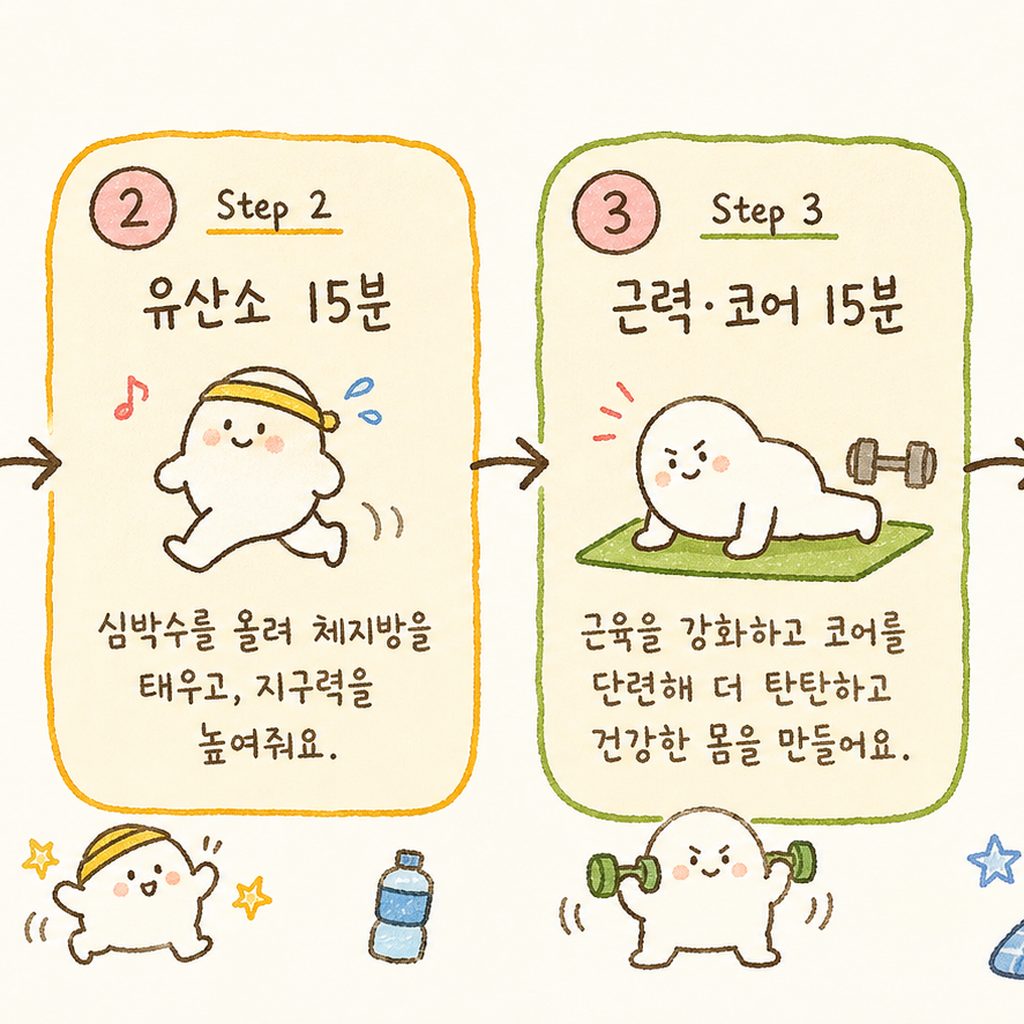
Cardio (15 min) — Full-body calorie burning
Strength & Core (15 min) — Reducing body fat and toning the body line
Cool-down Stretching (5 min) — Injury prevention and recovery
For those worried about noise between floors, there are alternative cardio versions. The same guide suggests a bodyweight cardio routine that burns approximately 195 kcal in 20 minutes, which can be adjusted to 15 minutes by performing each movement for 40 seconds followed by 20 seconds of rest for a total of 3 rounds. If jumping is a burden, you can swap jumping jacks for step jacks, where you simply step side to side.
At first, 40 minutes might feel long. In that case, it is perfectly fine to start with at least 5–10 minutes of moderate intensity. The standard for "moderate intensity" is a level where you can hold a conversation but find it difficult to sing.
Korean Medicine Starts with Your Body's Signals
When weight isn't dropping easily, I don't just blame the amount of exercise. Even with the same routine, every person reacts differently. Some see swelling go down first, while others feel their condition improve as digestion and circulation are restored. Reading the signals your body sends is the starting point of Korean medicine.
In particular, if your metabolism is sluggish or fatigue is accumulated, pushing yourself with high-intensity workouts can lead to burnout. Medical evidence also advises that those with diabetes, hypertension, or joint diseases should consult a doctor before starting exercise, and intensity should be lowered or stopped immediately if pain or shortness of breath occurs. The priority is finding the limit your body can handle, rather than just working out hard.

What You Can Do Today
You don't need a grand opening. Here is the sequence I frequently recommend in the clinic:
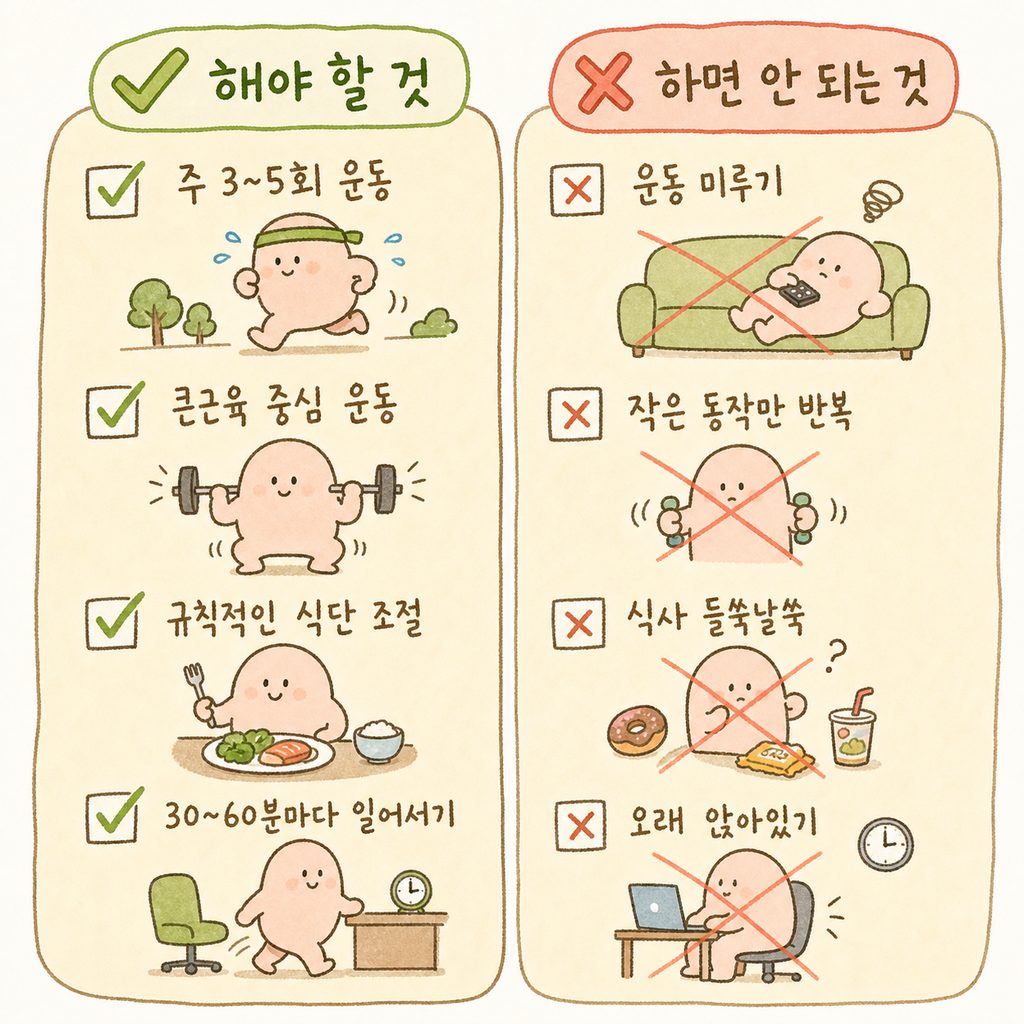
Set the frequency — 3–5 times a week, 20–30 minutes a day. Block these times out on your calendar in advance.
Focus on large muscles — Target major muscle groups like the lower body, chest, back, shoulders, arms, and core at least twice a week. Squats, lunges, knee push-ups, and planks are sufficient.
Don't overdo burpees — Beginners should start with 2 sets of 10 reps and increase to 3 sets of 15 as they get used to it.
Plank for 30–40 seconds — If your posture breaks, remember that form is more important than time.
Combine with diet — Keep three regular meals but reduce refined carbohydrates and switch to a focus on protein, vegetables, and whole grains. Data repeatedly suggests creating a daily calorie deficit of about 500–750 kcal for effective weight loss.
Stand up frequently — Move your body once every 30–60 minutes. This single habit protects the effectiveness of your exercise.
To recap the core strategy: Cardio and strength together, 3–5 times a week, 20–30 minutes a day. Following these three rules alone puts you on the right starting line.
Moving your body three times this week, even if it feels insufficient, is much more effective than overexerting yourself for just a day or two. If you feel that swelling won't go down or your metabolism is sluggish despite your efforts, it may not be laziness but a signal from your body. The Baekrokdam Clinic Baekrok Gambi-jung program examines these constitutions and metabolic states to support your home workout routine. Try this routine for just one week and let me know how it felt during your next visit.