
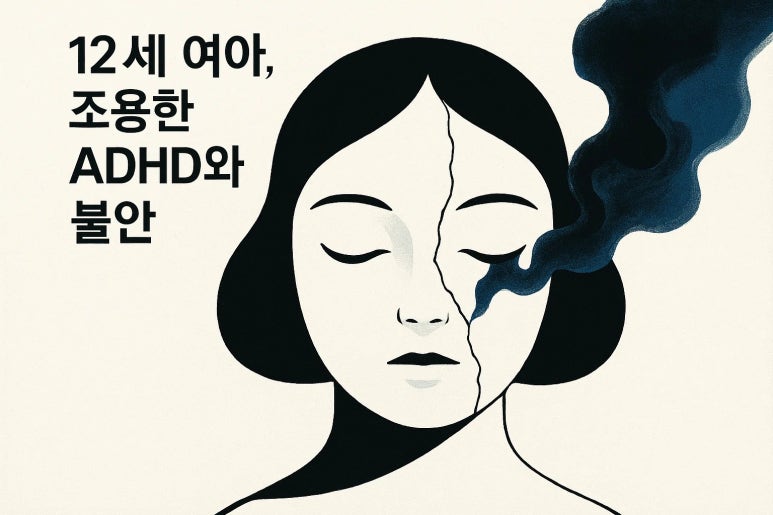
My quiet daughter, are you just crying on the inside? | Incheon ADHD

My quiet daughter, is she perhaps crying only on the inside?
A child's mind can be compared to a pressure cooker with a broken safety valve.
Inside, hot steam (energy) is boiling vigorously, but with no outlet to escape, the entire pot rattles precariously. Many ADHD characteristics in girls manifest precisely in this form of precarious pressure.
[CASE] The Child Who Appears Perfect on the Outside
Sooa, a 5th-grader, is known to everyone as a 'kind and smart child.'
However, at home, it's different.
|
"When she starts one homework assignment, she'll stick to it for three hours. She repeatedly erases and rewrites, eventually bursting into tears." |
Sooa's mother is most concerned about her child's perfectionism and frequent mood swings.
A year ago, Sooa was diagnosed with quiet ADHD and began taking methylphenidate-based medication. While her classroom behavior clearly improved, her tendency to blame herself for minor mistakes and burst into tears actually increased.
Notably, a phenomenon of increased errors was observed in performance evaluations that require adhering to a fixed framework, such as a jump rope skill test.
|
[A Critical Limitation] This is the dilemma we face. If this problem were merely 'lack of concentration,' then as concentration improved with medication, symptoms of anxiety and perfectionism, such as anxiety symptoms in elementary schoolers, should also ease. However, the fact that this is not the case suggests that the core of the problem lies elsewhere. This is why treatment for ADHD and anxiety disorders cannot be completed merely by flipping a switch in the brain. |
To avoid being criticized for 'distractibility' due to her overflowing energy and creative thoughts, Sooa had been pulling on the reins of her consciousness with all her might. It's like forcefully pressing down on the lid of a boiling pressure cooker to contain the steam.
The immense psychological energy consumed in this process is the true cause of anxiety and burnout. This overflowing energy, having nowhere to go, collides internally and transforms into perfectionism, mood swings, and physical symptoms.
|
[Traditional Korean Medicine Perspective: Gan-gi-ul-gyeong (肝氣鬱結)] In Traditional Korean Medicine (TKM), this state is explained by the concept of 'Gan-gi-ul-gyeong' (Liver Qi Stagnation). It refers to a state where the natural flow of energy (Qi) is blocked due to stress or repressed emotions. This interpretation precisely matches the 'state of a pressure cooker with a blocked steam vent'. It also aligns with the psychological basis of children experiencing ADHD social difficulties who want to interact with friends but hover, afraid to approach first due to fear of making mistakes. |
If Sooa's anxiety were unrelated to suppressed energy, she should feel more stable in activities with less control, such as drawing or free play. However, the fact that the opposite phenomenon occurs supports this hypothesis.
Praised for creativity in lower grades → Academic rules became stricter in higher grades → Began to be criticized for 'distractibility' → Excessively controlled herself to reduce mistakes → Anxiety and perfectionism symptoms worsened.
Does your child also fear mistakes to an extreme degree, and confine themselves to areas where they know they can excel?
|
[Starting a New Question] If so, we must now change our perspective on raising girls with ADHD. Our task is not to forcefully suppress the boiling steam, but to carefully open the 'safety valve' of the pressure cooker. The question we should now ask professionals is not 'Which medication will improve concentration?', but rather, "What safe outlet can help our child express their internally trapped energy in a non-destructive and creative way?" |