
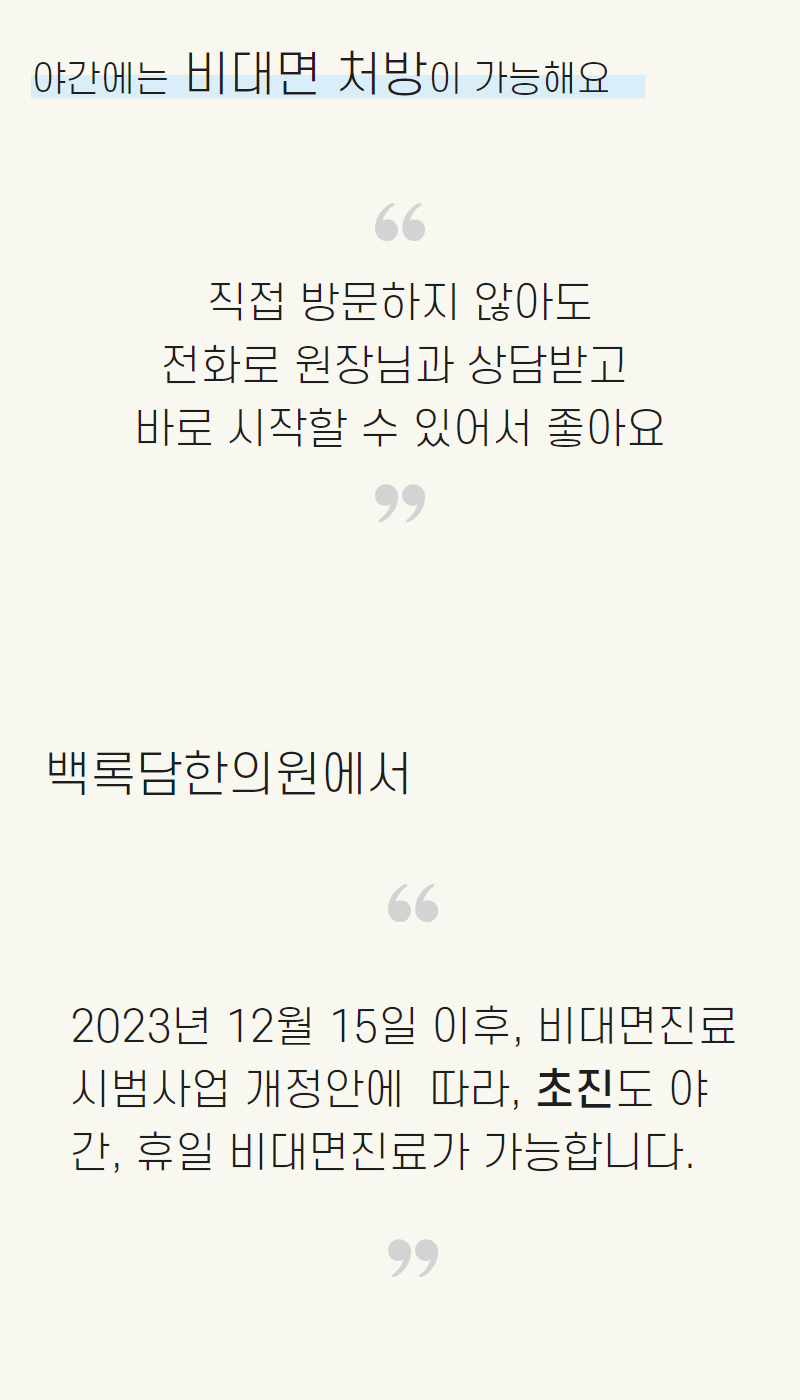
비대면 vs 대면
Q. For weight loss treatment in Gwangju, is it better to visit a Korean medicine clinic in person or use a non-face-to-face prescription service?
A.
Both options have their merits. In-person consultations allow a practitioner to perform pulse diagnosis and tongue diagnosis for a precise assessment of your constitution and health status, which is essential for treating root causes like Spleen Deficiency (Bi-heo) or Blood Stasis (Eo-hyeol). Conversely, non-face-to-face prescriptions offer convenience for busy professionals and are suitable for those already aware of their constitution who seek maintenance therapy. However, because non-face-to-face diagnostics are incomplete, they are limited during initial consultations or when symptoms change.
📝 Detailed Answer
The difference between these two approaches lies in 'precision' versus 'convenience.' The primary advantage of in-person visits is the ability to perform the Four Examinations (Sa-jin), specifically pulse diagnosis (Maek-jin) and abdominal palpation (Bok-jin). In Traditional Korean Medicine (TKM), the core mechanisms of obesity often involve a decline in the transport and transformation (Unhwa) functions due to Spleen Deficiency, accumulation of Phlegm-fluid (Dam-eum), and circulatory disorders caused by Blood Stasis. Accurate identification of these patterns requires physical examination. In clinical practice, a patient may appear to have excessive Dampness externally, but their pulse may indicate Deficiency (Heo)—a nuance easily missed in remote consultations.
Non-face-to-face prescriptions excel in accessibility and sustainability. They are highly beneficial for office workers who cannot visit a clinic every 1-2 weeks and for those accustomed to long-term maintenance patterns. However, remote care relies entirely on patient self-reporting. For instance, while a patient may describe 'bloating,' a practitioner in person can distinguish between Excess Stagnation (Sil-che) and Deficiency Stagnation (Heo-che) through palpation, which is impossible remotely.
Comparison by category:
1. Diagnostic Accuracy: In-person is superior (Pulse, Tongue, and Abdominal exams) / Non-face-to-face relies on patient reports.
2. Personalized Prescription: In-person allows detailed tailoring by constitution and pattern / Non-face-to-face tends toward symptom-based standardization.
3. Time Burden: In-person requires travel and waiting (30–60 mins) / Non-face-to-face takes approximately 10–20 mins.
4. Initial Visit Suitability: In-person is highly recommended for first-time visits / Non-face-to-face is suitable for follow-ups or maintenance.
5. Side Effect Response: In-person allows early detection via real-time examination / Non-face-to-face depends on the patient's self-awareness.
6. Cost-Effectiveness: While variable, accurate initial diagnosis reduces the likelihood of ineffective treatment in the long run.
Ultimately, the choice depends on your current stage of treatment. For a first-time diagnosis or a change in condition, in-person consultation is indispensable.
#comparison
#comparison-table

Expert Verified
Dr. Yeonseung Choe
Chief Director