
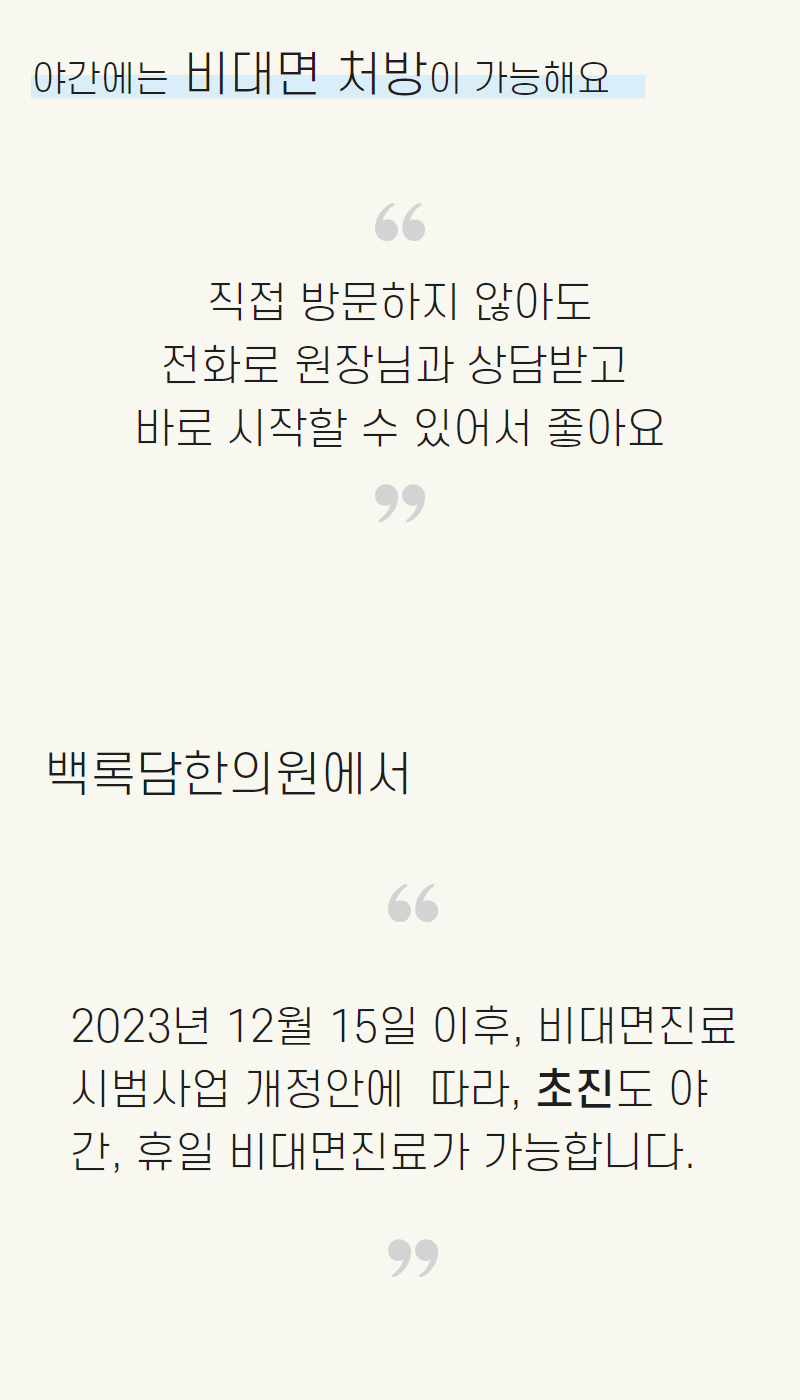
비대면 vs 대면
Q. I'm a busy professional considering remote prescriptions; what are the specific differences between remote consultations and visiting the clinic in person?
A.
Remote consultations offer great efficiency and accessibility for busy schedules. However, in-person visits allow for a comprehensive diagnosis through visual inspection (observing complexion and the tongue/Seol-jin) and palpation (checking the pulse/Maek-jin). While remote care is ideal for convenience during the maintenance phase, in-person visits are superior for a highly personalized prescription tailored to your specific constitution.
📝 Detailed Answer
Having been a professional myself, I completely understand the desire to prioritize efficiency. However, there is a delicate balance between convenience and diagnostic accuracy.
In Traditional Korean Medicine (TKM), weight management is not merely about reducing a number on the scale; it is about identifying the root cause of why the body is predisposed to weight gain. This could be 'Bi-heo' (Spleen deficiency leading to poor digestion), 'Dam-eum' (accumulation of phlegm-fluid/metabolic waste), or 'Eo-hyeol' (blood stasis). These nuances are most accurately identified through direct physical examination, such as pulse diagnosis and assessing body composition.
Here is a comparison between the two methods:
| Category | Remote Consultation | In-person Consultation |
| :--- | :--- | :--- |
| **Accessibility** | Very High (Anywhere) | Moderate (Requires visit) |
| **Diagnostic Method** | Primarily questionnaires/interviews | Comprehensive Four Examinations (Mang, Mun, Sim, 절/切) |
| **Personalization** | Focused on standardized prescriptions | Precise adjustment based on constitution/symptoms |
| **Physical Exam** | Not possible | Pulse, Tongue, and Abdominal diagnosis possible |
| **Patient-Doctor Bond**| Lower | Higher (Collaborative partnership) |
| **Recommended For** | Maintenance phase, prescription refills | Initial diagnosis, constitutional improvement |
In summary, remote care prioritizes 'convenience,' while in-person care prioritizes 'precision.' To ensure your journey begins with a correct understanding of your body's current state, I strongly recommend visiting the clinic for your first consultation to establish a safe and accurate baseline.
#comparison
#comparison-table

Expert Verified
Dr. Yeonseung Choe
Chief Director