
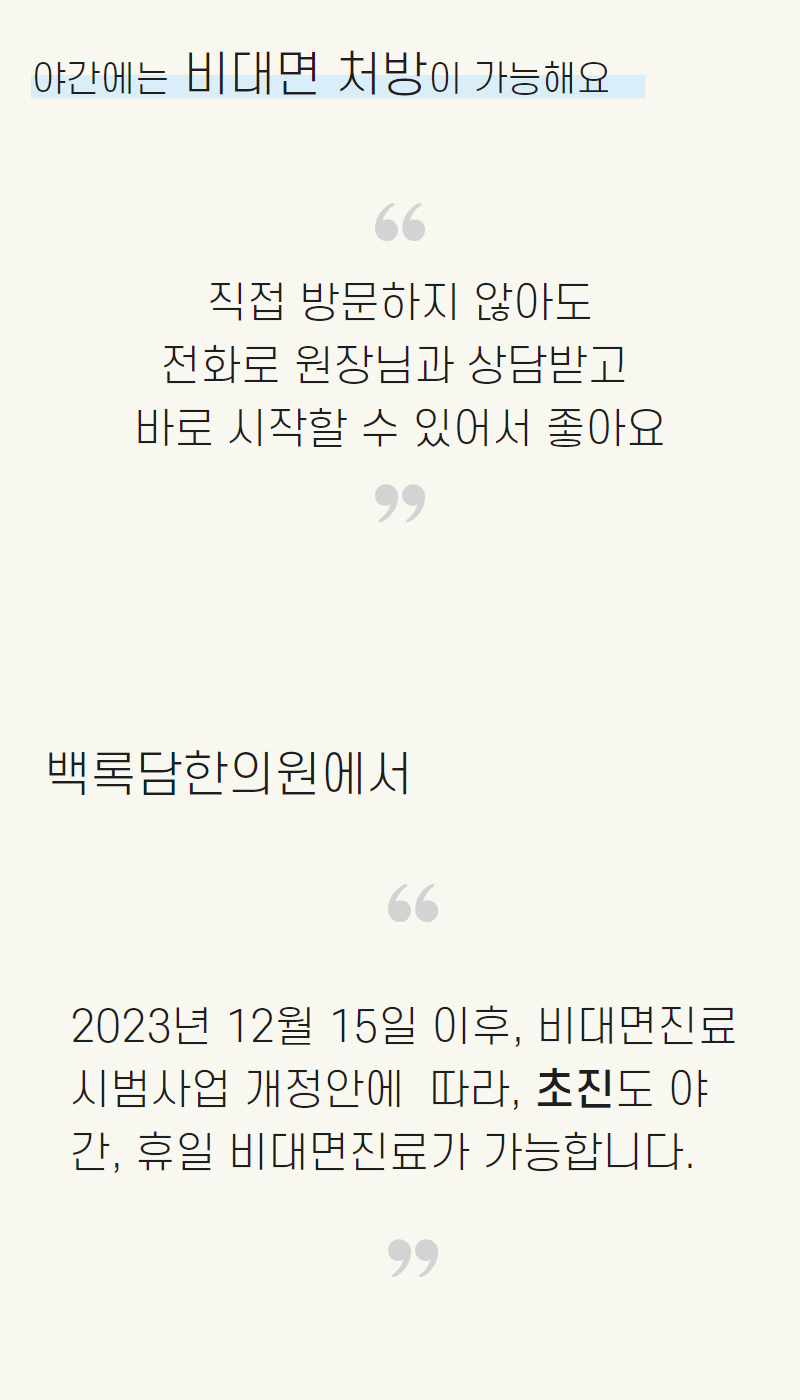
비대면 vs 대면
Q. Is it more effective to just receive medication via telehealth or to visit the clinic in person for a consultation?
A.
While telehealth is incredibly convenient for busy professionals, weight loss is not simply about taking medicine; it is about accurately reading your body's signals. By visiting in person, I can perform pulse diagnosis and examine your physical condition to determine why your body is prone to weight gain and where circulation is blocked. It is essentially a choice between convenience and diagnostic precision.
📝 Detailed Answer
I completely understand the desire for efficiency. However, Traditional Korean Medicine (TKM) diet herbal medicine should be treated as 'tailored clothing' rather than a 'ready-made product.'
Telehealth offers great time-saving benefits. In contrast, in-person consultations allow me to directly assess your complexion, pulse patterns, and perform Bok-jin (abdominal palpation) to identify the state of metabolic waste in your body.
For instance, the herbal formulation changes entirely depending on whether the primary cause is 'Eohyeol' (瘀血, blood stasis/stagnant blood) or 'Dameum' (痰飮, phlegm-fluid retention caused by impaired fluid metabolism). If a patient with 'Bi-heo' (脾虛, deficiency of the Spleen/digestive system) is given a formula focusing only on appetite suppression, they may experience dizziness and severe fatigue.
Here is a summary of the two approaches:
| Category | Telehealth Prescription | In-person Consultation & Prescription |
| :--- | :--- | :--- |
| Accessibility | Highly convenient | Requires travel/visit time |
| Diagnostic Method | Primarily questionnaire & consultation | Comprehensive diagnosis: pulse, tongue, and abdominal exams |
| Precision | Reflects general constitution | Reflects detailed individual physical signs |
| Side Effect Mgmt | Adjusted after symptom reporting | Real-time monitoring and immediate correction |
| Psychological Support | Text/Voice-based | Emotional rapport through face-to-face interaction |
If you are starting for the first time or have struggled with the 'yo-yo effect,' I strongly recommend visiting the clinic at least once to properly assess your current condition. Once your management routine is established, transitioning to telehealth is a viable option.
#comparison
#comparison-table

Expert Verified
Dr. Yeonseung Choe
Chief Director