
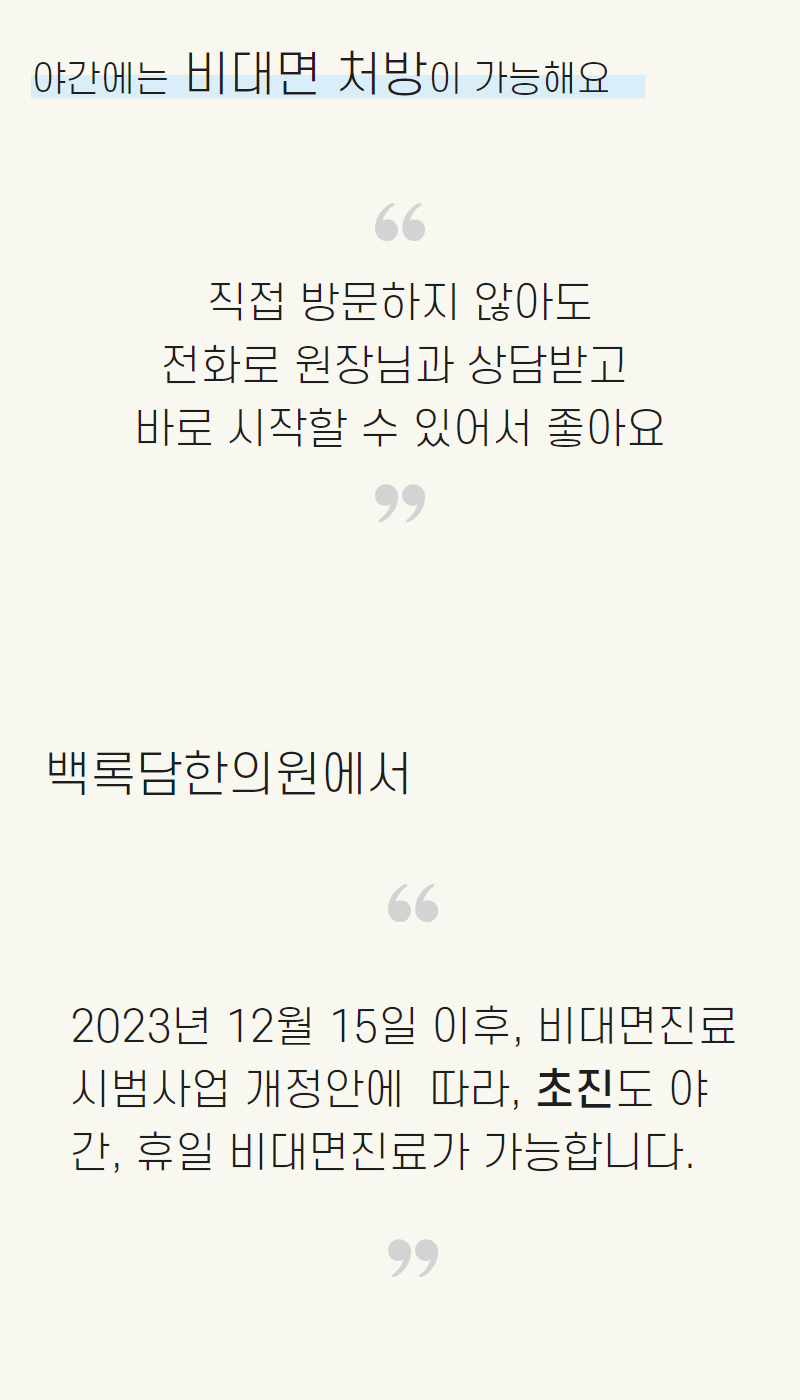
비대면 vs 대면
Q. I see a lot of non-face-to-face prescriptions for weight loss herbal medicine these days. What is the difference between that and visiting a clinic in person?
A.
Non-face-to-face prescriptions are a convenient alternative for busy professionals who struggle to find time. However, effective weight loss starts with accurately reading your current physiological state. In-person consultations allow for pulse diagnosis (Maek-jin) and tongue diagnosis (Seol-jin) to assess your Qi and energy levels, enabling a more precise adjustment of herbal ingredients tailored to your specific needs.
📝 Detailed Answer
I completely understand the desire to simply receive medication quickly when life gets busy. However, in Traditional Korean Medicine (TKM), weight loss is not merely about suppressing appetite, but a process of clearing accumulated metabolic waste from the body.
During an in-person consultation, we directly examine the state of 'Eohyeol' (瘀血, blood stasis) and 'Dameum' (痰飮, phlegm-fluid retention)—metabolic wastes that hinder circulation. For instance, patients with 'Bi-heo' (脾虛, Spleen deficiency) who have weakened digestive functions may experience severe fatigue if appetite is suppressed indiscriminately. Seeing a patient in person allows the practitioner to finely calibrate the potency and composition of the herbs to prevent such side effects.
Here is a comparison of the two approaches:
| Category | Non-Face-to-Face Prescription | In-Person Consultation (Baekrokdam) |
| :--- | :--- | :--- |
| Convenience | Very High (App/Phone) | Moderate (Requires Visit) |
| Diagnostic Method | Questionnaire & Interview based | Integrated Pulse, Tongue, and Interview diagnosis |
| Prescription Precision | Focused on standardized formulas | Personalized custom-tailored prescriptions |
| Side Effect Response | Adjustment via consultation | Immediate physical assessment and adjustment |
| Management System | Non-face-to-face guides provided | Close management based on constitutional analysis |
This is not to say that non-face-to-face options are inferior. However, if you desire a sophisticated prescription perfectly matched to your body, meeting in person is far more efficient. The fastest way to achieve your goals without wasting time or effort is to start with an accurate, comprehensive diagnosis.
#comparison
#comparison-table

Expert Verified
Dr. Yeonseung Choe
Chief Director