
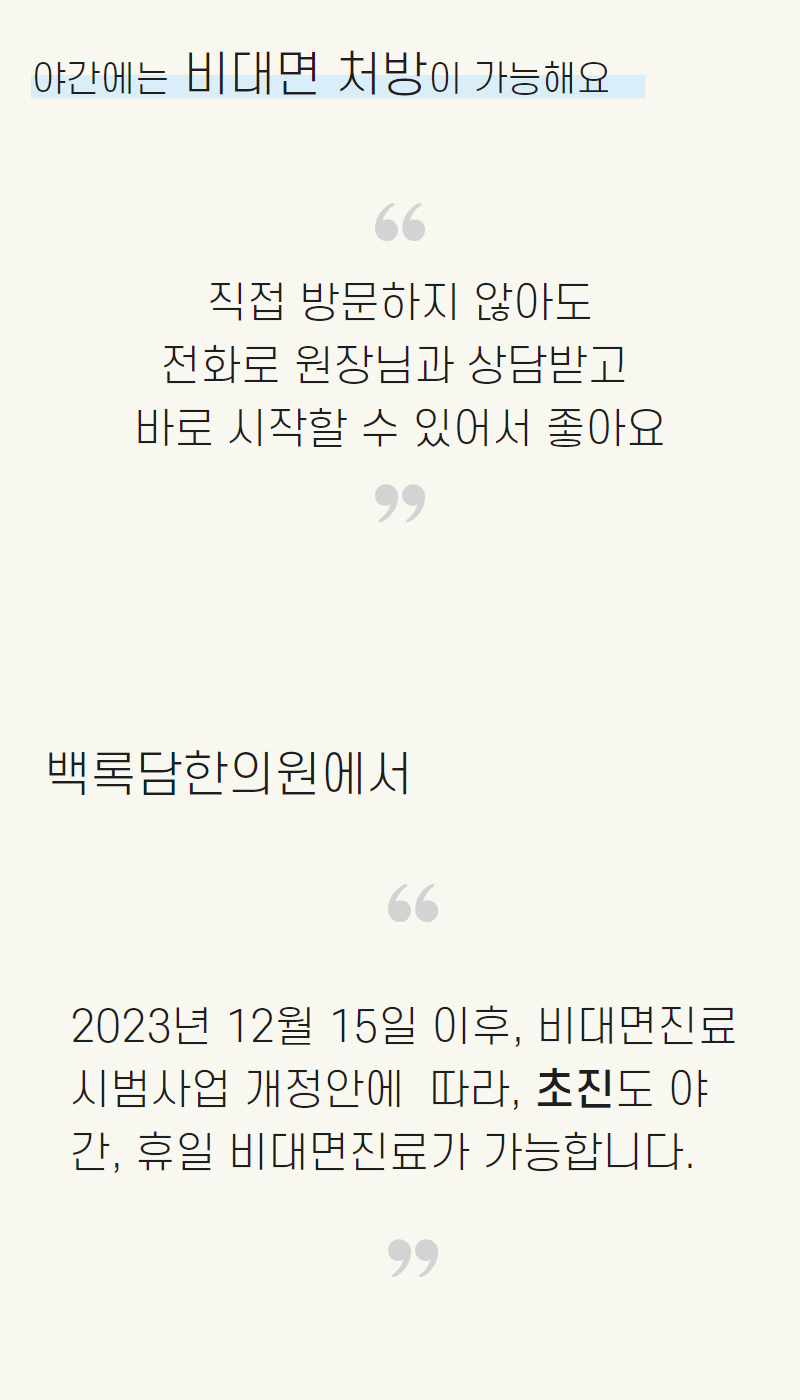
비대면 vs 대면
Q. There are so many remote diet herbal medicine options these days; is there really a big difference compared to visiting the clinic in person?
A.
Both have clear advantages. Remote services offer great time efficiency for busy professionals. However, in-person consultations allow me to personally observe, touch, and listen to your body. This enables a far more precise diagnosis of constitutional peculiarities or sudden changes in condition that occur during weight loss. Your choice depends on whether you prioritize convenience or a high-precision diagnosis.
📝 Detailed Answer
Initially, I also wondered if questionnaires alone would be sufficient for the sake of efficiency, but I found that the quality of care differs significantly from in-person visits. The core of Traditional Korean Medicine (TKM) is not simply reducing the number on the scale, but uncovering the 'root cause' of why your body has become prone to weight gain.
For instance, the composition of medicinal herbs changes entirely depending on whether your issue is an accumulation of Phlegm-Fluid (Dam-eum, 痰飮) or stagnant Blood Stasis (Eo-hyeol, 瘀血). If a patient suffers from Spleen Deficiency (Bi-heo, 脾虛) with severely impaired digestive function, blindly suppressing appetite can lead to extreme fatigue and dizziness. These subtle constitutional differences can only be accurately identified through face-to-face examinations such as Pulse Diagnosis (Maek-jin, 脈診) and Tongue Diagnosis (Seol-jin, 舌診).
Here is a brief comparison between remote and in-person consultations:
| Category | Remote Prescription | In-person Consultation |
| :--- | :--- | :--- |
| Accessibility | Highly convenient | Requires travel time |
| Diagnostic Method | Based on questionnaires | Comprehensive (Pulse, Tongue, Abdominal diagnosis) |
| Prescription Precision | Centered on standardized formulas | Highly personalized fine-tuning |
| Side Effect Response | Message/Phone communication | Immediate status check and formula adjustment |
| Emotional Support | Digital communication | Close management and psychological rapport |
| Recommended For | Those with absolute time constraints | Those requiring precise constitutional analysis and care |
Neither method is objectively 'correct'; it depends on which value is more important to you in your current situation. I recommend starting with an in-person visit to thoroughly check your physical condition, and then utilizing remote services once you enter the maintenance phase.
#comparison
#comparison-table

Expert Verified
Dr. Yeonseung Choe
Chief Director