
Wart Treatment in Traditional Korean Medicine: Moxibustion and Caustic Agents vs. The Lasting Root Treatment

Table of Contents
- Who should read this first
- Key Criteria for Treatment: How should warts be "treated"?
- Two Treatment Paradigms
- 1. External Treatment Focused: Moxibustion, Corrosive Agents, Excision
- 2. Internal Treatment Focused: Regulating Liver Blood and Nourishing Kidney Water
- Xue Lizhai's Warning: The Tragedy of Improper Surgical Treatment
- Which Method to Choose: Deficiency and Excess of Yuan Qi and Pathological Location
- Clinical Cases: The Efficacy of Long-Term Administration
- Case 1: Complete Cure After Recurrence with Long-Term Treatment
- Case 2: Preventing Recurrence with Two Years of Treatment
- Conclusion: The Wisdom of Pyo-bon Gyeomchi (Addressing Both Root and Manifestation)
Program: Dermatology Clinic
Who should read this first
Those concerned about how to treat warts (verrucae) on their hands, heels, or neck
Those who have tried folk remedies (moxibustion, vinegar, athlete's foot medication, etc.) only to find their warts grew larger or spread
Those who have experienced recurrence after dermatological laser or cryotherapy and are considering Traditional Korean Medicine treatment
Key Criteria for Treatment: How should warts be "treated"?
Even in modern medicine, warts (skin warts, HPV infection) are chronic, recurrent diseases that are difficult to cure completely. In Traditional Korean Medicine (TKM), they were called U (疣) or **Cheonilchang (天日瘡)**, names derived from the observation that they tend to disappear naturally after about three years.
However, within TKM, there was a stark methodological division regarding how to treat this condition. This was not merely a matter of preferred medical technique, but a fundamental question concerning **Pyo-bon (表本)**, a core philosophy of TKM—which should be prioritized: the external manifestations (pyo) or the underlying internal pathology (bon)?
Two Treatment Paradigms
1. External Treatment Focused: Moxibustion, Corrosive Agents, Excision
The surgical tradition, continued from the Song and Yuan dynasties, advocated for direct removal of lesions, inheriting the incisive techniques of Bian Que (扁鵲) and Hua Tuo (華佗).
Key Methods:
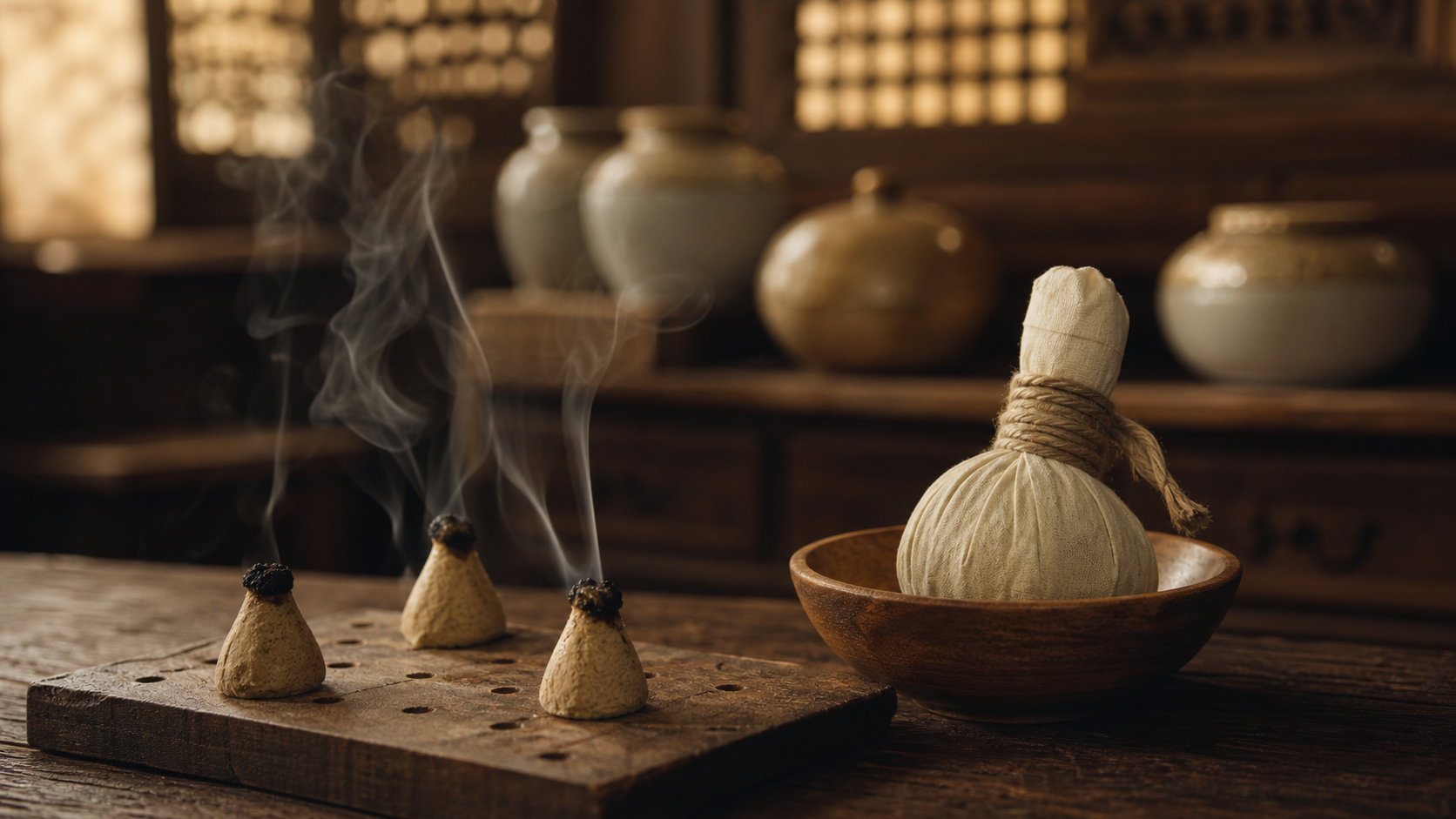
Moxibustion (灸法): Records state that applying mugwort moxibustion to a newly formed wart can also cause surrounding ones to fall off.
Baekgangdan (白降丹): A potent corrosive agent made by heating mercury, Xanthoxylum, alum, and realgar. It destroys lesion tissue by point application.
Hongseungdan (紅升丹): A medicinal agent that aids tissue regeneration after corrosion. The combined use of Seunggangidan (升降二丹, two types of dan) was central to the surgical tradition.
Tying with spider webs, tying with Wonhwaseon (toxic flower thread), etc.
Advantages: Immediate lesion removal Risks: Damage to normal tissue, infection, severe pain, possibility of recurrence
2. Internal Treatment Focused: Regulating Liver Blood and Nourishing Kidney Water
The internal treatment-focused school, represented by Xue Lizhai (薛立齋) and Xiao Jing (肖京) of the Ming Dynasty, condemned external physical treatments like corrosion, excision, and moxibustion as **"reckless actions that deplete jing-blood, damage liver sinews, and lead to adverse outcomes (敗證, aggravated conditions)."**
Pathogenesis:
Liver Fire and Blood Dryness (肝火血燥): Liver fire and dryness of blood.
Kidney Water Deficiency (腎水不足): Deficiency of kidney fluid/yin.
Warts are not merely localized skin lesions but superficial manifestations of systemic pathologies: Liver Fire, Blood Dryness, and Kidney Water Deficiency. Therefore, merely removing the external wart does not resolve the root pathology, inevitably leading to recurrence, and surgical stimulation can further exacerbate Liver Fire.
Key Prescriptions:
Liuwei Dihuang Wan (六味地黄丸): Nourishes Kidney Water (腎水) → promotes Liver Blood production.
Qinggan Yiying Tang (清肝益榮湯): Clears Liver Fire, nourishes Blood.
Jiawei Xiaoyao San (加味逍遙散): Harmonizes Liver Qi, descends Fire.
Jiawei Guipi Tang (加味歸脾湯): Tonifies Spleen and Stomach.
Advantages: Prevents recurrence, improves overall health Disadvantages: Takes several months to over a year for symptom improvement
Xue Lizhai's Warning: The Tragedy of Improper Surgical Treatment
According to 『Oegwa Simbeop Yogyeol (外科心法要訣, Essential Surgical Methods)』, Xue Lizhai warned as follows:
"If methods such as wrapping with spider webs, letting wart beetles gnaw, tying with Wonhwaseon, moxibustion, or corrosive poisons are used, misuse can lead to pathological changes."
Literature also records cases where lives were lost due to improper surgical treatment. One woman, after receiving various surgical treatments for warts—including wrapping with spider webs, tying with medicinal threads (Wonhwaseon), letting insects gnaw, corrosive poisons, and moxibustion—developed severe ulceration, swelling, pain, fever, and hemorrhage in the affected area, ultimately leading to her death.
Warts are essentially **Blood Dryness and Concretion (血燥結核, blood drying and congealing)**. If corrosive agents are applied externally or hot-dry (燥熱) medicines are taken internally, jing-blood (精血) becomes even more deficient, damaging the liver and muscles. The wound then becomes inverted and open, transforming into an intractable adverse outcome (敗證).
Which Method to Choose: Deficiency and Excess of Yuan Qi and Pathological Location
Xiao Jing's 『Heon'gi Gujeongnon (軒岐究竟論, Discourses on Ultimate Principles of Huangdi and Qibo)』 provides specific criteria for choosing between external and internal treatment methods:
Cases where external methods (moxibustion, corrosive agents, etc.) can be used:
When one is young and vigorous with abundant Yuan Qi (元氣).
When the Spleen and Stomach are strong, and appetite is normal.
When the six pulses are surging and full (洪實).
When the lesion is solitary and acute.
Cases where internal methods (medicinal treatment) are appropriate:
When Yin-Blood is deficient.
When one is elderly or has chronic, recurrent warts.
When moxibustion or corrosive agents have worsened the condition.
When warts are spread across multiple areas.
Clinical Cases: The Efficacy of Long-Term Administration
Actual clinical cases from Xue Lizhai, as recorded in 『Ipjae Oegwa Balhwi (立齋外科發揮, Xue Lizhai's Surgical Discourses)』:
Case 1: Complete Cure After Recurrence with Long-Term Treatment
A person had a nodule below the neck. Medicines for resolving stagnation and moving Qi (散堅行氣) were used but to no avail. Upon my examination, the liver pulse was wiry and rapid (弦數). I treated with Jiawei Xiaoyao San plus Huanglian (Coptis), and the condition resolved. Later, another one appeared, suddenly swelling due to anger. First, I treated with Xiao Chai Hu Tang plus Qingpi (Citrus peel), Shanzhi (Gardenia), and Danggui (Angelica gigas), which slightly reduced the swelling. Then, I alternated administration of Jiawei Guipi Tang and Jiagam Palmihwan (modified Eight-Ingredient Rehmannia Pill), which led to its disappearance.
Case 2: Preventing Recurrence with Two Years of Treatment
A person, accustomed to rich foods and strong alcohol, suffered from bloody stools and constipation. After losing sleep due to overwork, soybean-sized warts appeared and spread above the neck. They experienced fever, emaciation, poor appetite, dry mouth, and worsening symptoms around dusk. The left cubit pulse was surging and rapid (洪數), and the right guan pulse was wiry and rapid (弦數).
I stated: "As Kidney Water fails to nourish Liver Wood, and Fire is exuberant, dryness intensifies, causing fever and dry mouth. Liver Wood overacting on Spleen Earth leads to poor appetite and emaciation." I prescribed Jiawei Guipi Tang and Jiagam Palmihwan alternately. After about a year, several warts reappeared. I continued with the previous formulas, adding Huangbai (Phellodendron bark), Zhimu (Anemarrhena rhizome), Dihuang (Rehmannia root), and Danggui (Angelica gigas) to form a decoction for continuous administration. After another year, the warts did not reappear.
The core of this case lies in the fact that long-term (over 2 years) continuous medication combined with **lifestyle improvements (moderation of rich foods and alcohol)** is essential for ultimately preventing recurrence.
Conclusion: The Wisdom of Pyo-bon Gyeomchi (Addressing Both Root and Manifestation)
The wisest approach to wart treatment is to first assess the patient's Yuan Qi (元氣) and Jing-blood (精血) status.
For a young patient with abundant Yuan Qi and a solitary wart, immediate removal with Baekgangdan or similar agents, followed by taking Liuwei Dihuang Wan or Xiaoyao San to prevent recurrence, represents a Pyo-bon Gyeomchi (標本兼治) approach that combines the strengths of both schools.
However, if Yuan Qi is deficient or the condition is chronic and recurrent, rather than immediate removal, internal treatment methods that restore Liver Fire and Blood Dryness and Kidney Water Deficiency provide a fundamental solution.
Restoring the principle of "Kidney Water nourishing Liver Wood (腎水生肝木)" is the fundamental mechanism for wart disappearance.
## FAQQ: Is it also risky to apply folk remedies like vinegar or athlete's foot medication?A: Yes. As Xue Lizhai warned, external corrosive methods can deplete jing-blood and damage liver sinews, potentially leading to recurrence or worsening of the condition.Q: How long should Liuwei Dihuang Wan be taken?A: It varies depending on individual constitution and pathology, but literature shows cases of long-term administration for 1-2 years or more. It must be prescribed under the diagnosis of a licensed Traditional Korean Medicine practitioner.Q: My warts recurred after dermatological laser treatment; can Traditional Korean Medicine help?A: Laser treatment falls under surgical removal. If recurrence is repeated, regulating the underlying Liver Fire, Blood Dryness, and Kidney Water Deficiency through internal treatment methods can help prevent recurrence.
Related Program: Dermatology Clinic
This article is based on textual evidence from classical Traditional Korean Medicine texts, and individual treatment must be discussed with a qualified Traditional Korean Medicine practitioner.