

Understanding the Yo-yo Effect: Causes and Prevention

Table of Contents
Hello, I'm Director Choi Yeon-seung of Baekrokdam Clinic. In the consultation room, I often hear a very common concern from patients: "Director, I lost weight before but gained it back quickly. Can I really lose weight without the yo-yo effect this time?" It is incredibly disheartening to see the numbers return to your original weight—or even higher—after working so hard to lose it. Having heard these frustrations so often during my practice, today I want to break down the identity of that exhausting cycle: the yo-yo effect.

What exactly is the yo-yo effect?
By definition, the yo-yo effect refers to the phenomenon where weight lost through a diet/weight management program returns to the original weight or increases even further. Usually, this term is used when weight lost through dietary control or exercise is regained within a short period of one to two months.
Academically, it is called yo-yo dieting or weight cycling. It refers to a pattern where weight doesn't just stop at being regained but continues to fluctuate up and down repeatedly. The National Health Insurance Service also describes it as a phenomenon where weight lost rapidly through extreme dieting returns to its original state or increases.
Why is it called 'Yo-yo'?
Think of a yo-yo toy on a string. It moves up and down incessantly. Our body weight can move in a similar pattern—loss → regain → loss again → regain again—and because this cycle resembles the movement of a yo-yo toy, it earned this name.
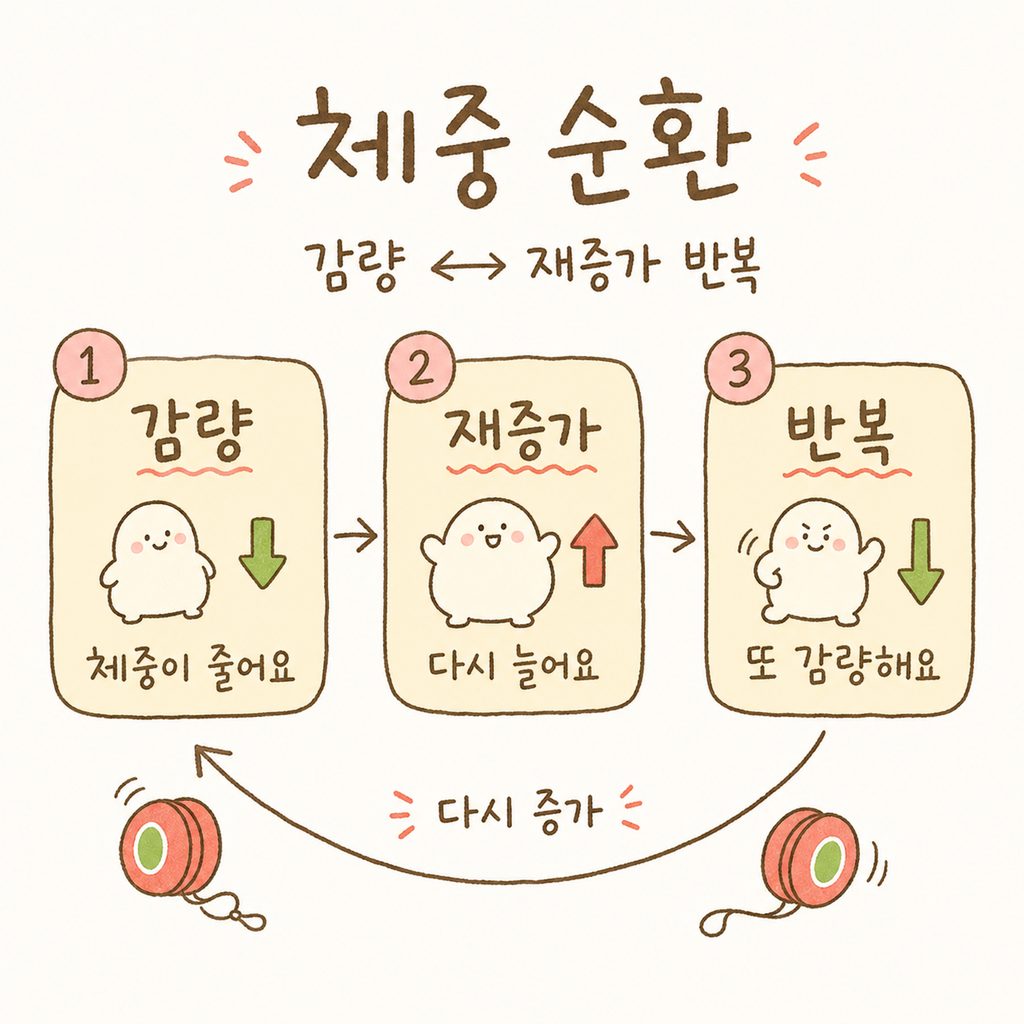
It’s a somewhat cruel analogy. While many people try to overcome this through sheer willpower, it is actually less about willpower and more about the survival instincts hardwired into our bodies.
Medical causes of the yo-yo effect
So why does our body try to return to the weight we worked so hard to lose? The key lies in the body's compensation mechanism. When weight drops suddenly, the body perceives it as an emergency. It reacts by lowering the basal metabolism and increasing appetite to return to its original state.
According to Kormedi, the secretion of hormones that increase hunger and appetite rises for at least one year after weight loss. Furthermore, if you starve yourself excessively, you lose muscle mass, which leads to a further decrease in basal metabolism. This turns your body into one that gains weight more easily even if you eat less than before. This is why extreme fasting, nutritional imbalances, and rapid short-term weight loss are the biggest causes of the yo-yo effect.
How to check if your diet/weight management is at risk
Is your current method setting you up for a yo-yo effect? If many of the following items apply to you, it's time for a check-up.

You are practicing extreme fasting or a one-food diet.
You focus solely on calorie restriction without considering nutritional content.
You are losing weight quickly by starving without any exercise.
Your goal is to lose a large amount of weight in a very short period.
You suddenly reduced your food intake and plan to return to old eating habits immediately after.
These methods may change the numbers on the scale quickly. However, as mentioned earlier, they trigger the body's compensation system intensely, making it easier to experience a significant yo-yo effect later.
Common misconceptions about the yo-yo effect
Many people blame themselves, saying, "I have weak willpower because the yo-yo effect happened." However, this is a biological response rather than a psychological one. Our bodies have a very strong sense of 'homeostasis'—the tendency to maintain a stable internal state.

Many also believe that "once the yo-yo effect starts, it's over." But by correcting the habits that caused it and gradually lowering the 'set point' that the body remembers, you can overcome it. The key is not a strategy of blind starvation, but a healthy, slow approach that the body doesn't perceive as a threat.
Practical points for healthy weight loss without the yo-yo effect
How can you escape this exhausting cycle? Here are the core principles I always emphasize in the consultation room.


First, lose weight slowly. Kormedi recommends a gradual weight loss of about 0.5 to 1 kg per week. If you lose weight too quickly, the body feels a sense of crisis and drops the basal metabolism sharply, but at this recommended speed, you can minimize the body's resistance.
Second, incorporate strength training. Losing muscle during a diet/weight management program is like taking an express train to the yo-yo effect. You must protect your muscle mass to preserve your basal metabolism and have the strength to maintain your weight without the yo-yo effect.
Third, eat a balanced diet. Ensure you get a balance of protein, dietary fiber, and healthy fats. Rather than an extremely restrictive diet, a meal plan that prevents nutritional imbalances is a much faster and safer path in the long run.
Stop the cycle of blind starvation and struggling with dizzying hunger. The wisest strategy is to approach weight management healthily without damaging your body's metabolism.
We have looked at the meaning, causes, and prevention of the yo-yo effect. The core of weight management is not 'how fast you lose it' but 'how you maintain it.' Rather than pushing your body to the limit with extreme methods, it is important to understand your constitution and metabolic state and move forward at a pace that suits you.
Managing your diet and maintaining weight alone can sometimes feel overwhelming. In such cases, it is helpful to seek professional help to regulate metabolism and refine your constitution. With the Baekrok Gambi-jung program, you can expect better results while preventing this metabolic decline. Try a new approach next time, and feel free to tell me how it went during your next visit. I am rooting for your healthy weight loss.
References