Low-Calorie Snacks — Examining Almonds and Protein Snacks Based on 100 Calories

Table of Contents
When meeting patients in the consultation room, one of the most common concerns I hear is 'binge eating' (ip-teojim). Even when managing your diet diligently, an unbearable hunger often hits around 3 to 4 PM. In these moments, a single bag of snacks picked up unconsciously often ruins the day's efforts. I also feel hungry between consultations, so I fully understand that feeling.
![A friendly-looking doctor character sitting at a consultation desk, kindly counseling a worried patient. A speech bubble shows an expression of empathy toward the concern.]](/api/files/assets/2026-08/7d8a9eba.jpg?sig=5ff4b0fe5e52dfa73df701c2cef8524b4bc09037185d5e9053c33487325c104a)
The Psychological Deadline of 100 Calories
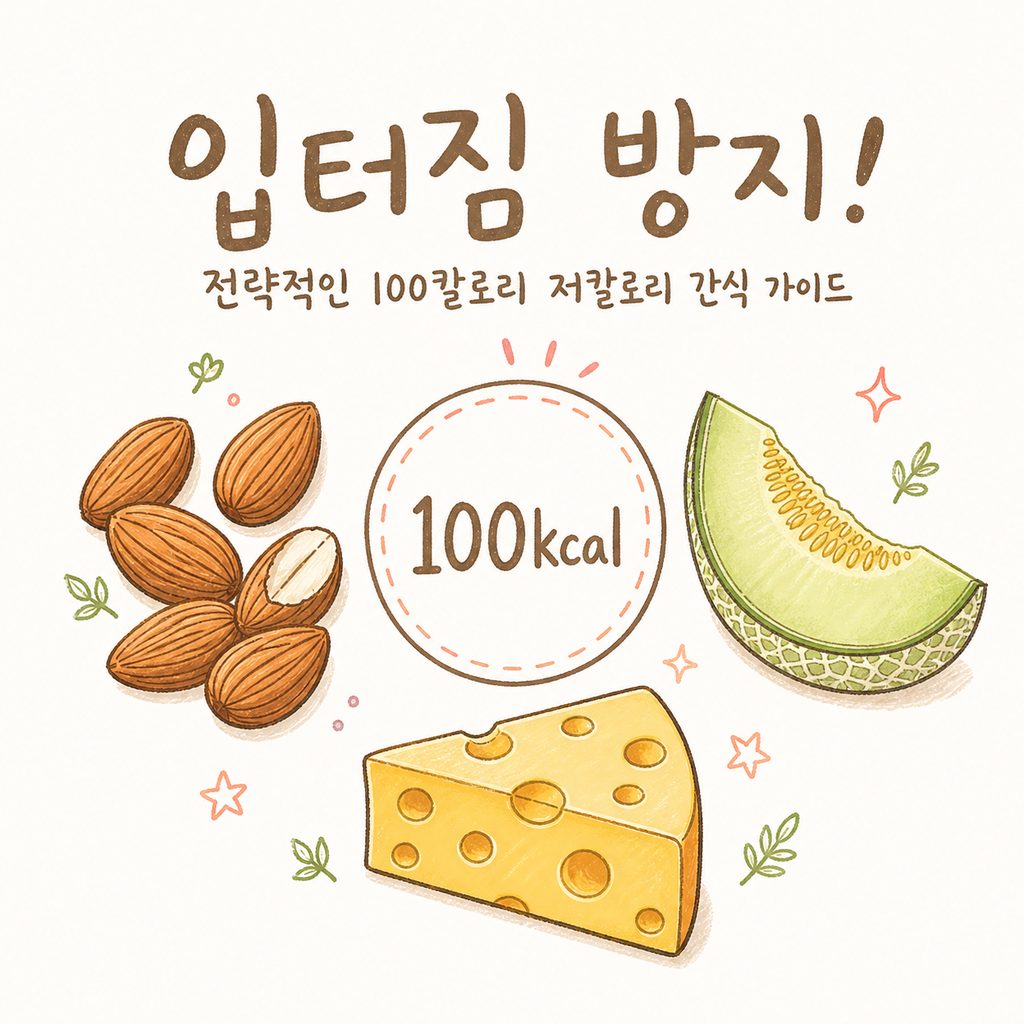
Starving yourself unconditionally often leads to overeating during the next meal. That is why during consultations, I suggest strategically utilizing snacks within 100 calories. According to data from the US health and medical medium Everyday Health, a light snack of about 100 calories helps suppress appetite and alleviate the feeling of emptiness.
![A checklist-style design. ✅ marks are placed next to 'Balanced nutritional components', 'Includes protein', 'Small amount supply' / ❌ marks are placed next to 'Starving unconditionally', 'Excessive refined carbohydrates'.]](/api/files/assets/2026-08/e5ccf1f7.jpg?sig=2b5bc0eea5614d83312317f4b9dcc5d25f31f81bd8670e76cd321285fd532e34)
The important point is that it should not simply be low in calories, but the nutritional components must be balanced. For example, crackers made from whole grains are rich in dietary fiber, which has the effect of soothing hunger between meals. Rather than blindly enduring, providing a small amount of appropriate energy that your body needs is the way to maintain metabolic flow.
The Role of Protein in Determining Satiety
If you feel hungry again quickly despite low calories, it is difficult to call it a good snack. The key here is protein. Protein has a slow digestion speed, which helps maintain satiety for a long time.
![A cut showing 15 almonds on a pretty plate, with arrows and labels providing detailed explanations: 'Approx. 100kcal', 'Rich in dietary fiber', 'Low saturated fat'.]](/api/files/assets/2026-08/a7fcfa4c.jpg?sig=076e5cdf827beffa99713fc9e91cb51a07b7e5de27bba97891a89cbdc65cbabe)Almonds are particularly recommended. About 15 almonds would be approximately 100 calories. They are rich in dietary fiber and protein, making them very suitable for those who do not have strong food cravings to reduce feelings of hunger. Saturated fat is relatively low at about 0.63g, and since there is no cholesterol or sodium, it becomes a healthy choice.
If you prefer something more filling, try cottage cheese. About half a cup contains approximately 1 14g of protein, making it an excellent protein supplement. Recently, products like sugar-free protein popcorn containing 3.8g of protein with less than 100 calories per bag have also become available, expanding your options.
Sugar Content and Amounts to Watch When Choosing Fruit
When you crave something sweet, you may turn to fruit. However, the sugar in fruit can also interfere with weight management if consumed excessively. Depending on the type of fruit, you should adjust both the amount and method of consumption.
For melon, one slice (100g) is approximately 40 calories, making it a relatively light option. On the other hand, for fruits that contain added sugars like Korean melon (chamoe), instead of eating a large amount at once, it is appropriate to portion it into a small cup containing 1 serving and consume it in divided amounts.
According to research, 77.7% of teenagers cited taste as the most important criterion when choosing snacks. The same applies to adults. Rather than eating delicious fruits without restraint, developing a habit of eating pre-measured portions divided over time is beneficial for both blood sugar management and diet.
How to Avoid the Liquid Fructose Trap
Choosing beverages to go with your snacks is also very important. Many people unknowingly drink carbonated beverages that contain more sugar than expected.
Looking at actual numbers, carbonated drinks contain 19.9g of sugar per 200mL. This is a major culprit that causes you to consume far more sugar at once than a typical low-calorie snack. Liquid fructose is quickly absorbed, rapidly raising insulin levels, and ultimately creates a vicious cycle that makes you hungry again soon after.
As much as possible, try pairing snacks with water or unsweetened tea. Just as important as lowering the calories of your snacks, removing unnecessary sugar from the beverages you drink together is key to weight loss.
High-Calorie Snacks vs Low-Calorie Snacks Comparison
Let me go over how the common snacks we typically eat differ from the low-calorie combinations I recommend.
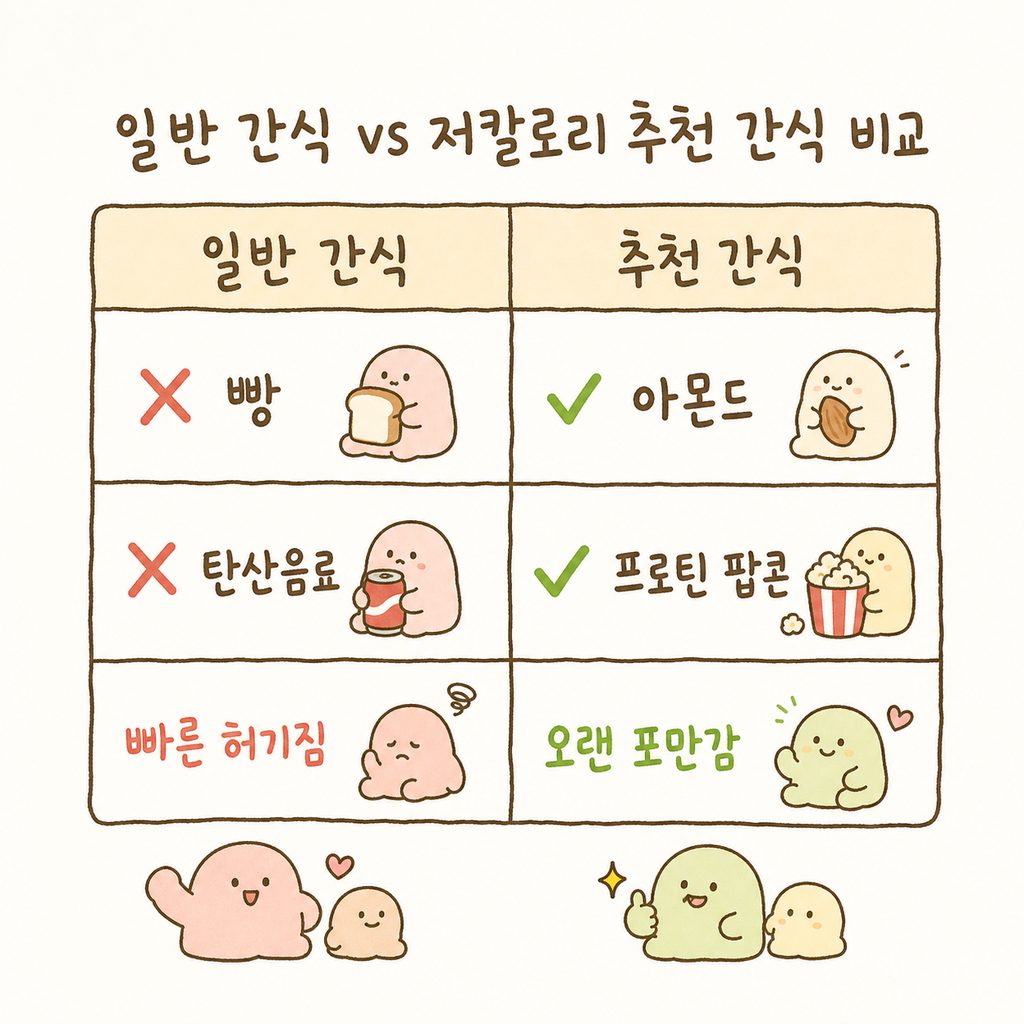
Common Snack Combinations
Cookies or bread containing high amounts of sugar
High-sugar carbonated drinks (19.9g of sugar per 200mL)
Compositions centered on refined carbohydrates, inducing rapid hunger
Recommended Low-Calorie Combinations
15 almonds (approximately 100 calories, rich in dietary fiber and protein)
3 whole grain crackers and cheese (within 100 calories, providing protein and calcium)
Sugar-free protein popcorn (less than 100 calories per bag, 3.8g of protein)
Simply changing the ingredients, rather than just reducing the quantity, completely changes the body's response.
3 Recommended Combinations from the Clinic
To help you put this into practice starting today, I have summarized three combinations that I frequently mention to my patients.
![Cafe menu style design. Three combinations—1. 15 almonds, 2. 3 whole grain crackers + cheese, 3. melon pieces + cottage cheese—are listed in a clean list.]](/api/files/assets/2026-08/025ee468.jpg?sig=774a2ca60cd0e50406ca0ae63ca74919c5487ca3d0d721915f587f1d80f227be)
![A doctor character smiling brightly in a cheering pose. A closing cut with one hand giving a thumbs-up and small heart or star effects scattered around.]](/api/files/assets/2026-08/6baa7cf9.jpg?sig=b2f9473ff81d8fc1911ddfb67e65bdc1f86b48eac5eea4116187b6ab4acb1626)
The first is the 15 almonds combination. It is the simplest yet most certain way to reduce feelings of hunger. I recommend portioning them into your bag and chewing them slowly one by one when you feel the urge to snack.
The second is the 3 whole grain crackers and cheese combination. This combination can be kept within 100 calories while remaining quite filling. It has a good nutritional balance, containing approximately 1.2g of saturated fat, 397mg of sodium, and 7mg of cholesterol.
The third is the melon pieces and cottage cheese combination. By adding the rich protein of cottage cheese (14g per half cup) to the light calories of 100g of melon (approximately 40 calories), you can achieve both taste and satiety.
Dietary management is not a time of pain through unconditional endurance, but a process of finding healthy alternatives that satisfy your body. Rather than restricting too strictly, I hope you manage your diet enjoyably through these small changes.
When I see you in the clinic next time, please let me know which snack suited your taste best. Since the most suitable snack may vary depending on an individual's constitution and metabolic state, we can adjust them together. If combined with the Baekrok Gambi-jung tablet program, appetite control becomes much easier, and you can expect more effective results.
Reference Materials
-All good for appetite and weight control... snacks that are less than 100 calories