No Time to Exercise? Combating Belly Fat Through Diet

Table of Contents
Do you often find yourself sitting at your desk after lunch and barely moving until you get off work? I frequently encounter patients in the clinic who diligently manage their diet, exercise occasionally, yet see no reduction in waist circumference.
The key is not simply the causal relationship that "one sedentary lifestyle creates belly fat." Observational studies have shown associations between prolonged sitting patterns and abdominal obesity, and the World Health Organization (WHO) recommends reducing sedentary time and replacing it with even light activities. Rather than exaggerated "metabolism switch" claims, let's examine practical criteria you can implement right away.
View Sedentary Time and Abdominal Obesity as "Correlation" Rather Than "Cause"
A domestic study analyzing 2,274 women aged 45–65 who participated in the 2016–2017 Korea National Health and Nutrition Examination Survey found that those with daily sedentary time of 5 hours or more were about 1.5 times more likely to have abdominal obesity compared to those with less than 5 hours[1]. However, since this is an observational study, it does not mean that "exceeding 5 hours necessarily causes abdominal obesity."
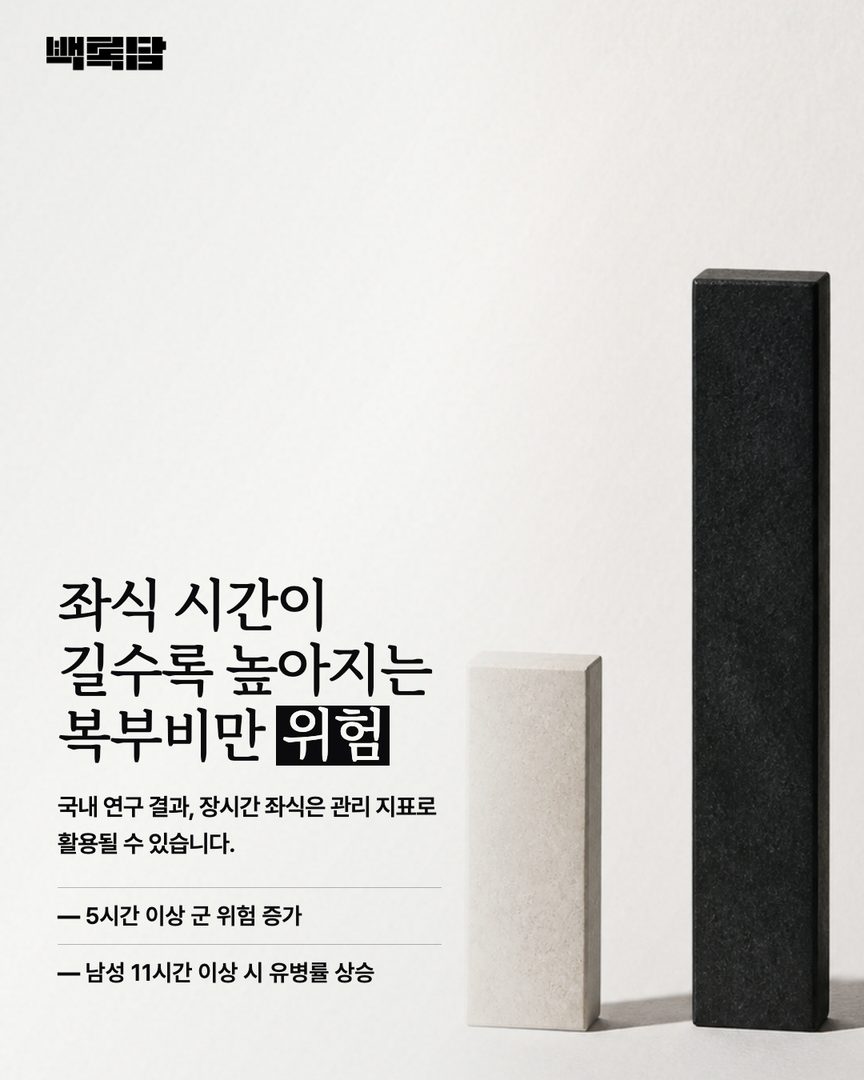
Other nationally representative sample studies in Korea also showed that as men's sedentary time increased, waist circumference and abdominal obesity prevalence rose. Compared to the group with less than 4 hours daily, the odds ratio for abdominal obesity in the group with 11 or more hours was 1.81 after adjusting for confounders[2]. Again, this is not a result that establishes causality—it serves as evidence for viewing prolonged sedentary behavior as one management indicator.
Check Waist Circumference Alongside Body Weight
The Korean Society for the Study of Obesity clinical guidelines define abdominal obesity in Korean adults as 90cm or more for men and 85cm or more for women[3]. These values are based on the Korean Society for the Study of Obesity criteria for Koreans, not American Heart Association standards.
Don't draw conclusions from a single measurement. Look at the trend of changes measured periodically at the same location. Recording whether you stayed seated all morning without standing, sat down immediately after meals, or spent long hours lying down after work will provide context to the numbers.
Waist circumference should be measured without forcibly inhaling or protruding your stomach. If the measurement location and time vary each time, small changes can be easily overestimated, so maintain consistency with the same tape measure and similar conditions. In the clinic, I check not just one number but recent weeks' changes, sleep duration, eating patterns, and activity levels together. If waist circumference increases despite stable weight, you need to look at other factors besides sedentary time, such as late-night eating, alcohol consumption, and insufficient sleep.
Even If You Exercise, Long Sitting Still Matters
WHO recommends that adults reduce sedentary time and replace it with any physical activity, including light intensity[4]. They also advise 150–300 minutes of moderate-intensity aerobic activity or 75–150 minutes of vigorous-intensity activity per week, plus muscle-strengthening activities on 2 or more days per week.

In other words, it's not "I exercised after work, so I don't need to worry about daytime sedentary time." You need a structure that addresses both weekly exercise and interrupting sitting throughout the day. In Korean medicine, the heaviness and discomfort from prolonged fixed postures are explained as "stagnation of circulation," but this is not directly equated with waste accumulation or as a direct cause of fat.
If you find it difficult to significantly reduce sitting time due to your work, don't give up just because of the total hours. First, identify periods during meetings and calls where you can stand. Next, try adding short walks after lunch and dinner. If you have knee or back pain, start with what's possible within your range—such as slowly standing up and sitting down from a chair or indoor movements—rather than walking through pain. If you experience chest pain, severe shortness of breath, or dizziness, stop the activity and check whether medical attention is needed.
Sedentary-Breaking Routine to Apply Starting Today
1. Choose one cue to stand up. WHO has not specified exact intervals like "every 50 minutes for 5 minutes." However, as a practical experiment, choose one from: standing up after 50 minutes of focus, standing during phone calls, or getting water in a small cup to make more trips.

2. Try light walking after meals. In a small randomized crossover trial with elderly individuals at risk for glucose intolerance, walking 15 minutes after each of three daily meals helped improve 24-hour glycemic control[5]. This does not prove weight loss effects for everyone, so start with a comfortable 10–15 minute walk and adjust intensity if you have illness or pain.
3. Simplify meal combinations rather than using ratio formulas. Check whether vegetables, protein foods, and whole grains are included together in each meal, and first adjust the frequency of sugar-laden beverages and frequent consumption of broth and sauces. Do not use rigid ratio formulas with unclear evidence and context.
4. Review on a weekly basis. Recording waist circumference, number of times you stood up, post-meal walking instances, and weekly aerobic and strength activities together will show you which conditions cause your routine to break down.
The goal for the first week is not to lose a certain number of kilograms, but to find "when you sit for extended periods." Choose the easiest time slot among morning, lunch, and evening to change, and note how many times you stood up. For the next week, select just one behavior to maintain and one new behavior to add. If you couldn't keep the routine all week, rather than concluding it's a willpower issue, first change execution conditions like notification times, footwear, or walking routes.
Reducing sedentary time is not the entirety of weight management, but it is an environmental design that makes diet and exercise work in your actual daily life. If waist circumference continues to increase despite your own adjustments, or if fatigue, sleep, and appetite issues persist alongside weight changes, it's advisable to consult with healthcare providers regarding your personal health status and any medications.