
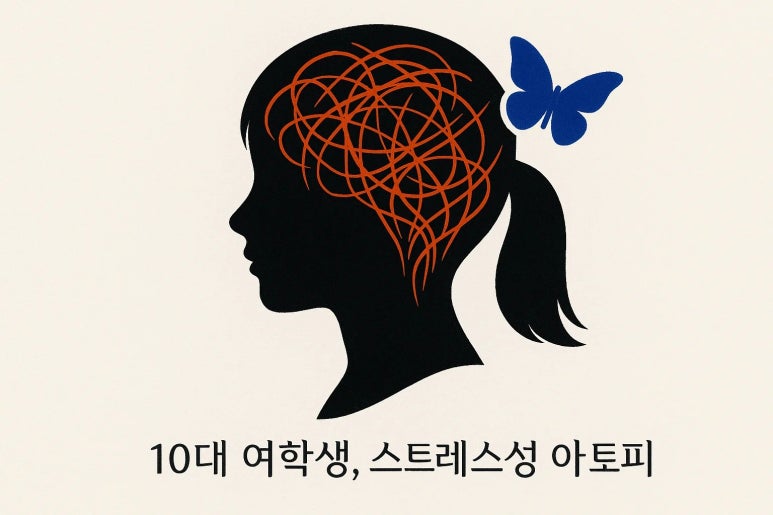
Teen Atopic Dermatitis: The Skin Isn't Always the Culprit | Stress-Induced Atopic Dermatitis

Our Daughter's Atopic Dermatitis Flares Up Every Exam Season – The Culprit Might Not Be Just the Skin
| "Doctor, it only gets better temporarily when I apply the ointment. I wonder if my child is stressed because of exam season; she scratches all night to the point of oozing. Does adolescent atopic dermatitis usually worsen with emotions like this? Both my child and I are exhausted." |
| [CASE] The Story of 16-year-old A This is the story of A, a 16-year-old female student who entered puberty. Her atopic dermatitis, which had been dormant since infancy, flared up again upon entering middle school. The itching and red rashes were particularly severe in the flexural areas of her arms and legs, as well as around her face and neck. The dermatologist consistently prescribed steroid ointment containing desoximetasone, but the effect was only temporary. Her parents observed a pattern where A's condition would explosively worsen specifically when she lacked sleep due to exam studies or became sensitive due to peer issues. |
In fact, a closer look at A's daily life revealed that,
Her average weekday sleep duration was less than 5 hours,
and she showed an irregular pattern of "catching up on sleep" on weekends.
Due to academic stress, she often sought stimulating foods like spicy tteokbokki or snacks late at night.
This is a phenomenon that cannot be fully explained by simply stating that her skin barrier is weak.
| [A Critical Limitation] This is precisely where a clear "wall" in conventional treatment becomes apparent. If atopic dermatitis were simply an immunological problem of the skin, its symptoms should be consistently managed with powerful anti-inflammatory ointments. However, for symptoms to rollercoaster, as in A's case, depending on specific situations—especially emotional and physical stress—strongly suggests that the true switch for the problem lies not in the skin itself but in our body's "central control tower." The label of stress-induced dermatitis merely describes the phenomenon but fails to fully explain its underlying mechanism. |
To untangle this complex knot, we need a shift in perspective.
This situation is akin to "running multiple heavy programs (stress, hormonal changes) simultaneously on a high-performance computer (our body) that it cannot handle."
When too many programs are running, the CPU (Central Processing Unit) overheats, and the cooling fan starts spinning frantically.
This "heat from the overheated CPU" is precisely the uncontrolled "heat" (熱) raging within the body of a teenage girl, and atopic dermatitis is akin to the body manifesting a "heat rash" through the skin, acting as an "emergency vent," to cool down this heat.
Indeed, excessive stress can trigger autonomic nervous system dysfunction-related skin responses.
It hyperactivates the sympathetic nervous system, causing vasoconstriction, disrupting the immune system, and increasing skin temperature, thus acting as a trigger that amplifies inflammatory responses.
Coupled with the unpredictable variable of pubertal hormonal changes impacting atopic dermatitis, the body's regulatory system becomes truly overloaded.
| [The Perspective of Traditional Korean Medicine: Heart Fire (心火)] Traditional Korean Medicine has focused on this mind-body connection for thousands of years. According to the 『Donguibogam』, it states, "All sores and itching originate from Heart Fire (諸瘡痛癢 皆屬於心火)." 'Heart Fire (心火)' refers to unnecessary heat that accumulates in the heart and mind due to excessive stress or emotional suppression. This 'fire of the mind' heats the blood (Blood Heat, 血熱), circulates throughout the body, and erupts through the skin, which is the weakest area. This is considered one of the core causes in Traditional Korean Medicine treatment for atopic dermatitis. This is by no means an unscientific concept. Modern medicine has already revealed that stress stimulates the amygdala in the brain, which then influences the autonomic nervous system and hormone secretion via the hypothalamus. Traditional Korean Medicine simply expressed this final outcome with the insightful symbol of 'Heart Fire.' |
Heart Rate Variability (HRV) tests conducted at stress clinics often show that such students typically have a severely disrupted autonomic nervous system balance.
While sympathetic nervous system activity is extremely high, the function of the parasympathetic nervous system, which stabilizes and restores the body, is markedly reduced.
This is objective evidence that our body is unable to rest and is continuously running in an "overheated" state.
| "The dermatologist keeps giving the same medication, and I feel helpless wondering if I have to apply this for the rest of my life." |
Could our child's skin problem perhaps be a cry for help, representing an emotional burden too heavy for them to bear?
| [The Beginning of a New Question] Now, we can change the question we ask alongside medical professionals. Instead of asking, "What stronger ointment should we use?", we should ask, "What wisdom is needed to lower the overheated temperature of our child's body and mind, and help them regain their balance naturally?" Learning how to manage internal heat and collaboratively examining the causes of the child's stress—this will be the beginning of a fundamental solution that can rescue the child from the torment of persistent itching. |