
Anxiety Hyperhidrosis in My 20s, A War with Sweat | Incheon Hyperhidrosis

Anxiety-Induced Hyperhidrosis in the Twenties: The Battle Against Sweat | Incheon Hyperhidrosis
| "Doctor, whenever I stand in front of people, sweat pours like rain from my face to my hands and feet. It gets worse when I'm nervous, and especially during important interviews or presentations, my clothes get completely soaked, which is incredibly difficult. Am I the only one who experiences this? I'm so anxious about failing interviews because of this, and about feeling people's stares." |
This is one of the most common complaints I hear from patients in their 20s whom I see in my clinic.
The experience of suddenly breaking out in sweat even in autumn when cold winds blow, or in air-conditioned indoor spaces, particularly in situations where others' gazes or judgments are expected.
Are there perhaps any readers among you who struggle with such experiences?
It would be even more distressing if your daily life becomes restricted and your self-esteem lowers due to this sweat, especially when it gushes out like interview sweat at crucial moments.
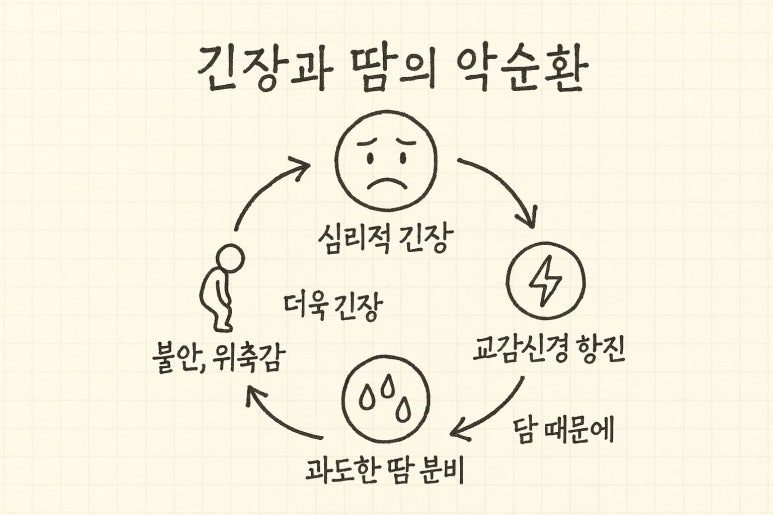
Why Does Sweat Specifically Erupt with 'Anxiety'? – The Sensitive Cry of the Autonomic Nervous System
Most hyperhidrosis patients in their 20s whom I see in my clinic suffer from anxiety-induced hyperhidrosis.
The areas where sweating occurs vary, from hands, feet, and armpits to the face, back, and groin, but they commonly share the characteristic that symptoms worsen in 'specific situations'.
For example, when taking public transport, giving a presentation in class, dating a romantic partner, or facing an important exam.
These situations go beyond mere physical burden; stress about others' evaluation or failure leads to psychological tension, and this, in turn, creates a vicious cycle that manifests as bodily sweat.
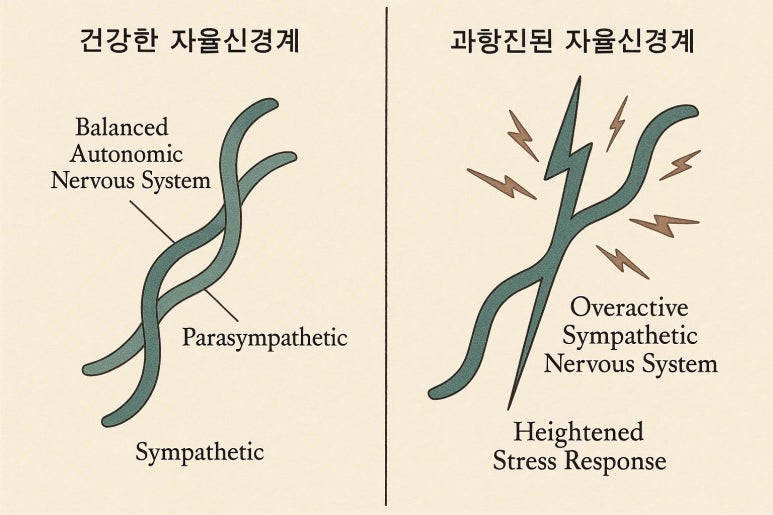
The Boiler in the Fish Tank Analogy: An Overactive Autonomic Nervous System Switch in the Body
Why does sweat specifically erupt with the emotion of 'anxiety'?
Is it simply due to overly active sweat glands?
I find the answer to this question in our body's regulatory system, namely the autonomic nervous system.
The autonomic nervous system is like a boiler that regulates the water temperature for fish in an aquarium.
It maintains an optimal temperature, ensuring it doesn't get too hot or too cold.
But what happens if this boiler breaks down?
It can overheat beyond what's necessary, or fail to function properly and become too cold.
What regulates sweat in our bodies is the autonomic nervous system, composed of the sympathetic and parasympathetic nerves.
When we get anxious or stressed, the body perceives it as a dangerous situation and prepares to 'fight or flee'.
At this time, the sympathetic nervous system becomes overactive, leading to an increased heart rate, elevated blood pressure, and stimulation of sweat glands to secrete sweat.
The problem is that this response goes beyond a natural reaction to the external environment; it overreacts to even minor stimuli, leading to a chronically overheated sympathetic nervous system.
Like an oversensitive boiler reacting strongly to a weak signal and spewing out heat.
When individual constitutional factors are added, it leads to increased sensitivity of sweat glands and easier sweating, resulting in anxiety-induced hyperhidrosis.
Ultimately, sweat is not merely an uncomfortable symptom, but can be interpreted as a strong signal sent by an overloaded autonomic nervous system.
Clues about 'Sweat' Found in Classical Korean Medicine Texts and Their Modern Significance
| In classical Korean medicine texts like Shanghanlun (Treatise on Cold Damage), the connection between psychological factors and physical symptoms has already been deeply explored. For example, in conditions like *shim-ha-bi-gyeong* (epigastric hardness/fullness) or when prescribing *Gyejigayonggolmoryeotang* (Cinnamon Twig Decoction with Dragon Bone and Oyster Shell), various symptoms emerging from the patient's anxious and restless psychological state, including sweat, were considered important clues. Rather than simply suppressing 'sweat' just because there was excessive sweating, the aim was to address the underlying 'overactive neurological state' and 'mental tension' that caused the sweat. Based on my clinical observations, this perspective deeply aligns with the autonomic nervous system imbalances seen in modern issues like stress-induced chronic fatigue and anxiety disorders. Korean medicine thus interprets the body's reactions not as simple physiological phenomena, but as holistic occurrences arising from the interaction between mind and environment. This goes hand-in-hand with correcting autonomic nervous system imbalance; by restoring overall bodily balance, calming the overheated sympathetic nervous system, and inducing a state of comfort, it helps the body regain its own sweat-regulating ability. |
The Vicious Cycle of Anxiety and Sweat: Restoring Balance with Herbal Medicine Treatment
Therefore, the herbal medicine treatment I recommend for patients in their 20s with anxiety-induced hyperhidrosis is not merely a symptomatic approach to stop sweating.
It focuses on calming the excessively overactive sympathetic nervous system and reducing overall body tension.
This process can be explained in two main parts.
| First, it is the delicate stabilization of the nervous system. By thoroughly understanding the patient's constitution and current bodily state, we prescribe herbal medicine that helps calm the overheated sympathetic nervous system and restore balance with the parasympathetic nervous system. This differs from taking temporary sedatives. The goal is to build the body's fundamental ability to better cope with stress and recover on its own. It's like steadying a rocking boat, helping it find stability even amidst rough waves. |
| Second, it is holistic harmony and recovery of the body. Sweat can be complexly connected not only to autonomic nervous system issues but also to the dysfunction of various organs, such as the digestive system, circulatory system, or general stagnation of *qi* and blood circulation. Herbal medicine resolves these organically intertwined bodily imbalances, addressing the root causes of excessive sweating. When the body's environment becomes healthy and harmonious, it reacts less sensitively to external stimuli and can efficiently exert its own sweat-regulating ability. |
Through this Korean medicine approach, we can break the 'vicious cycle of anxiety and sweat' where one sweats when anxious, and then becomes anxious again about sweating.
If you haven't achieved satisfactory results with conventional treatments, or if you are always feeling inhibited by anxiety and sweat, the Korean medicine solution could be a new path of hope.
| If you are currently struggling with sweat, please do not regard sweat merely as an uncomfortable symptom. Sweat can be an important signal from our body, and a cry from an overworked autonomic nervous system. Do not ignore this signal; I recommend consulting medical professionals who carefully examine the entire body and listening to your body's voice. Your body definitely has the power to heal itself. |