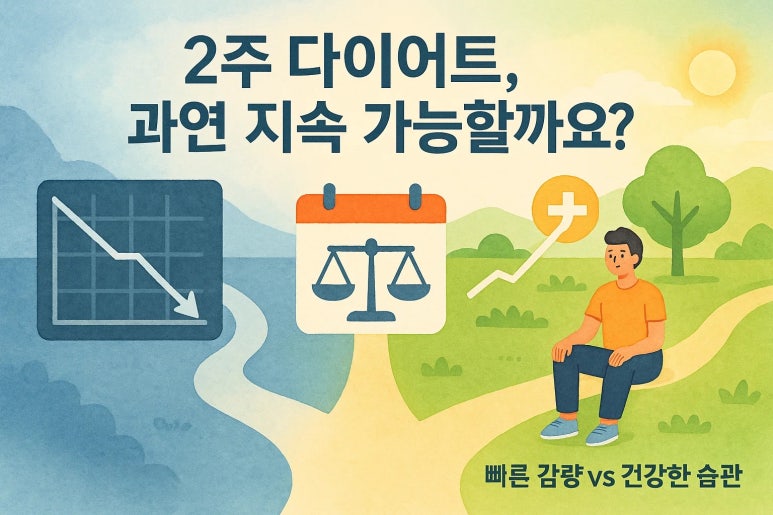
The 2-Week Diet: Is It Truly Sustainable?

2-Week Diet: Is it Really Sustainable?
Many people want to lose weight quickly in their busy daily lives.
It's understandable that the phrase '2-week diet plan' alone can be enticing.
But how does this short-term goal truly affect our bodies, and can it create sustainable change?
Patient's Question: Is a 2-Week Diet Really Okay?
| “Doctor, I urgently need to lose weight before my vacation next month. My friend told me about a diet plan where she lost 5kg in just two weeks. Is it okay for me to follow it? I think I can endure it for just two weeks.” |
This is a question I often hear in my clinic.
Many patients, captivated by quick results, try specific diets or methods, but often fail to deeply consider the underlying principles or whether they suit their own bodies.
Missing Your Body's 'Environment' Leads to Yo-Yo Effect
Simply reducing calories or excluding certain foods can lead to temporary weight loss, but in the long term, it often disrupts the body's balance, easily causing the yo-yo effect.
This is like scooping water out of a bathtub without blocking the drain. The water (weight) in the tub may temporarily decrease, but if the drain (body's environment) isn't addressed, the water will eventually fill up again. Here, 'body's environment' refers to the body's systems that determine weight, such as stress hormones, sleep quality, and appetite control signals. If these are not considered, the body perceives it as an emergency, tending to accumulate more fat.
CASE: Jihoon (pseudonym)'s 2-Week Weight Loss and Yo-Yo Experience
| Jihoon (pseudonym), an office worker in his 30s, tried a very low-calorie diet for two weeks before an important presentation. He succeeded in losing 4kg in two weeks by eating only chicken breast and salad. However, as soon as the presentation ended, his suppressed appetite exploded, and he developed a habit of binging late into the night. Ultimately, he returned less than a month later, having gained back 2kg more than what he had initially lost. My observations are as follows: The very low-calorie diet led to an initial 4kg weight loss, but this caused increased stress and decreased sleep quality. Consequently, the frequency of binges and late-night eating increased, resulting in an additional 2kg weight gain due to the yo-yo phenomenon. The corrective points were clear. Jihoon (pseudonym) achieved his short-term weight loss goal, but he lacked understanding of stress management and appetite control signals. To prevent the body from perceiving a state of emergency, it was necessary to focus on stress hormone regulation through gradual calorie adjustment combined with sufficient sleep and light physical activity. In particular, it was important to structure dinner around protein and vegetables that provide satiety while being easy to digest, thereby reducing the temptation for late-night snacks. |
Jihoon (pseudonym)'s case demonstrates that while a 2-week diet plan can be an opportunity for successful short-term weight loss, it can lead to greater difficulties if the body's environment is not considered.
Interpreting the Body's Environment: Traditional Korean Medicine and Modern Science
So, what does 'body's environment' signify?
From a Traditional Korean Medicine perspective, I view this as the harmony of 'organ balance' and 'phlegm-fluid, Qi, blood, and body fluids'. In modern metabolic science, it's interpreted as 'sleep quality', 'stress response', 'appetite signals', and so on.
These elements are organically interconnected, forming a complex environment that determines our body weight.
For busy office workers, in particular, sleep deprivation and chronic stress can easily become the main culprits that disrupt the body's environment.
Practical Strategies to Improve the 'Body's Environment' for Busy Office Workers
| A (Observation): Patients experiencing frequent overtime, sleep deprivation, and chronic stress due to busy work complain of body swelling and indigestion in the morning, and cravings for sweets in the afternoon. B (Principle/Mechanism Interpretation): From a Traditional Korean Medicine perspective, excessive stress and sleep deprivation cause Liver Qi stagnation (肝氣鬱結) and weaken Spleen-Stomach function (脾胃機能), promoting the generation of phlegm-fluid (痰飮生成). This leads to imbalances in the body's water metabolism and decreased digestive function, causing edema and weight gain. From a modern perspective, stress hormone (cortisol) secretion increases, and sleep deprivation causes imbalances in appetite-regulating hormones (ghrelin, leptin), increasing the preference for sweet foods and promoting fat accumulation. C (Action): The action steps are as follows: First, it is important to ensure regular sleep of at least 7 hours. Next, utilize your lunch break to take a walk for about 10 minutes or practice a short meditation to manage stress. Finally, during meals, prioritize vegetables and protein to increase satiety, and gradually move towards reducing the intake of refined carbohydrates and sugar. |
Beyond simply counting calories, it's crucial to understand how your body's 'environment' functions, as explained above.
A 2-week diet plan should also be designed to healthily change this body environment.
Realistic 2-Week Diet Plan: How to Design It?
So, what does a 2-week diet plan that busy office workers can realistically follow look like?
The key is 'consistency' and 'personalization'.
Rather than adhering to a perfect diet every day, it's more important to establish minimal principles that suit you and consistently follow them.
| For busy office workers, here are some realistic 2-week diet tips: For breakfast, I recommend starting simply with a shake made from unsweetened soy milk and protein powder, or two hard-boiled eggs and cherry tomatoes. For lunch, reduce your regular rice portion by 1/3, and for side dishes, it's good to focus on protein like fish or lean meat, and vegetables. Dinner should consist of boiled chicken breast salad or tofu steak with vegetables. For company dinners, it's wise to focus on protein and vegetables instead of carbohydrates, and limit alcohol to 1-2 drinks. For snacks, a handful of nuts or plain yogurt would be appropriate. |
Of course, rather than expecting drastic changes in a short period of two weeks, it's wiser to view it as the 'starting point for a sustainable diet'.
Giving your body enough time to adapt is key to preventing the yo-yo effect.
Important to Remember: Potential Risks of a 2-Week Diet
| While a 2-week diet plan can lead to expectations of quick results, it's important to remember that excessive restriction can cause the following risks: First, fatigue, decreased immunity, and hair loss can occur due to insufficient essential nutrients. Second, insufficient protein intake or extreme calorie restriction can lead to muscle mass loss along with body fat reduction, thereby lowering basal metabolic rate. Finally, after short-term weight loss, returning to your original diet can result in the yo-yo effect, where weight increases faster than before. To mitigate these risks, it is important to consult with a specialist and create a diet plan tailored to your individual health condition. |
Conclusion: The 2-Week Diet is Just a Starting Point
In conclusion, a 2-week diet plan can be a good opportunity to motivate rapid weight loss.
However, it should not be solely focused on numbers, but rather seen as a process of 'understanding your body's environment and building healthy habits'.
Why not start with small changes today?
This small beginning will be the first step towards a sustainable, healthy body. If not with me, then seek out a healthcare professional who carefully considers your entire body.