
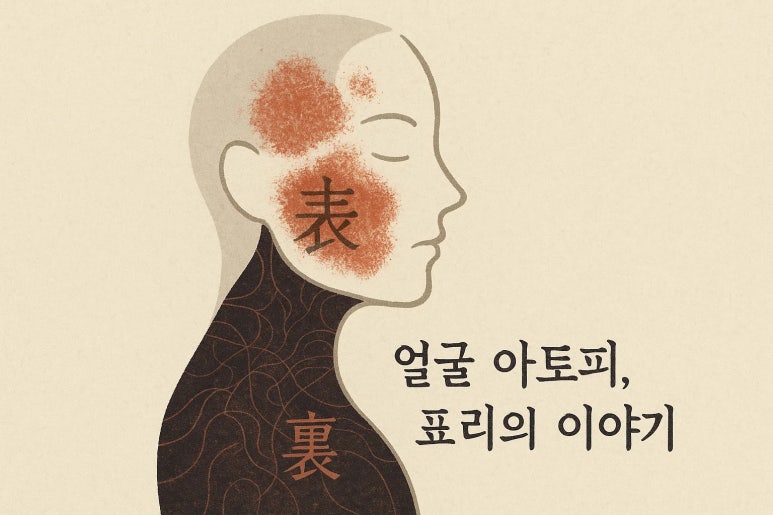
Facial Atopy in Your 30s: It's More Than Just a Skin Problem | Incheon Facial Atopy

| "Doctor, can this persistent facial atopic dermatitis truly be cured? Every time I look in the mirror, I cry. My social life is shrinking, and I'm afraid to meet people. Whatever I apply only helps temporarily, and it keeps flaring up." |
This is one of the stories I hear from many patients in my clinic.
Especially among women in their 30s, many express deep frustration and anxiety about their appearance due to facial atopic dermatitis.
The face is the most important area for expressing self-confidence, so the suffering is indescribable when itching and red inflammation repeatedly occur.
Facial Atopic Dermatitis: Why Does It Keep Flaring Up and Not Improving?
Many people consistently use ointments and moisturizers said to be good for the skin, but they repeatedly experience it improving for a short while, only to become red and itchy again with minor stress or environmental changes.
Whenever I hear these patients' voices, I emphasize that it's not simply a problem of the skin surface.
Three Key Factors Worsening Facial Atopic Dermatitis
Synthesizing the clues I've gathered in clinical practice, facial atopic dermatitis tends to arise and worsen due to a complex interplay of three factors:
1. Immune Imbalance: Our body's immune system overreacts, causing inflammation.
2. Stress: Chronic stress disrupts the immune system and further promotes inflammatory responses.
3. Impaired Skin Barrier Function: The barrier that should protect the skin from external irritants breaks down, allowing harmful substances to easily penetrate and moisture to rapidly evaporate.
These three factors interlock like gears, creating a vicious cycle of facial atopic dermatitis.
Facial Atopic Dermatitis from the 'Biao-Li' (Exterior-Interior) Perspective of Shanghan Lun
| What always amazes me when studying the classic Korean medicine text, 『Shanghan Lun (傷寒論)』, is its insight that even 2,000 years ago, it viewed the human body as a single organism. In 『Shanghan Lun』, the causes and progression of illness are explained by dividing them into 'Biao' (表) and 'Li' (裏). 'Biao' refers to the exterior, and 'Li' refers to the interior. |
Skin symptoms like itching and inflammation appearing on the face correspond to the 'Biao'.
However, a crucial perspective is that the problem in the 'Biao' doesn't simply originate from the 'Biao' itself, but rather begins from an imbalance in the 'Li' – that is, our body's internal environment.
It can be explained by drawing a parallel to the surface and bottom of a pond.
If the pond's surface (Biao) is dirty, simply removing the trash isn't enough; the pollutants at the bottom (Li) must be removed and the water flow changed for it to become fundamentally clean.
In other words, unless internal problems like immune imbalance, stress, and impaired skin barrier function – that is, the environment of the 'Li' – are changed, the facial atopic dermatitis symptoms appearing on the 'Biao' will inevitably recur endlessly.
Korean Medicine Treatment: Restoring the Skin's Self-Healing Power
So, how can we break this vicious cycle and change the 'Li'?
Korean medicine treatment doesn't simply focus on suppressing itching or calming inflammation.
We synthesize all clues – the patient's voice, skin color and warmth, digestive state, sleep patterns, etc. – to focus on restoring each individual's overall body balance.
Customized Prescriptions to Address the Body's 'Li'
When prescribing, I don't simply use herbs said to be good for atopic dermatitis; I focus on resolving the patient's 'Li' problems.
For instance, for individuals with excessive internal heat due to stress, I use herbs that reduce heat and calm the mind; for those with weakened immunity due to poor digestive function, I use herbs that strengthen gastrointestinal function to improve the internal environment.
By making the 'Li' healthy in this way, our body naturally regains its skin's self-healing power.
In clinical practice, I frequently observe that as the immune system achieves harmony, resistance to stress increases, and damaged skin barrier function gradually recovers, facial atopic dermatitis symptoms alleviate, and the recurrence rate also decreases.
| Patient A, a woman in her 30s whom I treated, was a similar case. She had developed social phobia due to chronic facial atopic dermatitis. However, with Korean herbal medicine treatment to resolve 'heat-toxin' (熱毒) and improve digestive function, along with lifestyle adjustments, she made significant progress. After a few months, the redness and itching on her face noticeably reduced, and most importantly, I still vividly remember how brightly Ms. A smiled, saying, "Now I have the courage to look in the mirror again!" |
Facial atopic dermatitis is by no means a suffering you have to endure alone.
If you are someone exhausted by recurrent skin problems, I encourage you now to listen to the story of your body's 'Biao-Li' (exterior-interior), beyond the visible symptoms.
I sincerely hope that a bright smile will blossom again on the faces of all those who step forward to become the agents of their own recovery.