

My stomach often hurts, chronic stress-related abdominal pain in a woman in her 20s

Table of Contents
- When Stress is Added to an Already Weak Gut
- “My digestive system has always been a bit weak. Whenever I get stressed, my stomach cramps intensely. Even after going to the restroom, I don't feel completely relieved.”
- Antispasmodics, Probiotics, Antidepressants: Why Did Every Attempt Fail?
- The Decisive Testimony: 'My Stomach Hurts Because I'm Anxious'
- “After thinking about it carefully, I realized that before my stomach starts to hurt, I always first feel a tightness in my chest and a sense of anxiety.”
- The Exhausted Musicians (Spleen-Stomach) and the Passionate Conductor (Liver)
- The Wisdom of Encouraging the Musicians and Calming the Conductor
When Stress is Added to an Already Weak Gut
A woman in her late twenties,
She had an important interview approaching.
However, the real battle wasn't happening in the interview room, but within her own body.
“My digestive system has always been a bit weak. Whenever I get stressed, my stomach cramps intensely. Even after going to the restroom, I don't feel completely relieved.”
Her body was like an orchestra.
Normally, the string section (digestive system) wasn't in very good condition,
and with an important performance approaching, the conductor (emotions) became extremely sensitive,
causing the entire orchestra to begin playing a precarious dissonance.
Antispasmodics, Probiotics, Antidepressants: Why Did Every Attempt Fail?
Her treatment journey over the past two years was a series of desperate attempts to silence this dissonance.
The first attempt was with an antispasmodic/gastrointestinal motility regulator, Foributin (containing trimebutine maleate).
When she took the medication, the cramping pain temporarily subsided.
However, what remained in the absence of pain was not comfort,
but the anxiety of 'when will it hurt again?' and a persistent feeling of bloating and discomfort.
To compare it to an orchestra,
it was like forcibly stopping the bows of violently vibrating string instruments.
The loud dissonance paused momentarily,
but since the conductor's passionate conducting didn't stop,
the musicians merely maintained a precarious silence, ready to unleash noise again at any moment.
The second attempt was probiotics.
It was like an effort to replace the worn-out, creaking bows of the string instruments with new ones.
However, since the sheet music given to the musicians was already chaotic,
good instruments made little difference.
The final attempt was a low-dose antidepressant.
This was like subtly spraying a calming agent throughout the concert hall.
However, it failed to quell the storm raging within the conductor's mind,
nor could it rouse the exhausted musicians (digestive system).
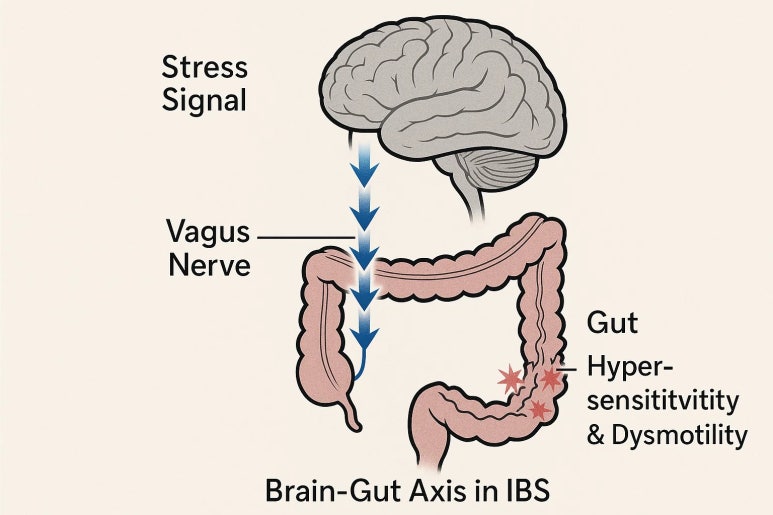
The Decisive Testimony: 'My Stomach Hurts Because I'm Anxious'
At that time, when all attempts had failed,
a single statement from her completely changed the direction of the inquiry.
“After thinking about it carefully, I realized that before my stomach starts to hurt, I always first feel a tightness in my chest and a sense of anxiety.”
This was the decisive clue.
While most people say, 'I'm anxious because my stomach hurts',
she testified, 'My stomach hurts because I'm anxious'.
She herself revealed that the problem's origin wasn't with the musician (intestines),
but with the 'conductor (brain/emotions)'.
The Exhausted Musicians (Spleen-Stomach) and the Passionate Conductor (Liver)
The complete disarray of this orchestra
was clearly revealed under the diagnosis of 'Spleen Qi Deficiency accompanied by Liver Qi Stagnation (脾氣虛 兼 肝氣鬱結)'.
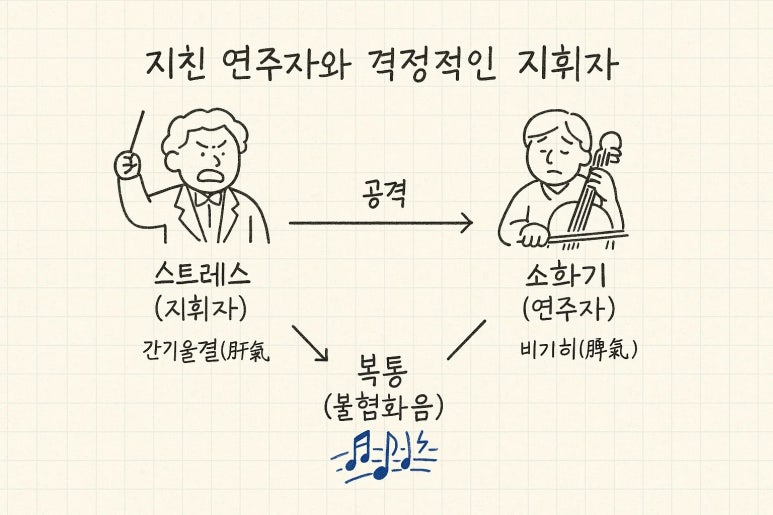
This was neither solely a problem of the 'conductor' nor solely a problem of the 'musicians'.
It was a situation where the 'exhausted musicians (Spleen-Stomach weakness)', who inherently had weak basic physical constitutions and old instruments,
were being harshly driven by the 'passionate conductor (Liver Qi stagnation)', who was overwhelmed by the pressure of the job search stage.
The conductor's anxiety was exploding at the musicians' weak points
as a dissonance of pain.
The Wisdom of Encouraging the Musicians and Calming the Conductor
The solution, then, is clear.
Both the conductor and the musicians,
not just one, but both, must be cared for simultaneously.
The wisdom of the prescription used in Korean traditional medicine for such a situation,
called 'Hyangsaryukgunja-tang (Xiangsha Liujunzi Tang, 香砂六君子湯)', lies precisely in this.
The treatment consists of two steps.
First, a chief tuner boosts the vitality (ginseng, white atractylodes) of the exhausted string musicians,
and fragrantly warms the damp and cold air of the concert hall (Amomum fruit)
creating an environment for them to recover to their optimal condition.
Second, simultaneously, a sub-conductor calms the agitated conductor (Cyperus rhizome)
and helps them regain the rhythm of their baton.
As the musicians regain their strength and the conductor finds stability,
the entire orchestra finally recovers its harmonious sound.
In this way, inexplicable abdominal pain
can be a distress signal from the exhausted musicians of your body,
and a scream from an anxious conductor.
Only by listening to both of their voices together can the performance of pain finally cease.