
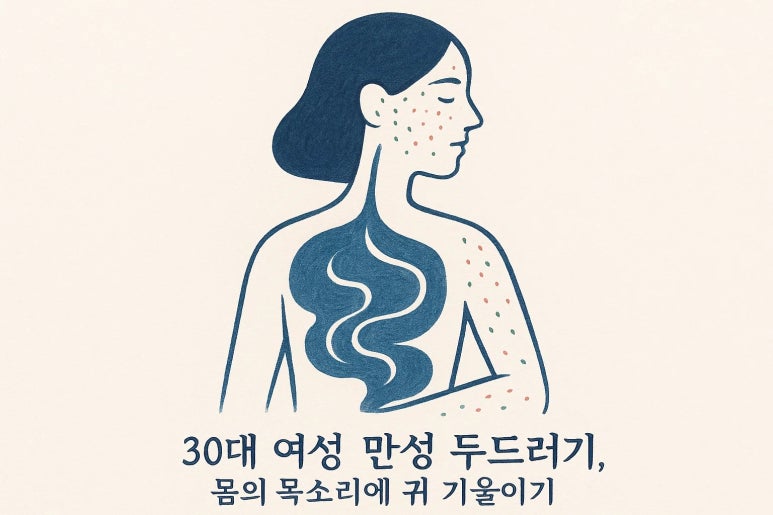
I scratched all night and couldn't sleep, making the next day so tough | Incheon Hives

Among the many patients I see in my clinic, a significant number suffer specifically from evening hives.
| "I'm fine during the day, but as soon as night falls, my body feels like it's on fire and itches like crazy." |
| "I hardly sleep because I'm scratching all night, and the next day is so difficult." |
Every time I hear stories like these, my heart feels heavy.
Why on earth do hives appear in the evening, not during the day, and why do they keep recurring so persistently?
Can we simply view this as just a superficial skin problem?
Based on my observations through countless clinical cases, and in comparison with insights from classical medicine, chronic skin hives often signal deeper changes within our bodies.
| Ms. A, a woman in her 30s who recently visited me, was a similar case. She reported that for over a year, hives would appear all over her body every evening, preventing her from sleeping properly. Although the medication prescribed by the dermatologist seemed to calm them down temporarily, she was exhausted by the relentless recurrence as soon as the effects wore off. Ms. A specifically mentioned that her symptoms worsened when she had an important presentation coming up or when her daily rhythm was disrupted by working late. She also said she often suffered from indigestion and frequent abdominal gas. |
Listening to Ms. A's story, I instinctively knew that her hives were not just a skin problem, and I recognized it as one of the long-standing patterns I've seen countless times in my clinical notes.
Classical medicine has long emphasized the deep connection between the body's 'internal environment' and skin symptoms. What subtle changes might have been accumulating within Ms. A's body during the day?
Stress from work life, digestive dysfunction due to irregular meals and late-night snacks, and work extending late into the night would have gradually disrupted Ms. A's internal bodily environment.
Our bodies are like a complex city road network. During the day, various activities can lead to heavy traffic and congestion. Stress or unhealthy lifestyle habits are like the fatigue that accumulates in this road network. In particular, the autonomic nervous system is like a control tower regulating our body's traffic flow, and stress and irregular lifestyles can disrupt this control tower's system. During the day, our bodies relatively effectively cope with external stimuli and stress, maintaining a state of tension. However, when night falls and the body begins to relax, the release of imbalances and tensions suppressed during the day often leads to an excessive physical response.
Just like a dam breaking. I interpret evening hives as a phenomenon where imbalances in the internal environment accumulated during the day and autonomic nervous system dysfunction are amplified during the evening when the body relaxes. At this time, the skin acts as a 'window' expressing internal chaos externally. As the balance of the autonomic nervous system, which was excessively tense during the day, is disrupted, the skin's microvessels and nerve endings become oversensitive, excessively stimulating a localized skin immune response, which then manifests as unbearable itching and rashes.
So, why has it been so difficult for existing treatments to break this persistent cycle of recurrence? Most treatments focus on rapidly suppressing the existing hive symptoms. While they can put out the immediate fire, if the underlying cause of water continuously filling the body's dam isn't addressed, it will inevitably break again.
The herbal medicine treatment I pursue begins precisely at this point. Beyond merely soothing the skin, it aims to improve the body's environment itself by delicately adjusting the internal imbalances caused by accumulated stress, digestive dysfunction, and autonomic nervous system disruption during the day, much like Ms. A's case. It calms the stomach and intestinal functions to enhance the body's waste processing ability and stabilizes the excited autonomic nervous system, helping the body regain its balance naturally. This is like cultivating barren land to make it fertile, allowing healthy crops to grow. It's not just about planting seeds, but about changing the quality of the soil to create an environment where crops can grow healthily on their own.
As the body's internal environment gradually improves in this way, oversensitive skin immune responses also normalize. The skin no longer reacts sensitively to minor stimuli, and the cycle of hives slowly loses its power. This leads to true long-term recovery, not just short-term symptom suppression.
| Evening hives are a very important signal sent by our bodies. Are you, too, wrestling with inexplicable itching every evening? The journey to recovery can begin by listening to your body's internal environment, rather than just your skin. Even if it's not with me, I sincerely recommend that you seek out medical professionals who can carefully examine your entire body and help you discover the root cause. I hope your nights are no longer marred by itching. |