A Child Making “Um-um” Sounds and Unable to Concentrate on Class | Incheon Vocal Tic

Table of Contents
- In 《Donguibogam》, it says \"Generally, a person’s Liver (肝) governs Qi (氣) to regulate communication, and Heart (心) governs Spirit (神) to stabilize mind.\" In other words, if Liver-Qi is lumped (Liver-Qi stagnation) due to emotional tension and stress, this can hypersensitize the nervous system and become a `vocal tic cause`, inducing anxiety and irritation. Also, if Heart-Yin (心陰) is insufficient due to lack of sleep and excessive activity, the energy stabilizing the spirit weakens, so attention concentration can drop and one can show an unstable look.
- Could you also be feeling stifled watching your child’s tic and distraction worsen?
A Child Making “Um-um” Sounds and Unable to Concentrate on Class, Could It Be the Nervous System’s Scream?
This is the story of A, a mother of a 12-year-old boy.
The child’s vocal tic (`vocal tic`) was natural enough that we didn’t know when it started, but recently she received feedback from the school teacher that \"he cannot concentrate during class and is distracted.\" She found out that the child’s attention concentration item was level 4 out of 10.
\n\n| \n Since the child is sensitive, tic symptoms worsened in weeks when there were minor quarrels with friends or more academies and assignments. Particularly, days when he couldn’t sleep well at night became frequent. She received prescription for methylphenidate-based psychotropic drugs from the hospital, but the mother is hesitating due to anxiety about giving such medicine to the child. \n |
Do you also have such experience?
Have you ever dismissed the child’s tic and attention problem (`child attention problem`) simply as a ‘habit’ or a ‘matter of will’? This is an approach focusing only on symptoms revealed on the outside. In Korean medicine, tics are interpreted not as a simple behavioral problem but as an ‘internal imbalance signal’ sent by the body and mind.
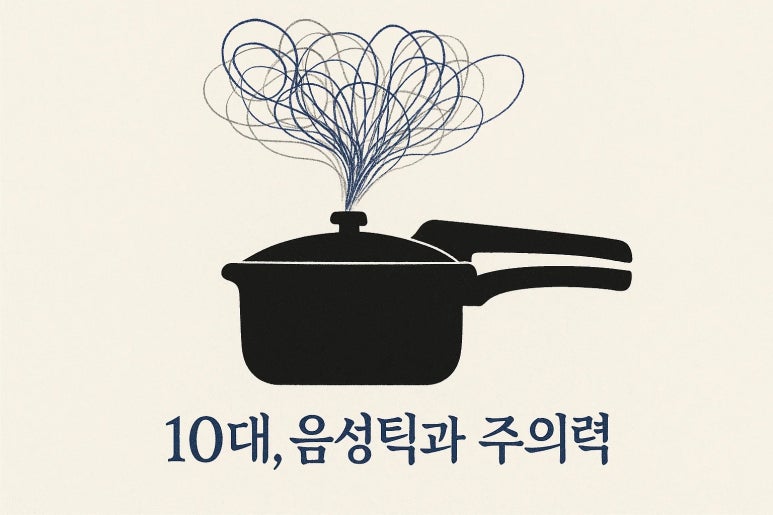
This is like a pressure cooker before explosion. No matter how much you try to suppress and lock it from the outside, if the pressure accumulated inside is not relieved, it eventually ejects steam (tic, distraction) through another hole. In fact, there is a case where a tic of blinking eyes newly appeared when the child was told to suppress the tic forcibly.
\n\n| \n Then, what is the true cause? \n |
Korean medicine focuses on relieving fundamental body imbalance inducing the symptom instead of suppressing symptoms revealed on the outside.
In 《Donguibogam》, it says \"Generally, a person’s Liver (肝) governs Qi (氣) to regulate communication, and Heart (心) governs Spirit (神) to stabilize mind.\" In other words, if Liver-Qi is lumped (Liver-Qi stagnation) due to emotional tension and stress, this can hypersensitize the nervous system and become a `vocal tic cause`, inducing anxiety and irritation. Also, if Heart-Yin (心陰) is insufficient due to lack of sleep and excessive activity, the energy stabilizing the spirit weakens, so attention concentration can drop and one can show an unstable look.
These two symptoms (`tic disorder`) may eventually be ‘branches’ coming from one root of nervous system hypersensitivity stemming from stress and lifestyle imbalance.
This also touches upon the etymology of the word ‘neurasthenia’ we commonly use. It means that the nerve is worn out, and is an old term explaining lethargy or hypersensitivity revealed on the outside.
Herbal medicine treatment is not simply suppressing nervous excitement, but a principle of relaxing lumped Liver-Qi and supplementing insufficient Heart-Yin to stabilize the nervous system. This is the core of Korean medical treatment for tic disorder.
Could you also be feeling stifled watching your child’s tic and distraction worsen?
This problem is by no means the parents’ responsibility. The first step to solve this problem starts from a new perspective and deep understanding of vocal tic treatment.
\n\n| \n [Key Takeaways]
|