
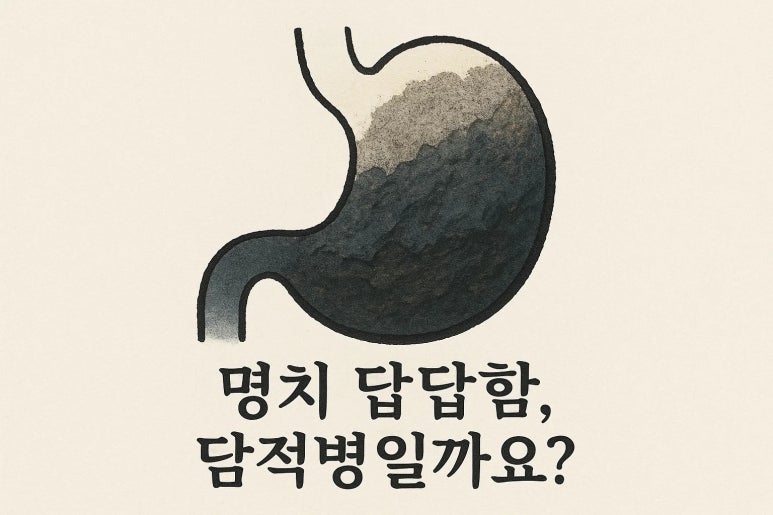
Good Foods for Damjeok Disease

Do you ever feel a tight, stuffy sensation at the pit of your stomach, constant bloating, and sometimes even epigastric pain?
Among the patients I see in my clinic, women aged 40 and over particularly often struggle with these chronic indigestion symptoms.
There may also be people wondering if this discomfort, which isn't resolved by simply taking digestive aids or adjusting meal portions, might actually be 'Damjeok-byeong' (Phlegm-Retention Disease).
Today, I'd like to explore the Traditional Korean Medicine (TKM) principles of Damjeok-byeong together and share wisdom on dietary management that can bring comfort to your upset stomach.
---
Damjeok-byeong: More Than Just Simple Indigestion
Many people, when experiencing indigestion, often think it's simply 'due to a weak stomach.'
However, Damjeok-byeong goes beyond simple gastrointestinal functional decline; it is closer to a systemic syndrome caused by waste products accumulated deep within our bodies.
In Traditional Korean Medicine, the turbid and sticky waste products generated from undigested food are called 'Dam (痰)', or phlegm.
When this Dam accumulates and hardens on the gastrointestinal mucosa or outer wall, it is called 'Damjeok (痰积)', or accumulated phlegm, much like muddy water accumulating and hardening in an old dam.
This hardened Damjeok not only obstructs normal stomach movement but also spreads throughout the body via blood circulation, causing a variety of symptoms.
Even in the classical medical texts I study, the importance of Dam was emphasized to the extent that it's stated 'Sibbyeonggudam (十病九痰)', meaning nine out of ten diseases are related to phlegm.
| "My stomach never feels comfortable. My head doesn't feel clear, and my shoulders always feel like rocks. I can't sleep deeply either." |
These were the words shared with me by a patient in her late 40s.
Like this patient, Damjeok-byeong is often accompanied by headaches, dizziness, chest tightness, neck and shoulder stiffness, chronic fatigue, and even anxiety or depression, in addition to gastrointestinal symptoms.
The close connection between our body's gut and brain (the gut-brain axis) means that gastrointestinal problems can affect mental health, a fact increasingly being revealed in modern medicine.
---
'Seonyeong (Pseudonym)'s Story: Like a Dam Blocked Within the Body

| Seonyeong (pseudonym), in her mid-40s, had suffered for over 10 years from chronic indigestion, abdominal distension, and epigastric pain. She constantly felt bloated, wanting to loosen her belt after meals, and on highly stressful days, she even experienced sharp, piercing pain in her epigastrium. At night, discomfort in her stomach made it difficult to sleep deeply, leading to chronic fatigue and increased irritability, which she said significantly reduced her quality of life. She underwent various tests at different hospitals but was told no specific organic issues (organ damage) were found, which left her feeling frustrated. When I palpated Seonyeong's (pseudonym) abdomen, I clearly felt a hardened, knotted sensation (induration/mass-like stiffness) in her epigastrium and several areas of her upper abdomen. These symptoms and palpation findings are key clues for Damjeok-byeong. Through examination, I diagnosed Seonyeong (pseudonym) with Damjeok (accumulated phlegm) that had formed due to weakened gastrointestinal function and had accumulated over a long period. |
As in Seonyeong's (pseudonym) case, Damjeok does not merely remain in the stomach.
Chronic Damjeok obstructs the circulation of our body's Jin-aek (body fluids) and is also related to Eo-hyeol (stagnant blood/blood stasis), leading to a variety of systemic symptoms.
| The key pathway for Damjeok-byeong development begins with impaired digestive function. Irregular eating habits, overeating, and stress weaken gastrointestinal function, which causes undigested food residues to linger in the stomach, transforming into turbid and sticky 'Dam' (phlegm). When this generated Dam accumulates on the gastrointestinal mucosa or outer wall over a long period and gradually hardens, 'Damjeok' (accumulated phlegm) is finally formed. This hardened Damjeok obstructs gastrointestinal movement and spreads throughout the body via blood circulation, causing various symptoms such as headaches, shoulder stiffness, fatigue, and anxiety. |
Ultimately, healing Damjeok-byeong goes beyond simply suppressing outwardly uncomfortable symptoms; it is a process of resolving the accumulated Damjeok within the body and fundamentally restoring gastrointestinal function.
---
The Start of Damjeok-byeong Healing: Proper Dietary Management

Herbal medicine and acupuncture play an important role in treating Damjeok-byeong.
However, I always emphasize to my patients that 'dietary management' is indeed the first step towards becoming an active participant in one's recovery.
Because our bodies are built from the food we consume.
So, how should one begin dietary management to help with Damjeok-byeong?
| When patients with Damjeok-byeong begin dietary management, I suggest three basic principles. First, eat 'soft and warm' foods. Reducing the digestive burden is paramount. Second, eat 'slowly, in small portions'. You must give your stomach enough time to digest. Third, eat 'at regular times'. This helps stabilize your body's digestive rhythm. |
Foods Beneficial for Damjeok
Foods beneficial for Damjeok should generally be warm and soft. Porridge, white rice, easily digestible brown rice, boiled vegetables like zucchini, radish, and cabbage, or boiled lean meats like chicken breast and white fish are good choices. For fermented foods that aid digestion, well-fermented pastes like Doenjang (soybean paste) and Cheonggukjang (fermented soybean paste) are recommended, but excessive sodium intake should be avoided. To protect the gastric mucosa, cabbage, cooked broccoli, and potatoes are beneficial, and hydration through warm water, ginger tea, or plum tea helps digestion and promotes the discharge of phlegm.
Foods to Avoid That Worsen Damjeok
| When suffering from Damjeok-byeong, it is advisable to avoid or reduce intake of foods that place a heavy burden on digestion and can accelerate Damjeok formation, such as cold foods, flour-based foods, instant foods, fried foods, excessively spicy and salty stimulating foods, caffeinated beverages, alcohol, and carbonated drinks. In particular, since there is significant individual variation with meats and dairy products that are difficult to digest, it is important to consume them in small quantities and observe your body's reaction. |
Dietary management goes beyond simply choosing foods; it is a process of carefully observing how your body reacts to different foods.
Just as you would cultivate a small garden, wisdom is needed to consider which seeds (foods) to plant to grow healthy crops (a healthy body).
---
The Wisdom of Listening to Your Body
Just as Damjeok-byeong didn't appear in an instant, recovery also requires consistent effort and patience.
In addition to the dietary management I've discussed today, regular exercise, sufficient sleep, and stress management are also very important factors in restoring gastrointestinal function and resolving Damjeok.
I sincerely hope that rather than simply being dragged along by symptoms as a 'patient', you will, as the master of your own body, continue to make beneficial choices for yourself.
The journey of exploration itself – figuring out what foods suit your body and what lifestyle habits make you more comfortable – is the process of healing.
If this journey feels too difficult or daunting to undertake alone, please seek help from a medical professional who can carefully examine your entire body, even if not me.
I hope that many people suffering from Damjeok-byeong can escape the bloated and stuffy feeling and regain a comfortable and vibrant daily life.
Until the day your stomach feels comfortable, I will be with you.