
Why Your Diet Hit a Plateau — A Korean Medicine Doctor Explains

Table of Contents
Ji-su Lee (pseudonym, 43, office worker) came in frustrated. Two weeks in, the scale had not budged.
"Doctor, I am eating the same and exercising the same — but nothing is happening. Am I doing something wrong?"
I completely understand that feeling. You are clearly putting in the work, yet your body refuses to respond. This is called a diet plateau, and it is not about willpower. Your body has simply started defending itself.
What Is a Diet Plateau
When you start a diet, weight drops quickly at first — 2 to 3 kg in the first few weeks for many people. Then, suddenly, nothing. This is called adaptive thermogenesis: your body senses an energy deficit and responds by lowering your basal metabolic rate (BMR). In plain terms, it shifts into energy-saving mode.
Research shows that after 6 months of caloric restriction, BMR can drop by an average of 10 to 15 percent. The “eat less, lose more” formula stops working because your body has recalibrated.
The Korean Medicine Perspective
In Korean medicine, a plateau is often understood as Bi-heo (脾虛) — a weakening of the Spleen system, which governs digestion, nutrient absorption, and metabolic energy. When you under-eat, over-exercise, or stay chronically stressed, the Spleen qi declines and metabolism slows further.
Many patients in plateau also show signs of Gi-heo (氣虛) — general qi deficiency — which signals the body to conserve rather than burn. Ji-su mentioned she had been exhausted lately. That was exactly why.
Three Ways to Break Through
1. Temporarily eat more. Counterintuitive, but it works. A 2 to 3 day refeed — increasing carbohydrates by about 30% — sends the signal that food is available again, nudging your BMR back up.
2. Change your exercise pattern. Your body adapts to repeated stimuli. If you have been doing 40 minutes of steady cardio, try mixing in high-intensity interval training (HIIT) or increasing strength work. More muscle mass raises resting metabolism over time.
3. Prioritize sleep and stress management. High cortisol (the stress hormone) suppresses fat breakdown and promotes abdominal fat storage. Seven hours of sleep per night is not optional.
How Korean Herbal Medicine Can Help
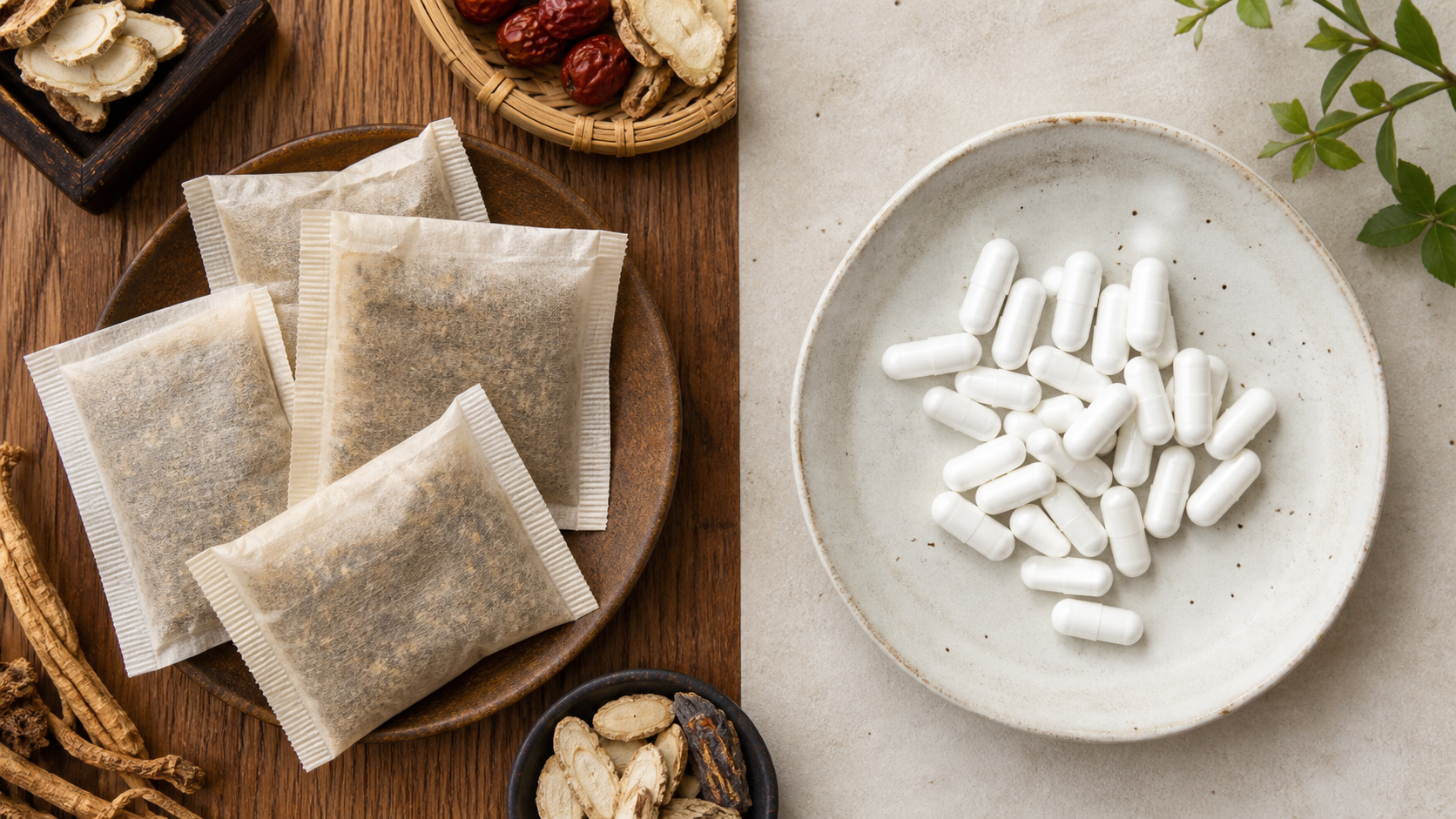
Herbal formulas for plateaus target Bi-heo and Gi-heo simultaneously, helping restore metabolic function rather than just suppressing appetite. At Baekrokdam, we use Baekrok Gam-bi-jeong (白鹿減肥錠) — a personalized prescription based on your individual constitution and current condition. For patients in plateau, the focus is on restoring Spleen-Stomach (脾胃) function to restart the metabolism.
Ji-su completed four weeks of herbal treatment and lost an additional 2.8 kg after breaking through her plateau.
FAQ
Q. How long does a plateau typically last?
Usually 2 to 4 weeks. With the right interventions you can break through within 2 weeks. Without any response it can drag on much longer.
Q. Should I just exercise more during a plateau?
Not necessarily. Changing the type of exercise is more effective than simply adding volume. Overloading an already fatigued body raises cortisol and can backfire.
Q. Can I consult remotely about a plateau?
Yes. Baekrokdam offers online consultations nationwide. After a detailed intake questionnaire, we create a personalized herbal prescription and ship it to you. → Book a remote consultation
References
· Leibel RL, Rosenbaum M, Hirsch J. Changes in energy expenditure resulting from altered body weight. N Engl J Med. 1995;332(10):621-628.
· Rosenbaum M, Leibel RL. Adaptive thermogenesis in humans. Int J Obes. 2010;34 Suppl 1:S47-55.