
The Difference Between Hives and Rash | Incheon Hives

Different Itch? The Difference Between Hives and Rash, A Key Guide
When I see patients in my clinic, they often feel a great deal of confusion and anxiety due to something that has appeared on their skin.
"Doctor, is this urticaria or a rash? It keeps coming and going..." they ask me.
Although they may look similar on the surface, urticaria (hives) and rash convey different signals from our body.
Accurately understanding this difference reduces unnecessary worry and is crucial for a quick recovery with the right approach.
Today, based on my experience observing and interpreting cases in clinical practice, I will clearly explain the key differences between these two skin conditions.
Shall we begin your journey to skin health recovery together?
Urticaria (Hives), Why Does It Appear Suddenly?
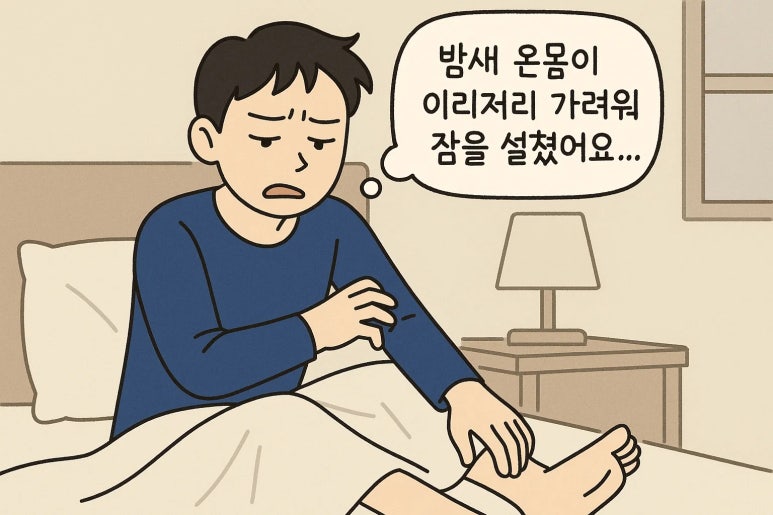
Urticaria (hives) is a skin condition that appears suddenly like a passing shower and then vanishes without a trace.
“Suddenly my body feels hot, it swells red and itches intensely, then disappears completely after a few hours,” patients explain.
The first clue I pay attention to regarding the difference between urticaria and rash is the characteristic of the itch.
The itch of urticaria is very intense and has a ‘migratory’ quality, moving from one part of the body to another.
It doesn't stay in one place, but appears and disappears unpredictably, like leaves carried by the wind.
| “Suddenly in the early morning, it started on my legs and spread all over my body, but an hour later, only my arms were itchy, and my legs were fine. Then another area would start itching again. I barely slept all night.” |
The form of urticaria is primarily characterized by red, swollen marks called ‘wheals’.
Their size varies from small, coin-sized ones to large patches spreading across the palm of the hand.
These wheals have relatively clear borders and are characterized by temporarily turning white when pressed, then reddening again.
The duration is usually within 24 hours, often disappearing within a few minutes.
If urticaria recurs almost daily for more than 6 weeks, it is diagnosed as chronic urticaria, requiring a more in-depth approach.
The causes are most commonly allergic reactions to foods, medications, or insect bites, but also include many physical factors such as temperature changes, sunlight, pressure, and stress.
It's best understood as a sudden hypersensitive reaction of the body.
Rash, What Does It Look Like?
On the other hand, a rash is more like an ‘extended guest’.
“For several days now, the inside of my arm has been continuously red and bumpy, and it's itchy. Even if I apply ointment, it's only a temporary fix....” This is a typical description from patients.
The characteristic of the itch in a rash is not as explosive as urticaria, but is persistently and ‘localized’.
A specific area consistently itches and tends to become redder or rougher when scratched.
| Among female patients in their 30s, there was a case where only the inner wrists and elbow creases developed red, small bumps, and scratching led to the skin gradually thickening and even hyperpigmentation. The symptoms were concentrated only in those areas, rather than feeling like they were spreading throughout the body. |
The form of rash is highly diverse, unlike the wheals of urticaria.
It can manifest in various forms such as red patches (erythema), small blisters (vesicles), crusts, scales, or lichenification (skin thickening).
The duration typically lasts from several days to several weeks, or even several months or more.
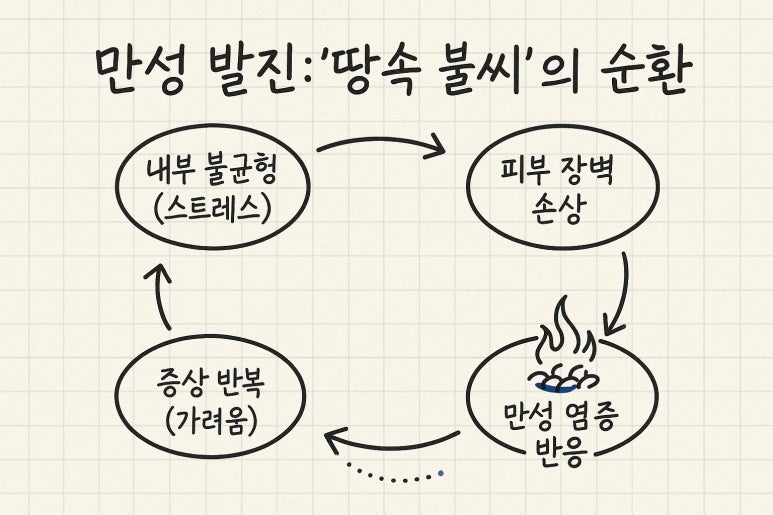
Since this is an inflammatory skin reaction caused by external stimuli or specific diseases, it will not easily disappear without efforts to understand and resolve its cause and context.
The causes are very broad, including atopic dermatitis, contact dermatitis, eczema, scabies, fungal infections, and viral diseases.
Various causes can act in combination, from simple irritation to underlying immune imbalance.
Hives and Rash: The Eye to Discern Key Differences
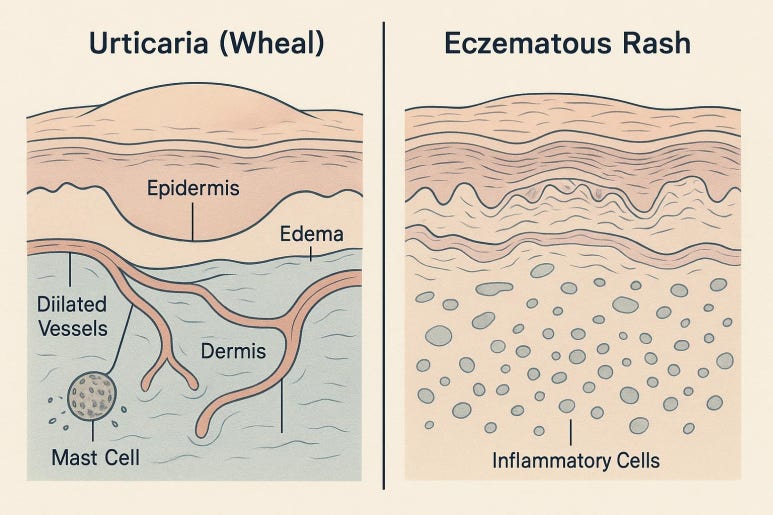
Now, let's look at the key differences between these two skin conditions as if we're organizing them into a table.
This will help you develop your ‘skin detective’ eye.
Itch Characteristics:* Urticaria is intense and migratory, like fire spreading from place to place. A rash is persistent and localized; it's an itch that feels ‘stuck’ to a specific spot.
Rash Type/Morphology:* Urticaria is characterized by red, swollen ‘wheals’; these marks turn white when pressed. A rash has highly diverse forms, including red patches, papules (small, bumpy protrusions), blisters, and crusts.
Duration:* Urticaria typically appears and disappears within 24 hours; it's a visitor that comes and goes ‘like lightning’. A rash tends to persist for several days to several weeks or longer.
Causes:* Urticaria often involves acute reactions to specific allergens, physical stimuli, or stress. A rash is more deeply related to underlying causes such as infections, irritation, or chronic skin conditions (e.g., eczema).
| “My child always scratches the creases of their arms every night because it's itchy. It doesn't come and go like urticaria; they keep scratching the same spot, and the skin is becoming bumpy.” This description is typical of a rash. |
Thus, if urticaria is an ‘allergic shower’, a rash can be likened to a ‘smoldering ember beneath the surface’.
Wise Response to Your Body's Signals
So, once you've identified whether the skin issue on your body is urticaria or a rash, how should you respond?
The most important thing is to open your eyes to ‘observation’ instead of ‘confusion’.
First, to accurately identify symptoms, recall the four key differences I've explained.
It's helpful to carefully record when it started, where it's most itchy, what shape it takes, and how long it lasts.
If it's urticaria:* The priority is to identify and avoid the triggers.
Calming the affected area with a cold compress or taking an antihistamine from the pharmacy can be the correct initial response.
Most cases subside quickly, but if systemic symptoms such as shortness of breath or dizziness accompany it, you must visit the emergency room immediately.
If it's a rash:* It's important not to scratch indiscriminately and to avoid irritating the skin.
Apply a gentle moisturizer generously to protect the skin barrier, and it's advisable to choose soft fabrics for your clothing.
Most importantly, since a rash requires finding and resolving the underlying problem, it's wise to consult a specialist for an accurate diagnosis and treatment plan rather than struggling alone.
There's something I always emphasize to patients in my clinic.
“The skin is like an honest mirror on the outermost part of our body. The visible skin itch or skin symptoms can be a signal that our body's internal balance is disturbed.”
Whether it's urticaria or a rash, instead of just rushing to scratch it away, we need an attitude that listens and tries to understand why these signals have appeared.
You yourself are the agent of your skin health recovery.
I sincerely hope that by understanding your symptoms and responding wisely, and seeking help from medical professionals like me when needed, you can regain healthy skin.
Don't struggle alone. We can find a way together.