
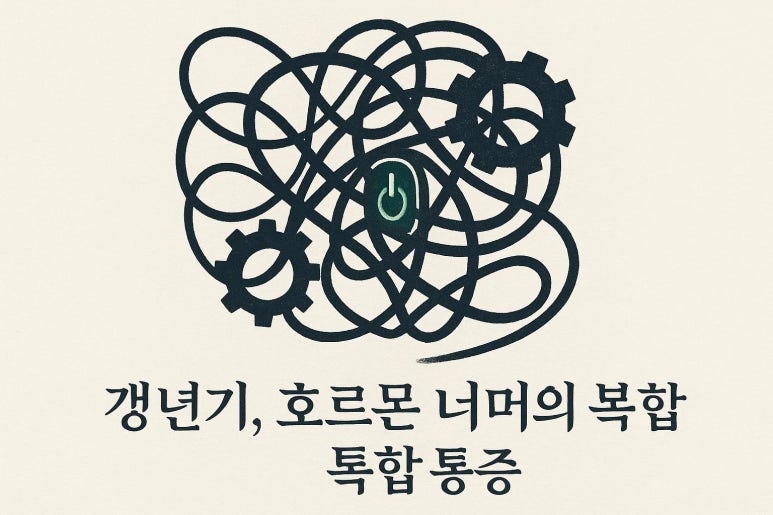
Menopause Symptoms: Understanding the Story Beyond Hormones | Menopause

“Director, I think I’m going through menopause lately.
My body aches all over, and I can’t sleep well.
I’m becoming irritable for no reason, and I feel so sorry for my family.”
Seon-young (pseudonym), in her mid-40s, confessed with a sigh as she entered the consultation room.
Whenever I hear such stories, I listen closely to read the complex hearts of my patients.
Menopause is a natural period that every woman goes through, but menopausal symptoms vary so much from person to person that many are confused, asking, “Am I in menopause?”
In particular, they can feel overwhelmed by changes that aren’t easily visible on the surface, such as autonomic hyperarousal (a state where the body’s tension switch is stuck in the "on" position) or edema (swelling).
I, Choi Cheol-woo, focus on untangling the patient’s loop by reading the trapezius muscle, cervical structure, autonomic rhythms, sleep/stress, and edema together.
Let’s take some time together to interpret which parts of your body are tensed and how within the large flow called menopause.
Menopause Symptoms: Reading the Story Beyond Hormones
\n\n
| \n “My chest feels tight, and the back of my neck is always stiff. I often wake up at night drenched in cold sweat. I feel like I might explode if someone even touches me.” “My friends say everyone is like this when they reach menopause, but it’s so hard for me. Could these all be early symptoms of menopause?” “The hospital says there’s nothing specifically wrong, but I’m still in pain.” \n |
Many patients make these complaints as they enter menopause.
It is far too diverse a set of discomforts to be dismissed as simply being due to hormonal changes.
I view these symptoms as often arising from the interaction between our body’s structure (trapezius tension) and environment (sleep, stress, edema).
Trapezius tension is not just a problem for the neck and shoulders; it serves as an important indicator showing the overall balance state of our entire body.
The Loop of Menopausal Pain Manifesting as "Trapezius Tension"

| \n Mi-jeong (pseudonym), in her late 40s, experienced severe shoulder stiffness along with head fogginess and dimming vision due to menopause a few months ago. Especially before falling asleep, she found it difficult to get a good night’s rest because of a feeling of heaviness and stuffiness throughout her body. Hospital examinations showed no specific abnormal findings, but it caused significant disruption to her daily life. Upon examination, chronic tension around the upper trapezius (the muscle connecting the shoulders and neck) was severe, and the alignment of her cervical spine (neck bones) was unstable. Her autonomic nervous system balance was also disrupted, making it difficult to fall asleep at night, and she tended to wake up with a heavy, swollen body in the morning. As in Mi-jeong’s case, it is common for early symptoms of menopause to appear in such complex patterns in menopausal women. \n |
Cases like Mi-jeong’s clearly show how menopausal hormonal changes can shake the rhythm of the entire body.
Estrogen is deeply involved not only in reproductive function but also in various systems of our body, particularly the autonomic nervous system and water metabolism.
When hormonal changes occur before and after menopause, the autonomic nervous system becomes sensitive, causing the body’s tension switch to be easily turned on by even small stimuli, which can easily lead to trapezius tension.
Furthermore, changes in water metabolism cause body edema (swelling), which obstructs lymphatic circulation and can further exacerbate the stiffness in the neck and shoulders.
As all these processes intertwine, they lead to chronic pain and fatigue.
\n\n| \n Menopausal symptoms are a phenomenon in which our body’s structure and environment interact in a complex way. First, the decrease in estrogen disrupts the delicate balance of the autonomic nervous system, putting the body in a state where the tension switch is turned on more easily than usual. When body tension increases due to this autonomic hyperarousal, the muscles of the cervical region (neck and shoulders), including the trapezius, easily become rigid. This can feel like shoulders drooping heavily as if a heavy garment were placed on a hanger, making it always feel stiff and uncomfortable.In a state where the tension switch is on, it becomes difficult to fall asleep at night and one becomes vulnerable to daily stress. If sleep quality drops, the body’s recovery power also declines, leading to a more sensitive reaction to pain. Additionally, estrogen is deeply involved in water metabolism in the body; if micro-edema occurs due to hormonal changes, it obstructs blood circulation and lymphatic drainage around the neck and shoulder tissues, further exacerbating stiffness and discomfort. In this way, hormonal changes, autonomic tension, lack of sleep, stress, and edema—all these elements negatively affect each other, creating a vicious cycle in which pain induces more pain and fatigue deepens fatigue.We believe that clearly understanding and breaking this complex loop through appropriate intervention is the key to managing menopause. \n |
Menopause: A Time to Reclaim the Balance of Body and Mind

Understanding these complex menopausal symptoms is more important than anything else.
However, it can be dangerous to judge everything based solely on a menopause self-diagnosis.
This is because even if symptoms are similar, the causes can be different, and the necessary management methods can also vary.
Small efforts in daily life that reduce the burden on the body and increase recovery power can be of great help in managing menopausal symptoms.
\n\n| \n Here are some tips for managing menopausal symptoms in daily life. First, consistently try light stretching for about 10 minutes a day to gently loosen the neck and shoulders. This is very helpful for relaxing hardened trapezius muscles and promoting blood circulation. Second, it is important to establish regular sleep habits by maintaining consistent bedtimes and wake-up times. A stable biorhythm is one of the most important factors for increasing body recovery power and maintaining autonomic balance. Third, sufficient water intake—especially the habit of frequently drinking lukewarm water—is highly beneficial for aiding internal circulation and managing edema. Finally, even for a short time, take time to relax the mind’s tension and manage stress through meditation or deep breathing.These efforts have a positive impact on stabilizing the autonomic nervous system and can promote overall physical and mental comfort. \n |
Of course, along with these lifestyle improvements, accurate diagnosis and consultation by a professional are essential.
The process of looking deeply into the signals sent by the body is crucial.
\n\n| \n Limitations of Self-Diagnosis and the Importance of Professional Medical Treatment Menopausal symptoms can be confused with symptoms of other diseases. For example, shoulder pain or insomnia can also be signals of thyroid disease, anemia, or other chronic illnesses.If you conclude it is menopause without an accurate diagnosis and leave it untreated, you may miss the appropriate window for treatment. Therefore, if you feel anxious about changes appearing in your body, it is important to consult a medical professional to confirm your exact condition. If necessary, objective indicators should be confirmed through blood tests or other precision examinations.Rather than making hasty self-judgments, it is safer to get professional help to accurately understand your body status and establish a customized management plan. \n |

I carefully examine each patient, from neck/shoulder tension to sleep quality, stress levels, and the presence of edema, designing customized management based on a 3-step model (Structural Correction → Local Recovery → Whole-Body Recovery).
In the Structural Correction stage, we focus on securing the stability of the misaligned cervical spine, and in the Local Recovery stage, we focus on reviving the function of cervical tissues, including the tense trapezius.
Finally, in the Whole-Body Recovery stage, we boost the body’s overall recovery power, including autonomic rhythms, water metabolism, and sleep quality, to create a sustainable relief gradient.
Through this process, tense trapezius muscles will soften, tangled autonomic rhythms will find their place, and body swelling will gradually subside, allowing you to feel comfort.
Menopause can be uncomfortable, but it is a period that can be fully managed and passed through comfortably.
I hope you reclaim the balance of body and mind through systematic management starting from small changes in daily life together with professionals.
One-line action for today: Before going to bed, take a warm shower and gently relax the area around your neck and shoulders. You will be able to turn down the body’s tension switch and welcome a peaceful night.