
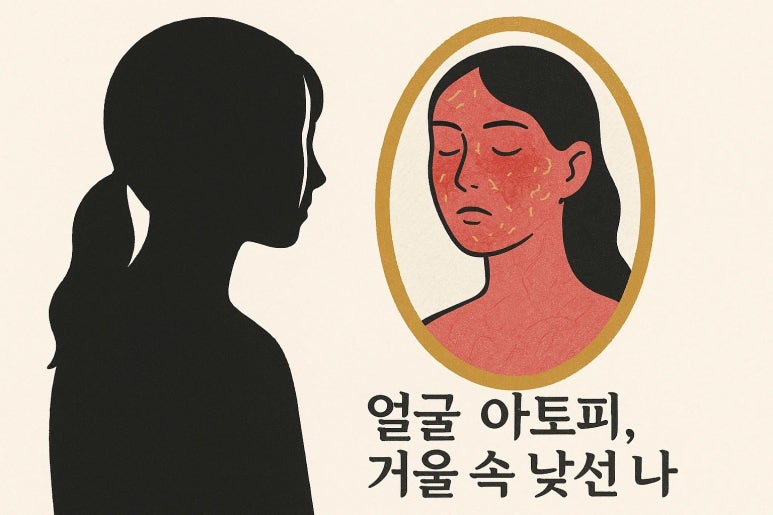
The Stranger in the Mirror: Facial Eczema in 20-Something Women and the Profound Frustration

An Unfamiliar Face in the Mirror: Facial Atopic Dermatitis in Women in Their 20s, and the Deep Frustration It Brings
Among the patients I see in my clinic, there are a particularly large number of women in their 20s who express deep frustration due to facial atopic dermatitis.
| “Doctor, every time I look in the mirror, it feels like it’s not my face. I scratch all night, making it hard to even open my eyes in the morning, and seeing my red, swollen face is incredibly painful.” |
These heartfelt voices reveal not just a skin problem, but a dark shadow cast over a person's self-esteem and overall social life.
The question, ‘Where on earth do this stubborn, rock-like itch and heat sensation come from?’ is likely not just a curiosity for the patient alone.
"Why Isn't It Getting Better?" The Limitations of Superficial Treatment
To be frank, facial atopic dermatitis is not a simple skin problem.
Many people apply ointments and moisturize diligently, yet they complain, "Why isn't it getting better? It seems to improve for a moment, then it flares up even worse." This is often because conventional treatments tend to focus on suppressing superficial symptoms, frequently missing the core underlying problem.
It's like when mold grows in a flowerpot; you only remove the mold without changing the environment, such as the soil's humidity or nutrient status. Our body's skin is similar. When you try to manage only external symptoms without internal environmental changes, the problem is bound to recur. Ultimately, the mold is structured to inevitably grow back.
Facial Atopic Dermatitis: A Signal of 'Internal Body Imbalance' Beyond the Skin
So, what is the real reason why facial atopic dermatitis, like mold, repeatedly appears in the flowerpot of our body’s skin? After seeing and researching patients for a long time, I interpret atopic dermatitis as a result of 'internal body imbalance' manifesting on the skin, beyond just a superficial inflammatory reaction.
Especially in the case of women in their 20s, the overall lifestyle context—including stress from academics or work, irregular eating habits, and lack of sleep—often leads to an excessive accumulation of 'heat' or 'inflammation' within the body. This internal heat then surges to areas with active circulation, like the face, or to stress-sensitive areas, breaking down the skin barrier and ultimately manifesting as atopic dermatitis symptoms.
The Wisdom of Changing the Body's Environment: A Traditional Korean Medicine Approach
Traditional Korean Medicine focuses on this internal imbalance. Rather than viewing facial atopic dermatitis simply as a 'skin disease,' it approaches it from the perspective of harmonious environmental improvement encompassing the entire body.
I carefully examine patients' sensory expressions—such as itching, heat sensation, redness level, and amount of exudate—along with their digestive status, sleep quality, bowel habits, and psychological state. By synthesizing these clinical clues, I form a hypothesis about 'which organs have accumulated heat' and 'which circulations are stagnant,' and based on this, I formulate a personalized herbal medicine prescription.
Herbal Medicine: A Personalized Approach to Restoring the Body's Balance
Herbal medicine does not merely suppress inflammation; it focuses on cooling excessive heat within the body, aiding stagnant circulation, and strengthening the functions of weakened organs, thereby restoring the skin's inherent defense capabilities.
It's easy to understand it as a kind of 'process of resetting the body's internal environment.' For example, for patients with severe hot sensations and redness on their face, herbs are prescribed to clear excessive heat and replenish vital fluids. For those who can't sleep due to nightly scratching, herbs are delicately combined to calm the mind and regulate the skin's hypersensitivity. When the body's internal environment changes in this way, the skin reacts less sensitively to external stimuli and regains its power to heal itself.
Ms. A's Story: Changes Found in a Tired Body and Mind
| Ms. A (28, office worker), whom I met recently, was experiencing severe facial atopic dermatitis due to work stress, even having difficulties in her interpersonal relationships. Specifically, she had severe red and dry eczema around her mouth and eyes, and experienced a pattern of explosive itching when she went to bed. I determined that Ms. A's tense psychological state, bloating from indigestion, and chronic lack of sleep were excessively accumulating 'heat' in her body. For Ms. A, I formulated a prescription with herbs that cool internal heat, regulate stomach function, and relax the nervous system. As one month, then two months passed, Ms. A reported gradual recovery, saying, "The itching has significantly decreased, and my face feels less swollen in the morning. My skin feels stronger than before." |
The Journey of Recovery: When You Listen to Your Body
Facial atopic dermatitis is the result of a long period of physical and mental exhaustion. Therefore, everything cannot be resolved at once.
However, I believe that through this process, patients can deeply understand their bodies and find a healthy life as agents of their own recovery.
If you listen to the signals your body sends and restore overall bodily balance, the patient's face in the mirror will surely regain its bright smile.