

Irritable Bowel Syndrome, Chronic Fatigue: "I'm Tired All Day Long"

Do you perhaps start each morning with the worry, `“How will my stomach feel today?”`
In the clinic, I often see working professionals in their 20s to 40s who are exhausted by daily life, plagued not only by a perpetually bloated and uncomfortable stomach but also by chronic fatigue that follows them like a shadow.
Many also feel anxious because their stomach rumbles constantly without having eaten anything special, and they notice sticky mucus along with loose stools when they go to the bathroom.
Could all this discomfort truly be just a simple digestive disorder?
| “Doctor, I’m dying because of irritable bowel syndrome. My stomach hurts so much, and I never feel completely relieved after going to the bathroom. Lately, I often pass sticky mucus with my stool. Could it be a serious illness? It seems to get worse with stress, and when I wake up in the morning, my whole body already feels incredibly heavy, so I have no energy to go to work.” – The complaint of Minjun (pseudonym), a professional in his 30s |
As in Minjun’s (pseudonym) case, Irritable Bowel Syndrome often doesn’t just cause intestinal discomfort but also burdens individuals with another heavy load: `‘chronic fatigue.’`
Many people tend to regard these symptoms as `mere digestive issues` or simply believe they are too common to do anything about.
However, I view Irritable Bowel Syndrome and the resulting chronic fatigue not as simple gut problems but as a sign of a systemic imbalance where the body's overall equilibrium has been disrupted.
Gut-Brain Axis Imbalance and Systemic Fatigue: A Deep-Rooted Connection

| `Gut-Brain Axis Imbalance and Systemic Fatigue: A Deep-Rooted Connection` Irritable Bowel Syndrome (IBS) is not merely an intestinal disorder. Much like the roots and branches of a giant tree, our gut and brain are `intimately connected by a complex neural network` called the ‘gut-brain axis.’ Chronic stress disrupts this connection, which in turn leads to changes in bowel motility, increased inflammatory responses, and excessive mucus secretion. This intestinal imbalance goes beyond simple digestive discomfort, disrupting the immune and nervous systems and causing systemic inflammation and energy depletion. Consequently, `a vicious cycle begins where a fatigued gut leads to whole-body exhaustion`. This is the fundamental principle behind chronic fatigue associated with Irritable Bowel Syndrome. |
Many patients I meet in the clinic say, `“When I’m tired, my stomach hurts more, and when my stomach is uncomfortable, I feel even more tired,”` which is a clear indicator of how significantly the gut-brain axis affects our overall physical condition.
Looking at research showing a high prevalence of Irritable Bowel Syndrome among working professionals in their 30s who experience high job stress, we can see that `stress acts as a major trigger for this condition`.
Irritable Bowel Syndrome and Mucous Stools: Careful Observation is Required
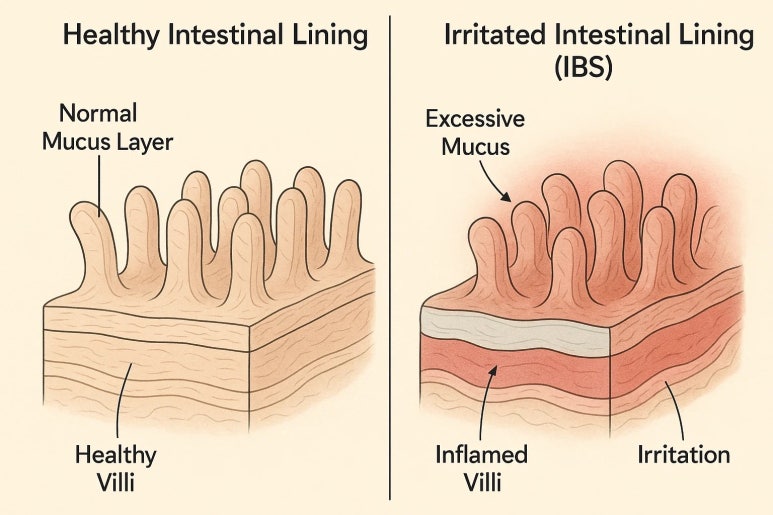
In this context, the symptom of mucus in stool is also `a natural response of the intestines to secrete more mucus than usual to protect themselves when irritated or inflamed`.
While mucus serves to lubricate and protect the intestinal wall, `when produced excessively, it mixes with stool and becomes noticeable.`
It is generally `clear or white, but when mixed with stool, it may appear yellow or light brown.`
This is one of the symptoms commonly observed in patients with Irritable Bowel Syndrome.
However, `not all mucous stools should be taken lightly.`
“If These Symptoms Are Accompanied” – Red Flags Not to Be Missed
| `“If These Symptoms Are Accompanied” – Red Flags Not to Be Missed` Even if observing mucus in stool is common for IBS patients, if the following symptoms are accompanied, `you must be examined by a medical professional.` * Drastic change in bowel habits * Rectal bleeding or bloody stools (`especially black and sticky stools`) * Unintentional weight loss * Iron deficiency anemia * Severe abdominal pain, vomiting, diarrhea These symptoms may indicate `the possibility of more serious underlying conditions` such as inflammatory bowel disease (Crohn's disease, ulcerative colitis), colorectal cancer, bowel obstruction, or severe gastrointestinal infection. `It is important to consult with a professional to find the accurate cause rather than making a premature self-diagnosis.` |
Integrated Approach: The Path to Restoring Gut and Systemic Function

When treating chronic fatigue caused by Irritable Bowel Syndrome, I emphasize an integrated approach that goes beyond simply suppressing symptoms. This involves changing the body's internal environment itself and restoring neuro-constitutional balance.
Just as fish in an aquarium need clear water and appropriate temperature to be healthy, our `body's environment must also be fundamentally improved` for gut and systemic function to be restored.
Minji’s (pseudonym) Recovery Story
| `Minji’s (pseudonym) Recovery Story` Minji (pseudonym), a professional in her 30s, suffered from chronic diarrhea and abdominal pain, as well as chronic fatigue, constantly feeling drained. In particular, `diarrhea and mucous stools would invariably appear before important meetings or on days with high stress`, significantly limiting her daily life. For Minji, I provided an herbal medicine prescription to reduce tension in the gut-brain axis and regulate intestinal inflammatory responses, along with `specific guidelines for stress management and dietary improvements`. After several months of consistent treatment, Minji was delighted to report that her bowel habits had stabilized, mucous stools had almost disappeared, and `she could wake up feeling refreshed in the morning, with her chronic fatigue also significantly reduced`. |
Carefully considering an individual's constitution, lifestyle habits, and stress factors to create a customized treatment plan is the first step towards recovery.
What I Focused On…
| `What I Focused On…` `To be honest, initially, I too tended to view Irritable Bowel Syndrome primarily as a gut functional problem.` However, through various clinical cases, I realized the importance of identifying patterns of systemic imbalance – stress, emotional factors, and more, hidden behind gut problems. Through in-depth conversations with patients, striving to `understand the true signals the body sends` hidden behind simple symptoms is the principle of care I consider important. This perspective also aligns with the ‘systemic perspective’ emphasized in classic medical texts like Shanghan Lun and Jingui Yaolüe. |
If you are also struggling through difficult days due to chronic fatigue caused by Irritable Bowel Syndrome, I recommend embarking on `an integrated approach to restore the body's overall balance rather than clinging solely to symptom suppression`.
Even if it's not with me, I sincerely hope you find medical professionals who will carefully attend to your entire body and address your exhausted gut and mind together.
I encourage you to listen to the signals your body sends, interpret them correctly, and together find a path to improving your quality of life.