
Irritable Bowel Syndrome with Diarrhea (IBS-D) | Nervousness Sends Me Straight to the Bathroom

Irritable Bowel Syndrome with Diarrhea (IBS-D) | When I get nervous, I have to go to the bathroom right away
Am I the only 30-something office worker who dreads the commute every morning?
Are you exhausted from sudden abdominal pain and constantly having to run to the bathroom?
Many patients who visit me collectively say this:
| "Doctor, my stomach hurts so much because I keep having diarrhea. I'm too anxious to sit still, even during important meetings or social engagements." |
Yes, I completely understand that feeling.
`Irritable Bowel Syndrome with Diarrhea (IBS-D)` brings a suffering that cannot be simply explained by saying 'the bowels are sensitive.'
Among the 30-something office workers I meet in my practice, many come after silently enduring this suffering for a long time.
In a busy daily life full of stress, bowel health tends to be pushed to the back burner.
However, if you ignore the signals your body sends, your quality of life will inevitably decrease significantly. Especially since digestive disorders affect overall body health, more meticulous management is required.
Today, I'd like to talk about why IBS-D occurs and what traditional Korean medicine perspectives can be used to approach this problem.
I hope this article will help those struggling with IBS-D understand their condition and become a `small spark that finds the key to recovery`.
How does stress shake up the gut? (The essence of Irritable Bowel Syndrome)
Many people commonly use the term 'stress-induced enteritis,' which is an expression that well illustrates the essence of Irritable Bowel Syndrome (IBS).
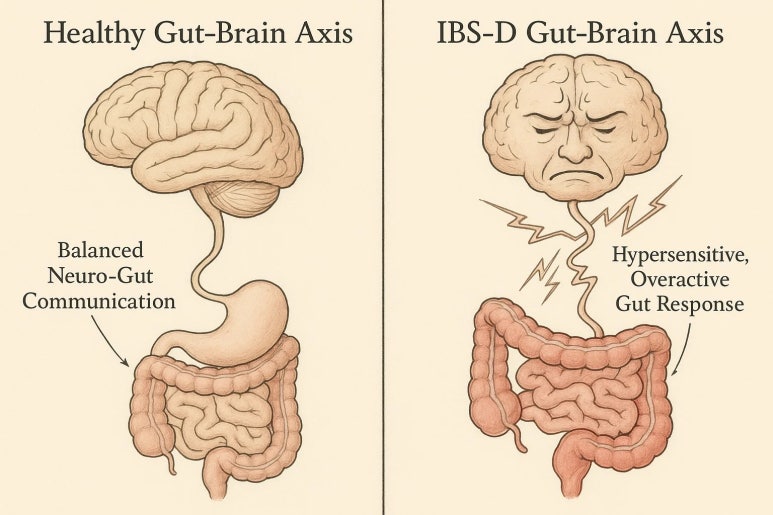
Our brain and gut are connected by a highway called the `'gut-brain axis'`, communicating closely with each other.
Mental stress, anxiety, and tension are directly transmitted to the gut via this highway, abnormally stimulating bowel movements or making the gut sensitive.
Just as `waves ripple when a stone is thrown into a calm lake`, mental stimuli create direct ripples in the gut.
This hyper-sensitivity of the gut manifests as symptoms like frequent diarrhea and abdominal pain.
What I always emphasize in my clinic is that the gut is not just an organ responsible for digestion but like a `mirror reflecting our emotional state`.
Even if it appears fine on the surface, in most cases, the gut suffers from functional problems without inflammatory reactions.
The Story of Jihoon (pseudonym) from My Clinic
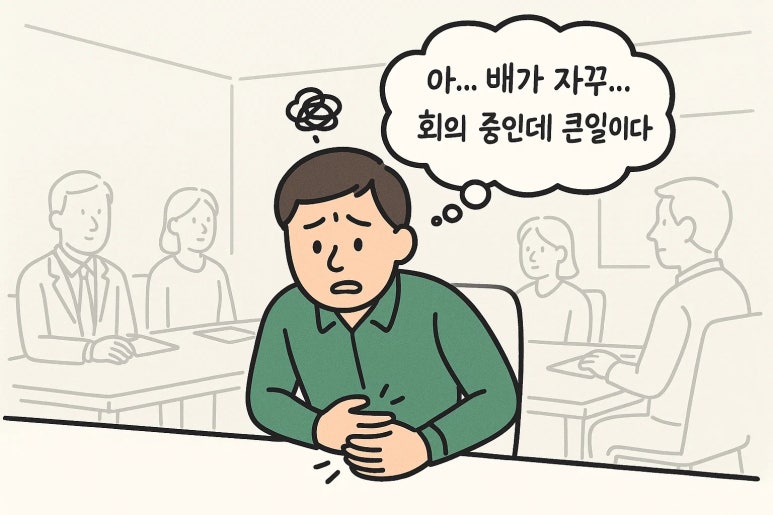
| Jihoon (pseudonym), a 30-something office worker, would invariably feel a dull ache in his lower abdomen and have to rush to the bathroom whenever he had an important presentation or client meeting. Always in a state of tension, Jihoon complained that he found it difficult to concentrate due to gas in his stomach and gurgling sounds. Especially after meals, diarrhea would follow almost without exception, and he had experienced embarrassing situations at company dinners multiple times. He had undergone various tests at the hospital but had only been told 'there's nothing particularly wrong,' and was even more frustrated because he couldn't find a clear treatment. He felt significant limitations in his social life due to chronic frequent diarrhea and abdominal pain. |
As such, patients with IBS-D often experience discomfort as their bowels react sensitively to even small changes in daily life.
Beyond simply 'having bad bowels,' it is a problem that affects the entire pattern of one's life.
Gut Health: A Traditional Korean Medicine Approach to Emptying the Stress Bowl
In Traditional Korean Medicine, IBS-D is not seen merely as a problem of the gut.
In cases like Jihoon's (pseudonym), it is interpreted that various factors act in combination, such as `weakening of Spleen and Stomach (Biwi) function`, `stagnation of Liver (Gan) energy (Qi)`, and `hyperactivity of Heart Fire (Simhwa)`.
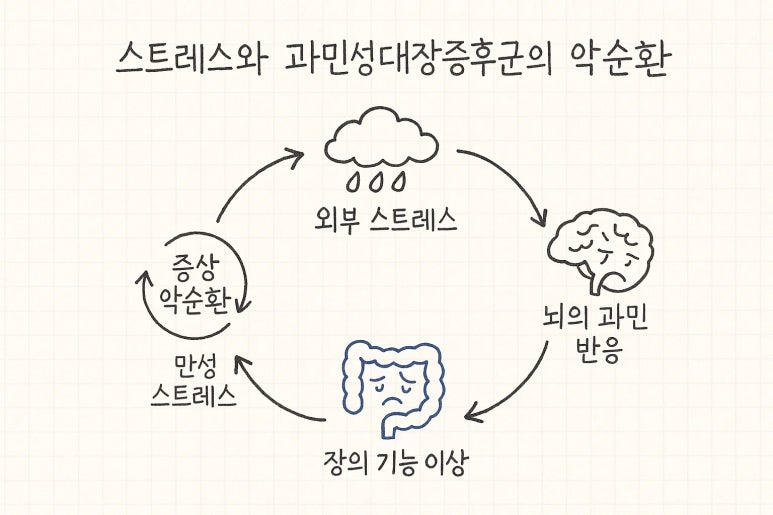
That is, when digestive function is weakened, stress accumulates, causing the Liver Qi to stagnate, which then stimulates the heart, amplifying anxiety and tension, and flowing into the gut.
| In Traditional Korean Medicine, several steps are considered for managing IBS-D. First, `strengthening Spleen and Stomach function` (Biwi) by supplementing weakened digestive function and fortifying the intestinal lining to stop diarrhea becomes an important goal. Next, the process of `promoting the free flow of Liver Qi` (Gan Gi) is necessary to release stagnated energy caused by stress, reduce intestinal hyper-sensitivity, and aid mental stability. Additionally, `calming Heart Fire` (Simhwa) is focused on to soothe anxiety and nervousness, restore the balance of the gut-brain axis, and alleviate intestinal tension. Through all these processes, aiming for `fundamental gut health recovery` is achieved via `personalized constitutional treatment` (Chejil Majchum Chiryo), which includes custom herbal prescriptions and lifestyle management guidance tailored to the individual's body condition and habits. |
The herbal medicines I use are prescribed based on insights into these complex issues.
We focus on changing the body's environment and the process of restoring the `balance of nerves and constitution`.
| Generally, for patients with Irritable Bowel Syndrome with Diarrhea (IBS-D), herbs such as `Baekchul (Atractylodes macrocephala)` and `Bokryeong (Poria cocos)` that strengthen the gut and replenish energy, and herbs like `Siho (Bupleurum)` and `Jinpi (Citrus peel)` that relieve stagnation caused by stress, may be combined and used depending on the situation. However, rather than simply taking specific herbs, it is crucial to receive a prescription tailored to your individual needs after a professional examination. |
The Journey to Recovery: Small Practices for Yourself
Along with treatment, small habits that can be practiced in daily life accumulate to create big changes.
The most important thing is regular meals and adequate fluid intake.
Since food directly affects our gut health, it is necessary to identify and avoid foods that cause discomfort by keeping a personal record.
Especially flour-based foods, instant foods, cold foods, excessive caffeine, or alcohol can easily irritate the gut, so they should be carefully monitored.
Finding `your own methods for managing stress`—such as meditation, light exercise, and adequate sleep—is also a key factor for gut health.
| Relying solely on self-diagnosis or internet information and indiscriminately trying specific herbs or folk remedies can be dangerous. While temporary symptom relief might occur, there is a possibility of worsening symptoms or causing other side effects. It is crucial to consult a professional to establish an accurate diagnosis and treatment plan. If diarrhea symptoms are severe, accompanied by fever, or if bloody stools are observed, there is a possibility of other inflammatory bowel diseases rather than IBS, so you must visit a medical institution immediately. Also, when diarrhea is severe, rather than excessively using anti-diarrhea medication, you should give your bowels a rest and sufficiently replenish fluids. If dehydration symptoms appear or severe abdominal pain persists, you must seek medical attention. |
Irritable Bowel Syndrome with Diarrhea is not merely a problem of the gut.
It is a signal that appears when the balance of body, mind, and daily life is disrupted.
Just like the conversations I have with patients in my clinic, I hope that through this article, you will listen to your body and gain `the courage to be an active participant in your recovery`.
If I can accompany you, even in a small way, on this journey of asking yourself questions and finding answers, that is enough.
Trusting in the strong resilience within you, I encourage you to start making small changes from today.