
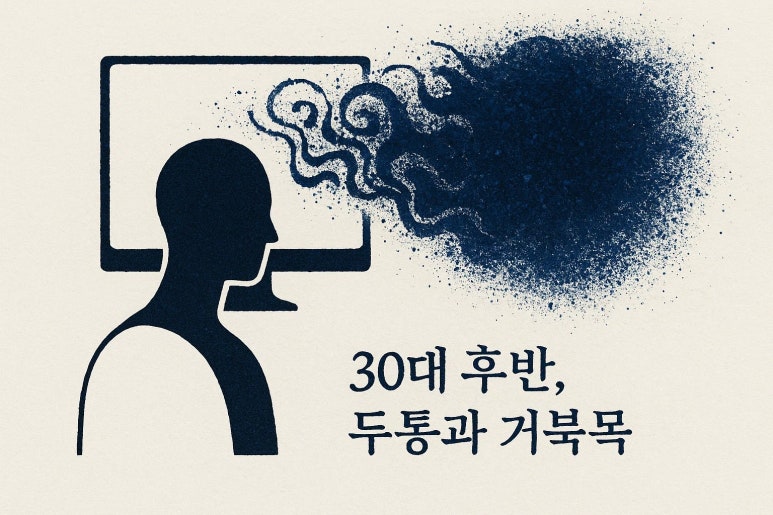
Computer Headache: It Might Not Just Be an Eye Problem

Your Computer Headache May Not Just Be an Eye Problem
| "Spending all day looking at a computer monitor, my eyes feel like they're going to pop out, and by the afternoon, my head throbs as if it's splitting." |
Do you perhaps think your computer headache starts with eye strain? We're all familiar with the experience of eye stiffness naturally leading to a headache. However, if the pain doesn't resolve even after visiting an ophthalmologist, getting an eye exam, and using artificial tears, the true cause of your headache is likely beyond just your eyeballs.
Just as a car's engine warning light isn't solely about the engine but signals complex issues like low oil or coolant problems, the headaches that occur after computer use can also be more than just 'tired eyes' – they can be a 'holistic warning signal from the body'. This is because our body is an organic system where the visual, musculoskeletal, and nervous systems are intricately connected.
So, what are the causes of headaches that go beyond simple eye strain?
The first cause is 'visual system overload'.
The blue light emitted from screens and subtle flickers continuously strain the eyes. According to cognitive science research, this visual stress can overactivate specific areas of the brain, leading to headaches. In Traditional Korean Medicine (TKM), this is sometimes seen as a type of 'Mokhyeon' (dizziness/blurred vision) caused by 'An-gu-jin-tang' (ocular tremor/nystagmus).
| [Glossary: An-gu-jin-tang (眼球震蕩) and Mokhyeon (目眩)] An-gu-jin-tang refers to eye tremors, while Mokhyeon refers to symptoms of blurred vision and dizziness, both interpreted as resulting from excessive visual stimulation or fatigue. |
The second cause is 'poor musculoskeletal posture'.
Let's look at the case of Ms. Park So-hyun (pseudonym), a woman in her 30s. She complained of frequent headaches while working over 10 hours a day on web design. Even after changing her glasses and getting eye massages, her symptoms didn't improve. When her posture was observed in the clinic, she exhibited the typical 'text neck' (or forward head posture), where her head was thrust forward, causing her neck to stiffen into a straight line.
| [CASE] Clues from Ms. Park So-hyun's (pseudonym) Daily Life She complained of frequent headaches while working over 10 hours a day on web design. Even after changing her glasses and getting eye massages, her symptoms didn't improve. When her posture was observed in the clinic, she exhibited the typical 'text neck' (or forward head posture), where her head was thrust forward, causing her neck to stiffen into a straight line. |
This posture isn't just about a stiff neck. The human head weighs approximately 4-5 kg (about 9-11 lbs), similar to a bowling ball. Even if the head is just one inch (approximately 2.54 cm) forward, the strain on the neck nearly doubles. This continuously tenses the muscles around the cervical spine, and this tension compresses the nerves in the occipital region, leading to 'tension headaches'.
Here's a [crucial clue] to note.
If the cause of the headache were solely related to the visual system, the pain should immediately subside when you turn off the computer and close your eyes. However, if the pain persists even after turning off the computer, like in Ms. Park So-hyun's case, it's highly probable that the headache is a complex symptom combined with musculoskeletal issues.
Therefore, if you recognize that your computer headache is not just simple eye strain, the solution begins with 'posture' and 'rest'. The '20-20-20' rule is highly effective: Every 20 minutes, look at something 20 feet (about 6 meters) away for 20 seconds to readjust your eye focus. Additionally, align the top of your monitor with your eye level and sit up straight to prevent your neck from jutting forward.
| [Counter-evidence] If the cause of the headache were solely related to the visual system, the pain should immediately subside when you turn off the computer and close your eyes. However, if the pain persists even after turning off the computer, like in Ms. Park So-hyun's case, it's highly probable that the headache is a complex symptom combined with musculoskeletal issues. |
To fundamentally alleviate headaches, stretching to release tension in the neck and shoulders is essential. Simply standing up from your chair for a moment and slowly stretching your neck from side to side and up and down can relax tense muscles and reduce the frequency of headaches. These efforts are a crucial first step in breaking the vicious cycle that connects 'vision-posture-brain'.
Computer headaches are the clearest signal from our body saying, 'Please rest now'.
A computer headache is not just a minor inconvenience, but a strong warning message from your body to 're-evaluate your posture and habits'. Therefore, rather than solely relying on painkillers, you should understand the problem holistically and seek fundamental solutions.
| [Key Takeaways]
|