
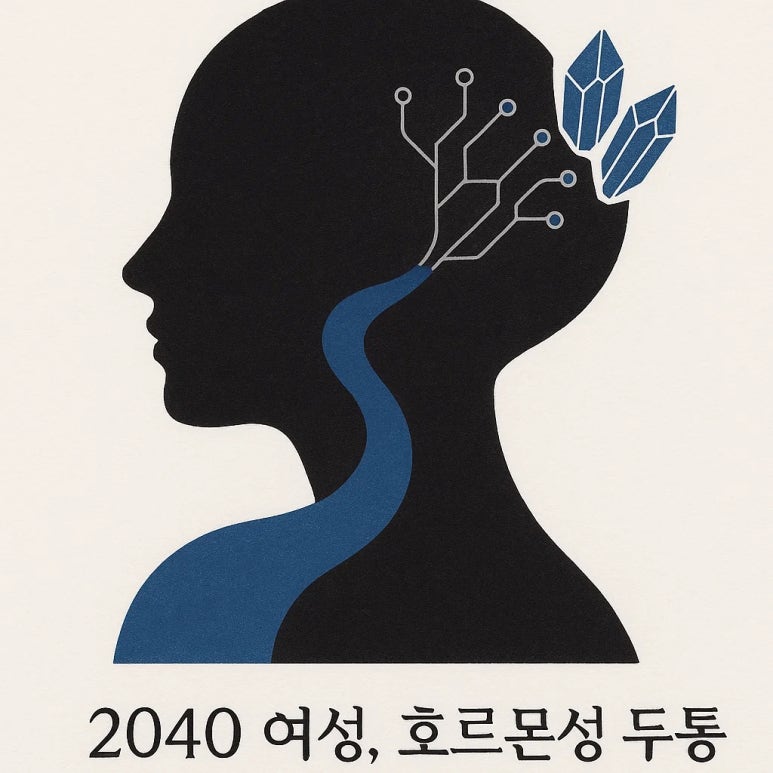
I Have Severe Headaches Every Period: Hormonal Headache?

Period-Related Headaches: The Disharmony Between the Brain and Hormones is to Blame
| "Starting exactly 3 days before my period, my head feels like it's going to split open. Even if I take medication like Ezen6, the relief is only temporary, and now I'm even experiencing stomach upset." |
Many women suffer from headaches that occur around the same time each month. They often dismiss them as simple fatigue or stress, taking a painkiller or two, but for some, the pain is so severe that even those don't provide relief.
| [CASE] Ms. C, a graphic designer in her mid-30s, was one such case. She frequently lost focus during critical moments due to migraines that invariably appeared at the end of the month, coinciding with important deadlines. The ibuprofen-based painkillers she took as a staple medicine no longer showed significant effectiveness. |
Headaches that show a clear pattern aligned with the menstrual cycle are called 'menstrual migraines' or 'hormonal headaches'. These are not just simple pain issues, but can be a signal from our body's intricate hormonal system.
| [KEY CLUE] If these headaches were merely due to muscle tension, they should improve with stretching or massage. However, the fact that periodic headaches often do not respond to such treatments suggests that the root of the problem lies elsewhere. |
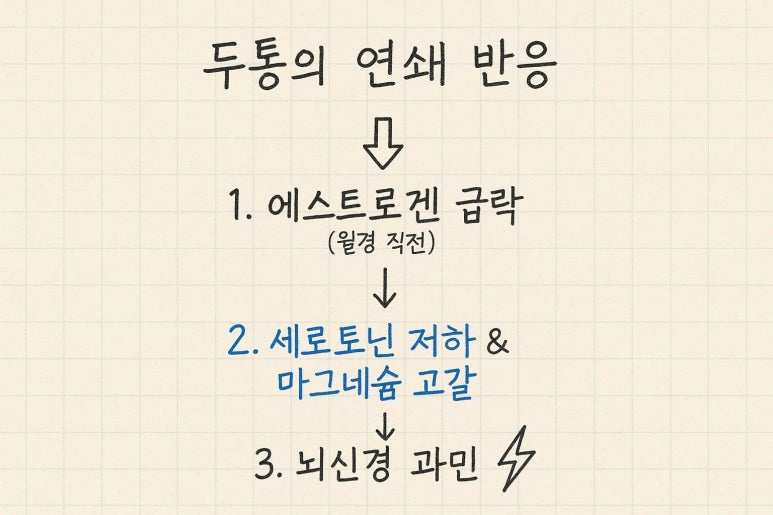
The prime suspect is the female hormone 'estrogen'. Estrogen levels, which peak during ovulation, drop sharply like a rollercoaster just before menstruation. This very 'estrogen cliff' triggers headaches. Estrogen plays a crucial role in regulating the secretion of 'serotonin,' often called the happiness hormone in the brain. When estrogen levels drop, serotonin concentrations also decrease.
Serotonin is a neurotransmitter that plays a key role in regulating blood vessel constriction and dilation, as well as controlling pain. When serotonin levels are low, brain blood vessels are more prone to abnormal dilation, and sensitivity to pain becomes extremely heightened. This is why the head throbs particularly intensely just before menstruation, and why patients with 'hormonal migraines' become sensitive to external stimuli like light and sound.
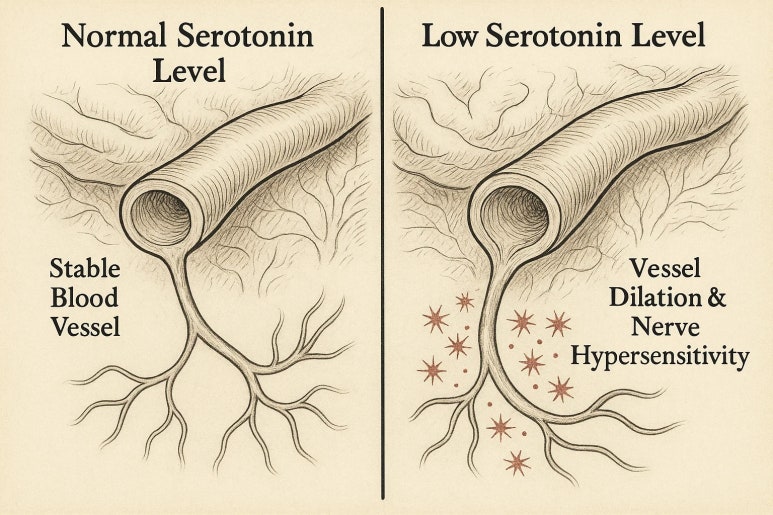
This situation is like 'a dam's water level control system breaking down'. Normally, the dam (brain) maintains an appropriate water level (serotonin) and stably manages pain signals, but when the core control system, estrogen, falters, even a small rain (stimulus) can easily lead to a flood (headache).
There's another accomplice here: 'magnesium'. Estrogen is also involved in maintaining magnesium levels in the body, so when estrogen levels drop, magnesium absorption decreases, and its excretion through urine increases. Indeed, studies have shown that women suffering from menstrual migraines have significantly lower intracellular magnesium levels in red blood cells than women who do not.
Magnesium is a vital mineral, often called a 'natural tranquilizer,' as it calms nerve excitability and relaxes muscles. This is also why headaches are listed as one of the symptoms of magnesium deficiency. When magnesium is deficient, brain nerves become easily excited even by minor stimuli, which further exacerbates headaches.
Ultimately, the cause of period headaches is a complex result created by two factors—'serotonin depletion' and 'magnesium deficiency'—acting simultaneously on the trigger of 'estrogen plummeting'. Estrogen plunge begins 3-5 days before menstruation → Increased sensitivity due to serotonin depletion 1-2 days later → Worsening magnesium deficiency just before menstruation begins → Severe PMS headache occurs.
| [Note: Traditional Korean Medicine Perspective] In Traditional Korean Medicine (TKM), this phenomenon is sometimes interpreted as a type of 'Du Pung' (head wind), arising from 'Xue Xu' (blood deficiency) – meaning a lack of nourishing substances and blood in the body, which prevents the brain from being adequately nourished. The Dongui Bogam states that 'when blood (Xue) is deficient, the head becomes dizzy and painful,' emphasizing the importance of replenishing the body's fundamental resources rather than merely suppressing pain. |
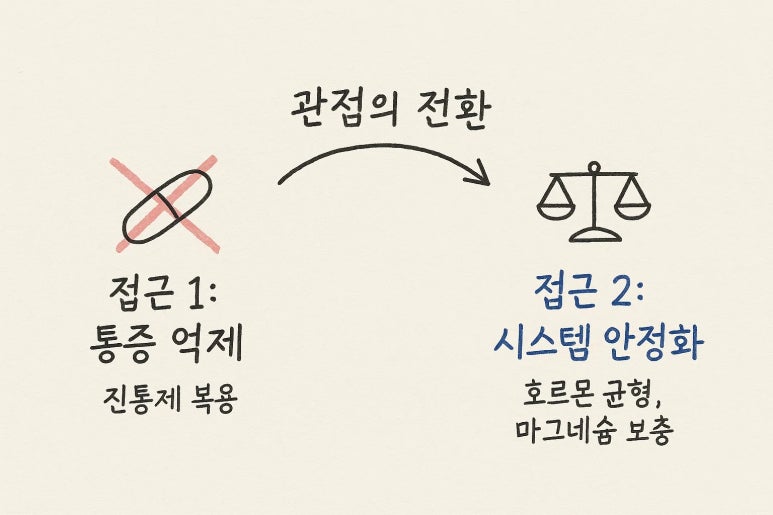
So, what can we do to break this vicious cycle of headaches? Instead of relying solely on painkillers for menstrual pain relief, we need to shift our perspective towards stabilizing our body's hormonal balance.
| [A NEW QUESTION] If you understand this new perspective, the question we should ask is no longer 'Which painkiller should I take?' Instead, we can ask a more fundamental question like 'What can I do to stabilize my neuro-hormonal system and mitigate the impact of periodic estrogen changes?' This is the true beginning of change. |
| Consultation Information | ||
| - Clinic Hours - Mon-Fri 10:00 AM - 7:00 PM Lunch Break 1:00 PM - 2:00 PM | ||
| ※ Individual consultations are not provided via the blog. For appointments and consultation inquiries, please check Naver Place or our official website. Baeknokdam Korean Medicine Clinic 3rd Floor, Songdo Dream City, 81 Convensia-daero, Yeonsu-gu, Incheon |