
Why Does Stiffness in the Back of My Neck Keep Recurring? | Incheon Chronic Cervicalgia

Table of Contents
- "It feels like an electric shock when I just turn my head."
- Stiffness in the Back of the Neck, Why Does It Keep Returning?
- The timeline of tests and treatments also provides clues.
- So, what should be checked?
- The treatment strategy is not a single prescription.
- One more self-check tip.
- Today's Key Three Lines
"It feels like an electric shock when I just turn my head."
| CASE Pattern: Stiffness in the back of the neck/between shoulder blades, sharp pain when turning the neck Course: Approximately 1 year duration, symptoms all day Tests: MRI showed mild cervical disc protrusion, straight neck Treatment History: Epidural injection 2 months ago had minimal effect Neurology: No arm numbness/weakness Lifestyle: 7 hours sleep, quit smoking 1 week ago, taking blood pressure medication |
Stiffness in the Back of the Neck, Why Does It Keep Returning?
“It feels like an electric shock when I just turn my head.”
All day, there's stiffness in the back of the neck and between the shoulder blades, with flashes of pain whenever the direction is changed. MRI shows a slight cervical disc protrusion and a straight neck posture.
Neck pain is often simplified as 'muscle knots', but this pattern is slightly different. Symptoms have persisted for nearly a year and worsen when moving the shoulder or tilting the neck back. There is no arm numbness or weakness, suggesting a low likelihood of severe neurological deficits.
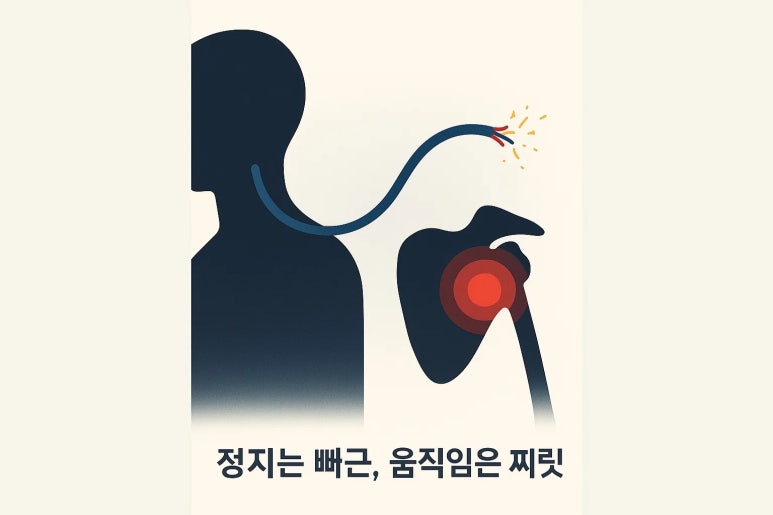
Let's establish a key analogy. It's like a slightly frayed electrical wire subtly sparking somewhere. The basis is this: straight neck → increased load on the lower cervical spine → posterior disc protrusion subtly irritates the nerve roots and surrounding tissues, and muscles like the levator scapulae and scalenes become defensively tense. Therefore, a dull stiffness occurs at rest, alternating with a sharp, tingling sensation upon movement.
The timeline of tests and treatments also provides clues.
An epidural injection 2 months ago had minimal effect, and starting to quit smoking 1 week ago could add sensitivity due to withdrawal. Sleep averaged 7 hours, which was reported as not a major issue.
Before asking what hurts, we observe what is being compressed and pulled. In a straight neck posture, the head's weight shifts forward, increasing the load on the C5-C6 region. At this point, the superior fibers of the levator scapulae, originating from the scapula, are pulled towards the transverse processes of the neck. When the head is turned, these fibers become taut, creating a sensation like a blade scraping.
Why does it hurt more during movement? When muscles move, their length and tension change, and the disc experiences slight shear forces. If there is chemical inflammation around already sensitized nerves, even small stimuli can amplify pain signals. Conversely, at rest, blood flow decreases, and discomfort persists mildly. This is the typical switching between 'stiffness at rest ↔ sharp pain during movement'.
| CAUTION If there is progressive arm numbness/weakness, gait disturbance, high fever/trauma, or urination difficulties, seek immediate re-evaluation at a medical institution. |
So, what should be checked?
First, red flags.
If accompanied by progressive arm numbness/weakness, gait disturbance, bowel/bladder control issues, recent high fever, or trauma, immediate re-evaluation at a hospital is necessary.
Second, find the pain trigger points. Palpate the levator scapulae, scalenes, and infraspinatus to check for reproducible pain.
Third, assess function. Record the range of motion and changes in pain during movements like head rotation, extension, shoulder elevation, and external rotation.
Adding a Traditional Korean Medicine (TKM) perspective clarifies the understanding.
When the qi and blood in the cervical and scapular regions become stagnant, it manifests as 'Bi-Yu' (痺瘀), leading to persistent dull and heavy pain. This overlaps with modern medicine's concepts of micro-inflammation and nerve sensitization. Acupuncture treatment is designed to relax hypertonic muscle fibers and improve local blood flow and pain-modulating neurotransmission.
The treatment strategy is not a single prescription.
① Acupuncture treatment: Observe hypertonic points in the lower cervical spine, levator scapulae, scalenes, and infraspinatus 1-2 times per week for 4 weeks.
② Exercise: Retrain chin tucks and scapular depression, followed by light joint mobilization after 5-7 minutes of low-intensity isometrics.
③ Lifestyle: Position monitor centerline at eye level, elbows at 90 degrees, reset neck/shoulders for 1-2 minutes every 30-40 minutes.
④ Medication/Injection History: Note the minimal effect of previous epidural injections to avoid redundant procedures.
Herbal medicine is closer to a sufficient condition than a necessary one. To help balance inflammation, tension, and sleep quality, a phased approach within safe limits is taken, considering the individual's constitution and medical history (e.g., taking antihypertensive medication). Especially in the initial 2 weeks, it is first observed whether changes in pain intensity are seen with acupuncture, exercise, and ergonomic adjustments alone.
The immediate task for daily life is simple. Today, note the direction where the 'sharp pain when turning the head' is prominent. With your gaze fixed in the opposite direction, gently tuck your chin for 4-6 seconds, then release, repeating 10 times, three sets. And when you notice your shoulders being pulled up towards your ears during work, perform 3 deep inhalations to lower your shoulder blades and 'reset'.
One more self-check tip.
Sit in a chair, gently tuck your chin, then lightly cup the back of your head below the occiput (suboccipital region) with both hands, pressing for 5 seconds before releasing. If dull pain spreads and your vision feels more comfortable, it's a sign that over-tension in the upper trapezius and suboccipital muscles is contributing to the pain. Conversely, if, when applying the same pressure while tilting your head to one side, sharp radiating pain shoots down your arm, suspect nerve root irritation and avoid excessive self-correction.
Let's also track the expected progress with numbers. Record your 0-10 point Numeric Rating Scale (NRS) for pain morning and evening, and if you see a decrease of 1 point or more in 2 weeks, maintain the current plan. If there's no change, adjust the acupuncture needle insertion points and further emphasize the scapular depression-retraction pattern. If the 'sharp pain when turning the head' still remains at week 4, re-evaluate cervical range of motion and neurological signs and consider re-imaging. Additionally, continue taking blood pressure medication, but always check for interactions when adding new supplements or pain relievers.
Today's Key Three Lines
① Straight neck + mild disc protrusion creates 'stiffness at rest ↔ sharp pain during movement'.
② For the first 2 weeks, accumulate subtle numerical changes with acupuncture + isometrics + ergonomic adjustments.
③ If red flags appear (progressive numbness/weakness, fever, trauma, urination difficulties), seek immediate re-evaluation at a medical institution.
Finally, pain is not a punishment, but a signal. Like replacing the insulation of an electrical wire, we gradually work to restore posture, muscle length, and nerve thresholds. When small numerical changes—for example, a 1-2 point drop in pain intensity (out of 10) after 2 weeks—accumulate, the path will clearly change.
| Today's Key Takeaways
|