
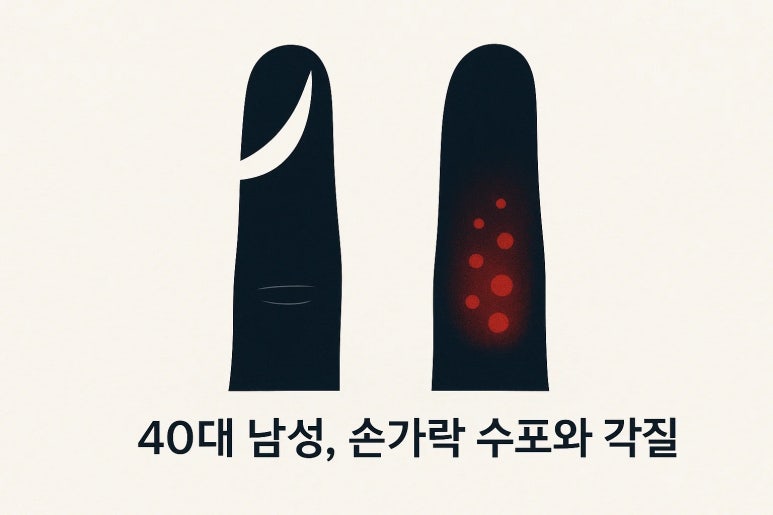
Finger Blisters and Peeling: Is it Keratolysis Exfoliativa or Dyshidrosis?

Your hands, tirelessly working through your late 40s. One day, you suddenly notice small blisters and itching on your fingers. You try to dismiss it, but the peeling skin makes you increasingly concerned. Searching 'finger blisters' online, you're inundated with unfamiliar medical terms.
| "It's itchy and peeling, so I'm completely confused whether it's keratolysis exfoliativa or dyshidrotic eczema." |
This article is a guide for you, standing amidst that confusion.
Chapter 1. Two Suspect Conditions: The Identity of Keratolysis Exfoliativa and Dyshidrotic Eczema
First, let's examine the profiles of these two 'suspects.' While they may seem similar, their underlying nature is entirely different.
Keratolysis Exfoliativa, often called 각피증, can be likened to 'a quiet, non-inflammatory exfoliation,' as its name 'Exfoliativa' suggests 'peeling.' It's a phenomenon where the stratum corneum, the outermost layer of our skin, spontaneously peels off due to external stimuli. The key is that it is 'non-inflammatory.'
On the other hand, Dyshidrotic Eczema is like 'a small rebellion within the skin.' Contrary to its name, it's not directly related to sweat, but rather a type of recurrent eczema characterized by small blisters on the hands and feet. The key is that it is an 'inflammatory' disease related to the immune system.
Chapter 2. Decisive Evidence: Key Clues to Distinguish Between the Two Conditions
Now it's time to differentiate between the two suspects. By carefully examining the symptoms, much like a forensic expert analyzes evidence, you can find crucial differences.
| Category | Keratolysis Exfoliativa | Dyshidrotic Eczema |
| Clue 1: Itching | Almost none or mild. | Severe, accompanied by a burning sensation. |
| Clue 2: Blisters | Shallow and air-filled, easily ruptures. No oozing. | Deep and firm (tapioca pearl-shaped), does not easily rupture. |
| Clue 3: Inflammation | None (no redness, no swelling) | May be present (blister surroundings may be red or swollen) |
| Key Summary | "Not itchy, only skin peeling" | "Extremely itchy with small blisters" |
| [Observation Example Over Time] 3 days ago, fingers started itching → last night, several small blisters appeared → this morning, the area around the blisters turned red. (Suspect Dyshidrotic Eczema) |
| [Symptom Difference] If these symptoms were simply keratolysis exfoliativa, severe itching or surrounding redness would not have appeared. |
This entire situation is like 'a fire alarm inside the house.' Keratolysis exfoliativa is similar to an alarm briefly sounding due to external smoke (friction, detergents) and then stopping.
Dyshidrotic eczema, on the other hand, is closer to a situation where the alarm continuously blares loudly due to an internal electrical short circuit (immune system imbalance). In other words, dyshidrotic eczema is part of a systemic reaction caused by internal factors like stress or allergies stimulating the immune system.
Chapter 3. Initial Response: What Should You Do?
So, how should you respond?
For mild keratolysis exfoliativa, consistently applying a moisturizer containing urea (10% or more), which can be purchased at a pharmacy, can help manage the damaged hand skin barrier.
However, if you observe the following signs, you should visit a Korean medicine clinic without delay:
- When itching is severe enough to disrupt daily life or sleep
- When there is oozing or pain (VAS 5/10 or higher) (risk of secondary infection)
- When symptoms spread beyond the hands to other areas
| [Caution] Especially when dyshidrotic eczema is suspected, never burst the blisters arbitrarily. This can lead to secondary bacterial infection, worsen the condition, and leave scars. |
Small changes in your fingers can be important signals from your body. Observe your symptoms calmly through the three lenses of 'itching,' 'blister depth,' and 'inflammation.' This article is merely a guide to help reduce your confusion; the final diagnosis is absolutely the responsibility of a professional. We hope that through an accurate diagnosis, you can bid farewell to uncertainty and take a wise first step towards a healthy daily life.