
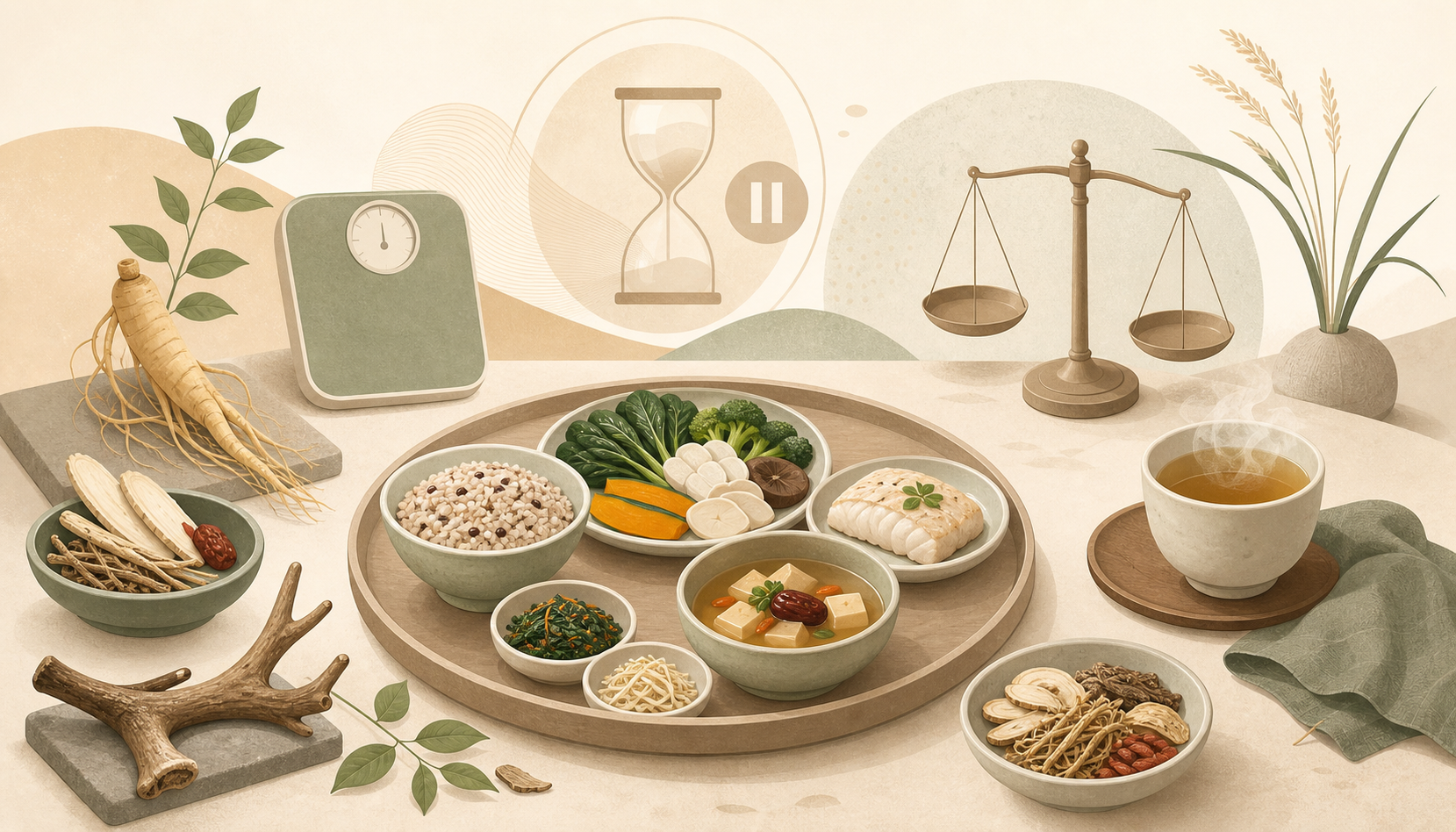
As We Get Older
Do you feel like your body is getting heavier? You eat the same amount as before, but the scale keeps going up, and even though you're eating less, the number on the scale doesn't budge.
I also had a difficult experience when I entered my 40s. Even though I ate only two meals a day, my body kept gaining weight, and now even drinking water makes me feel bloated.
This isn't just a matter of your willpower being weak. It's because our body has found its survival-oriented set point.
Your 40s: When Your Body's Language Changes
Your 40s are a time when your body changes the way it uses and stores energy. If you stubbornly stick to the methods you used in your 20s, you'll only harm your body and find yourself in a vicious cycle where you don't lose weight.
In this guide, we'll look at the recommended diet plan optimized for those in their 40s and explain in detail how you can reset your weight management strategy from a Korean medicine perspective.
Which of These People Are You Searching For?
When I meet patients in their 40s at the clinic, they often fall into one of three categories. Which one are you?
Type 1: Office workers with high abdominal fat
These are people with small children and busy work schedules, constantly running around for work. They have no time to exercise, but their belly fat keeps increasing, and they've recently received warnings about diabetes or high blood pressure in their health check-ups.
Type 2: Middle-aged women struggling with menopause and swelling
Many women who enter their 40s without their body returning to normal after childbirth fall into this category. They try to relieve stress with a glass of wine or comfort food, but end up complaining that their face becomes puffy and their body feels heavy all over.
Type 3: Those who can't keep up with their previous fitness routine
These are people who used to exercise regularly but find it difficult to get back in shape after turning 40. Even though they maintain the same high-intensity workouts as before, they feel more fatigued and take longer to recover, making it a frustrating situation.
Why Do Such Things Happen? — Key Points of Korean Medicine
Medically, the reason why dieting becomes difficult in your 40s is clear. It's due to hormonal changes and Sarcopenia.
Decrease in Basal Metabolic Rate
After age 30, our body's basal metabolic rate decreases by about 2-3% every 10 years. As growth hormone and sex hormones (estrogen, testosterone) secretion decreases, even if you eat the same amount, the energy that used to be used up may now be stored as fat.
- Increased insulin resistance: As cells become less sensitive to insulin, when you eat carbohydrates, the tendency to store them as fat becomes stronger rather than using them as energy.
- The mischief of cortisol: When under stress, the cortisol hormone that is secreted particularly promotes fat storage in the abdominal area.
Although some people simply reduce their food intake, for those in their 40s, caution is needed as there is a risk of side effects such as malnutrition or rebound weight gain.
Why Such Days Happen — A Korean Medicine Perspective
In Korean medicine, the 40s are considered the beginning of eumhyeol (陰血) deficiency. This is a state where the body's resilience weakens and fatigue sets in more easily.
Spleen Deficiency (脾虛) and Phlegm-Dampness (痰飮)
When the function of biwi (脾胃), the digestive system, becomes impaired, food cannot be properly transformed into energy, creating dameum (痰飮), a pathological fluid. This is precisely what we commonly refer to as 'swelling' or water retention.
Liver Qi Stagnation (肝氣鬱結) and Blood Stasis (瘀血)
When gan-gi-ulgyeol (肝氣鬱結) occurs due to excessive stress, the smooth flow of qi is disrupted. However, eohyeol (瘀血) forms inside the body, which blocks meridians and creates more pathological factors.
Kidney Yang Deficiency (腎陽虛) Issues
Especially for women in their 30s and 40s, symptoms of sinyangheo (腎陽虛) often appear due to dysfunction in the lower jiao. The body feels cold, doesn't retain moisture well, and this pattern of swelling tends to repeat.
Quick Start Methods and Their Effects
Many people choose the wrong method when they're in a hurry. Even then, try to 'control your mind' a bit more to calm that impatience.
- Irregular eating (1 meal a day): For those in their 40s, skipping meals only accelerates the loss of muscle mass. When your basal metabolic rate decreases, you end up gaining even more weight.
- High-intensity interval training: If you jump into intense exercise without any preparation, you might end up with just sore muscles or, worse, an injury.
- Mid-diet break: While it temporarily relieves stress, it doesn't change the fundamental structure of weight management. If you're not careful, it can lead to nutritional imbalances and increase the risk of the yo-yo effect.
Ultimately, the important thing isn't 'how little can I eat?' but rather 'how can I improve my weight management environment?'
Approach to Baekrokdam
At Baekrokdam Korean Medicine Clinic, we focus on recovery of energy by considering the special characteristics of people in their 40s. The goal is not simply to not eat.
Prescription Paradigm: Baekrok Gambi-jung
This is a standardized prescription called Baekrok Gambi-jung that helps create an environment where the body can naturally regulate fat. It applies the principle of Bangpungtongseongsan (防風通聖散) to help eliminate dampness (濕) and stagnation (瘀血) from the body.
One of the main ingredients, sesame (麻黃), when properly utilized, can increase basal metabolic rate and suppress heat generation. However, it's important to adjust the dosage carefully according to individual conditions.
Recommended Diet Guide for 40s
- Eliminate simple sugars first: Avoid simple sugars (bread, instant noodles, snacks) that cause blood sugar spikes.
- Order of eating: Eat in the order of vegetables → proteins → carbohydrates to prevent blood sugar spikes.
- Proper meals: Even with just eggs and sweet potatoes as proper meals, spleen deficiency (脾虛) can improve.
For lifestyle management, to relieve liver qi stagnation (肝氣鬱結), we recommend about 20 minutes of walking and adequate sleep.
Points to Check and Pay Attention to
Check if my body is currently in a state of excessive heat.
- After meals, I feel so full that I can't even drink water.
- When I wake up in the morning, I feel heavy and my body feels sticky with sweat.
- When I go to the bathroom, only a small amount of dark yellow urine comes out.
- Even with light activity, I get tired easily and don't recover well.
- Even if I eat the same amount as before, my weight keeps increasing.
If you experience more than 3 of the above symptoms, it's time to consult a specialist. It's dangerous to start a diet without any plan. Especially if you have underlying conditions, you should first receive an accurate diagnosis before starting a Korean medicine diet.
Mamuri — From Small Beginnings
Weight management in your 40s is about 'management' rather than 'perfection'. Instead of aiming to lose 5kg by tomorrow, start by letting go of one habit that's hindering your body's comfort.
Just like a cup of warm tea on a cold evening in Jeju, even that small gesture can be the beginning of our body sending signals.
Don't be too hard on yourself. Let's gently reopen the path to your great teacher, together with Baekrokdam. If you have any concerns, please don't hesitate to contact us anytime through the inquiry channel for comfortable consultation.