
Stress-Induced Facial Flushing: Your Body's Signal | Incheon Facial Flushing

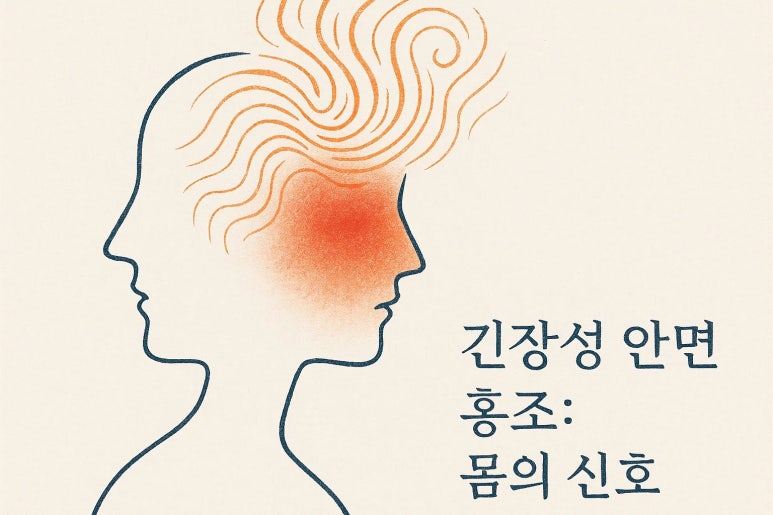
Is Blushing Really Due to My Willpower? Tension-Induced Facial Flushing is a Signal From Your Body.
Many patients I see in the clinic commonly say:
|
“Doctor, whenever I give a presentation in front of others or a meeting starts, my face quickly turns red. My heart pounds, and I sometimes break out in a cold sweat. It feels like my whole body suddenly gets hot. Every time, I feel a sense of self-reproach, wondering 'Why does this only happen to me?' ” |
Tension-induced facial flushing, where the face turns red, is not merely an expression of embarrassment or psychological inhibition; it is a very important signal sent by our body.
Initially, I also viewed this phenomenon as simply an emotional response.
However, by recording the vivid voices of patients and their subtle physical reactions in my clinical notes and examining them closely, I discovered clues that this phenomenon is connected to much deeper physiological principles.
In this process, exploring the intersection between Traditional Korean Medicine (TKM) patterns and modern physiological mechanisms has become my extensive clinical experience.
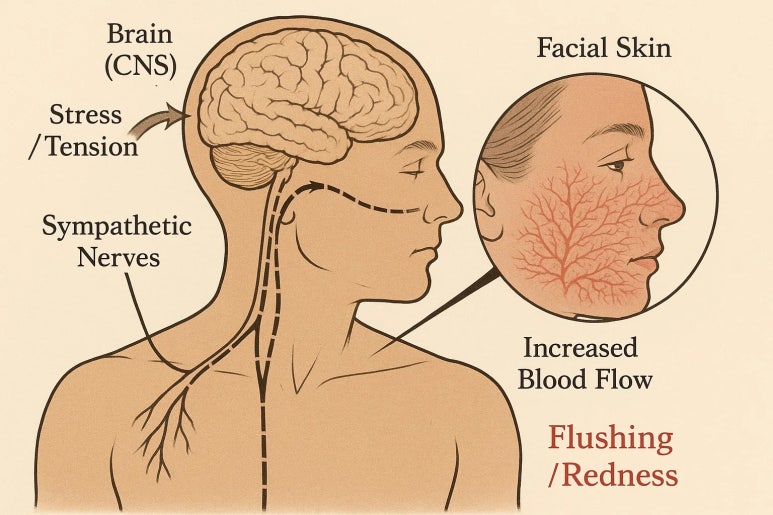
When we experience tension in unexpected social situations, the sympathetic nervous system, a part of the body's autonomic nervous system, becomes excessively activated.
It's as if the body enters an emergency state, like a car with its warning light on.
At this time, the heart beats rapidly, blood pressure rises, and blood rushes to peripheral blood vessels, especially in the facial area, causing the blood vessels to expand.
This leads to the phenomenon of the face suddenly turning red.
But why is it that in the same situation, some people's faces turn bright red while others' do not?
What is the context behind these individual differences?
What I focused on was the Traditional Korean Medicine pattern called heat flushing hidden behind the excessive reaction of the autonomic nervous system.
Beyond just sympathetic nervous system excitation, flushing becomes more severe and prolonged when there is an abnormality in the body's self-regulating heat control function.
It's similar to a situation where the cooling system that should cool down an overheating engine isn't working properly, causing the temperature to continuously rise.
Thus, when the body's internal thermoregulation system is overloaded or loses its balance, even minor stimuli can easily cause a rise in body temperature, sweating, and facial redness, manifesting as a pattern of heat flushing.
The focus is not simply on 'heat' that is externally visible, but on the mechanism by which heat is abnormally generated or not properly dissipated within the body.
|
For example, Ms. A, an office worker in her 30s, said that her face always turned bright red before important presentations, making it difficult for her to concentrate. However, as I delved deeper into her case, I found that Ms. A also suffered from chronic indigestion and irregular sleep patterns. I did not view all these symptoms as merely individual problems. I interpreted it as the body's cooling system not functioning properly, trapping heat in one place, which then acted as a vicious cycle, further exacerbating the autonomic nervous system imbalance. |
To deeply investigate this cause, I have long interpreted patients' symptoms from the perspective of Shanghanlun.
Shanghanlun, a classical medical text from thousands of years ago, has already interpreted the body's reaction system, which we now call the 'autonomic nervous system,' through its unique perspective of the 'Six Channels (Liujing).'
Shanghanlun is not merely a collection of prescriptions; it is a vast system of principles that delicately captures the body's physiological reactions and the progression of diseases.
In my clinical practice, this classical insight often serves as a powerful clue to understanding patients' complex symptoms.
Ultimately, tension-induced facial flushing is not just a skin problem.
While psychological inhibition can be a cause, behind it lies a state of disrupted overall body balance, characterized by autonomic nervous system imbalance and heat flushing.
When I see patients, I don't just look at their reddened face; I meticulously examine their overall condition, including their eating habits, sleep quality, stress response, bowel movements, and any co-occurring chronic symptoms.
It's like looking at a disease on a single tree, but if the tree's roots aren't strong and the soil is dry, spraying medicine on a particular leaf will be useless.
This is why the body's fundamental environment must be improved.
So, how can we break this vicious cycle and become the agent of our own recovery?
The herbal medicine treatment I pursue goes beyond simply cooling the face or temporarily calming the nerves.
The goal is to restore overall body balance, strengthen the autonomic nervous system's ability to regulate itself so it doesn't overreact to external stimuli, and normalize the body's internal heat regulation system.
Respecting each patient's unique body condition and life context, I formulate prescriptions as if weaving their own customized story.
Of course, herbal medicine treatment is not a short-term solution but a process that gradually changes the body's environment, requiring consistency and patience.
Throughout this entire process, I aim for a partnership with my patients, communicating transparently about the path forward.
[Key takeaway]To the many individuals whose social lives are inhibited and who suffer due to facial redness, I want to say: This symptom is not because you lack willpower or are weak-minded. It is simply a signal from your body. If you listen to this signal, identify the underlying principles such as autonomic nervous system imbalance and heat flushing, and restore your overall body balance, you will surely be able to reclaim a more comfortable and free daily life. I hope my clinical experience can be a small light on your path.