
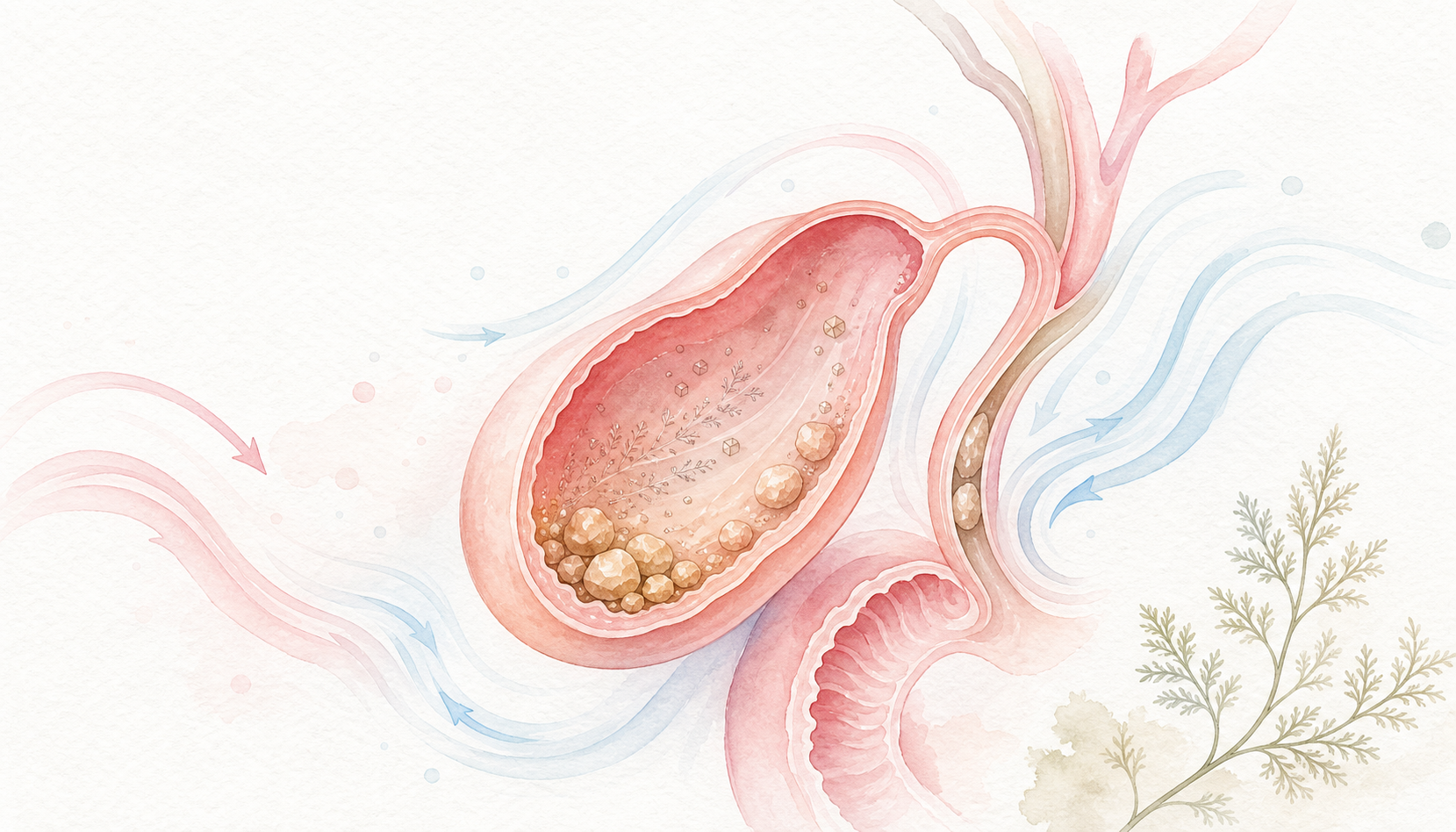
When a scan finds a gallstone, its size is not the first decision. Ask whether there are signs of a blocked duct or infection, where the stone is located, and whether pain has returned. Observation, gallbladder removal, and a procedure to clear the bile duct solve different problems. Diet changes, herbs, and acupuncture do not replace those decisions.
A stone is a finding; cholecystitis is inflammation
A gallstone is a solid deposit that can sit silently in the gallbladder. Cholecystitis means inflammation of the gallbladder; a stone may contribute to it, but finding a stone on a scan does not by itself diagnose inflammation. The NHS defines acute cholecystitis and explains its assessment. Fever, lasting pain, and vomiting change the urgency of assessment. Other abdominal conditions can cause similar pain, so a clinician combines the symptom history and examination with blood tests and imaging instead of assigning a diagnosis from one symptom or a single test result. This is an inference from NIDDK's multi-part diagnostic approach, not a claim that any particular normal result rules out disease.
Pain that lasts, fever, and jaundice need prompt medical assessment
Get medical help right away if upper abdominal pain lasts several hours or occurs with vomiting, fever or chills, yellowing of the eyes or skin, dark urine, or pale stools. These can signal a serious complication, but symptoms alone do not establish which one. Pain that settles does not prove a duct is clear. If these symptoms begin after surgery or an endoscopic procedure, use the treatment team's urgent contact route or an emergency department rather than waiting for a routine appointment. NIDDK explains the warning signs and why delay matters.
Bring the timing and duration of pain, temperatures taken, vomiting, changes in urine or stool colour, medicines, and previous scan or procedure reports. These notes help the clinician reconstruct what happened; they are not a home diagnostic test. Seek emergency help if you are faint, confused, or too unwell to travel safely.
Gallbladder stones and bile-duct stones are not interchangeable
Many stones discovered inside the gallbladder cause no symptoms and do not require immediate treatment. A repeated gallbladder attack, however, deserves a review of the treatment plan. A stone in the bile duct raises a different question: whether drainage is obstructed and whether infection or pancreatic complications need assessment. Neither a small stone nor a single normal-looking test result settles that question.
Ultrasound is a principal test for gallbladder stones. Blood tests can give clues about inflammation or problems involving the liver, bile ducts, or pancreas. If a duct stone remains possible, the team may consider magnetic-resonance cholangiopancreatography (MRCP) or endoscopic ultrasound (EUS). Endoscopic retrograde cholangiopancreatography (ERCP) is more invasive and is generally selected when treatment such as removing a duct stone is needed, not as a routine test for every gallstone. Ask what each test is meant to confirm and how its result would change care. See NIDDK's gallstone diagnosis guide and its ERCP explanation.
Observation, gallbladder surgery, and ERCP answer different questions
Observation is common when a gallbladder stone causes no symptoms. If attacks occur or recur, discuss the benefits and risks of cholecystectomy with the surgical team instead of assuming that a stricter diet will remove the stone. Medicines that dissolve certain cholesterol stones are considered only in selected circumstances; they are not a general substitute for surgery. NIDDK distinguishes these treatment paths.
An ERCP can clear a stone from the bile duct without removing the gallbladder. After ERCP, ask whether stones remain in the gallbladder, what follow-up is needed, and whether surgery should be discussed separately. The procedure result, infection or inflammation, and individual surgical risk affect the plan; this page cannot promise one operation date for everyone. New fever, worsening or severe abdominal pain, repeated vomiting, bloody or black stools, or vomiting blood after ERCP requires immediate contact with the procedure team; new jaundice also needs prompt assessment as a gallstone warning sign. Follow your own discharge instructions first. See NIDDK's post-ERCP warning list and gallstone warning signs.
What a Korean-medicine consultation can and cannot decide
Once urgent disease has been assessed and a medical treatment plan is clear, a consultation may explore how much a person can eat, when nausea or pain occurs, bowel changes, sleep, energy, and daily activities. Traditional descriptions such as qi stagnation or damp heat may organise the symptoms discussed in that consultation. They are not another name for an infected gallbladder, a blocked duct, or a test showing that a stone has passed.
Do not interpret herbal or acupuncture care as a proven way to dissolve stones, prevent infection or recurrence, or make recommended ERCP or surgery unnecessary. The sources cited here do not establish those effects for an individual treatment. Set observable goals for the remaining discomfort and agree when to reassess if it persists; seek prompt medical care again if warning signs appear. Tell the surgeon, endoscopy team, prescribing clinician, and Korean-medicine clinician about all prescription drugs, over-the-counter products, herbs, and supplements. Some products can interact with medicines or complicate a procedure. Do not stop a prescribed drug on your own. NCCIH explains why the full product list matters.
Food and symptoms after treatment
Avoiding every source of fat or losing weight rapidly is not a treatment for an existing stone. Use a balanced eating pattern and discuss foods that repeatedly trigger discomfort with the treating team. If attacks continue, revisit the diagnosis and treatment plan rather than lengthening a list of forbidden foods. NIDDK places diet and weight management in a prevention context.
Some people have softer or more frequent stools after gallbladder removal. Persistent diarrhea or difficulty eating still warrants review of medicines, diet, weight change, and other possible causes; do not label every new symptom a harmless consequence of surgery. New severe pain, fever, jaundice, or repeated vomiting needs urgent contact with the surgical team. Follow the discharge instructions you were given. NIDDK describes bowel changes after surgery.
Questions to take to the next appointment
Where was the stone actually found: in the gallbladder or a bile duct? Was there evidence of obstruction or inflammation? Why is observation, surgery, or ERCP proposed in this situation, and what remains to be decided after a procedure? Which new symptoms mean calling the team urgently? Bring your scan and procedure reports, a list of every medicine and supplement with doses, and a short account of the pain and meals. Symptom relief alone is not a reason to cancel planned follow-up without speaking to the treating team.
Explore three decisions in more detail
Why do gallbladder stones and bile duct stones need different tests and treatment?
Their location changes the risk and the purpose of testing. Ultrasound and blood tests often come first; MRCP or EUS may clarify a suspected duct stone, while ERCP is used selectively, usually to remove one.
After ERCP for a gallstone, do I still need to discuss gallbladder surgery?
Yes, discuss the plan. ERCP treats a bile duct stone; it does not remove the gallbladder. Whether and when to consider surgery depends on what remains, prior attacks, recovery, and individual surgical risks.
Before gallbladder surgery or ERCP, how should I report herbs and supplements?
Give the procedure team a full list of medicines, herbs, and supplements, including doses and the last time taken. Ask that team and your prescribers for individual stop-and-restart instructions; do not stop medicines on your own.
Frequently asked questions
I thought I just had indigestion, but suddenly I have a stabbing pain in the upper right abdomen. Is it because of the gallbladder?
It could, but the location or timing of pain cannot confirm a gallstone or cholecystitis. A clinician may need an examination, blood tests, and imaging; pain lasting several hours or accompanied by vomiting, fever, or jaundice calls for prompt assessment. Do not use a traditional pattern label to diagnose the cause of acute pain.
I've had my gallbladder removed, but I still have indigestion and frequent diarrhea. Why is this happening?
Bowel habits can change after surgery, but persistent symptoms have more than one possible cause. Take the timing, stool changes, weight, medicines, and surgical report to the treating team. Seek urgent assessment for new severe pain, fever, jaundice, or repeated vomiting instead of assuming recovery is simply slow.
I was told that I have gallstones, but I don't have any pain right now. Is it okay to just leave them alone?
Stones that cause no symptoms commonly need no immediate treatment. Ask what was found and which future symptoms should prompt a review. Do not treat an unproven idea about “bile stagnation” as evidence that an asymptomatic stone must be removed or treated with herbs.
Is it true that gallstones can be dissolved with herbal medicine?
Do not rely on herbs to dissolve a stone or clear a blocked duct. The information cited here does not establish a dependable herbal effect on stone size or the need for surgery. If you are considering a product, share its ingredients and all medicines with your treatment team, and keep the planned imaging or surgical follow-up.
I feel like my abdomen becomes stuffy and the pain worsens whenever I get stressed. What is the relationship between emotions and the gallbladder?
If pain and stress seem to occur together, record both without assuming that stress caused the pain. The timing and accompanying symptoms matter; recurrent attacks need a clinician's assessment. A traditional description can guide a conversation about daily discomfort, not replace imaging or an urgent assessment for lasting pain, fever, or jaundice.
I want to avoid surgery; how much can it be managed with Korean medicine?
Ask the surgeon why surgery was recommended, what happens if it is delayed, and which alternatives fit the actual stone and your health. Observation is different from postponing treatment for repeated attacks or a complication. Herbs or acupuncture should not be presented as proven ways to prevent infection, shrink stones, or make an indicated procedure unnecessary.