
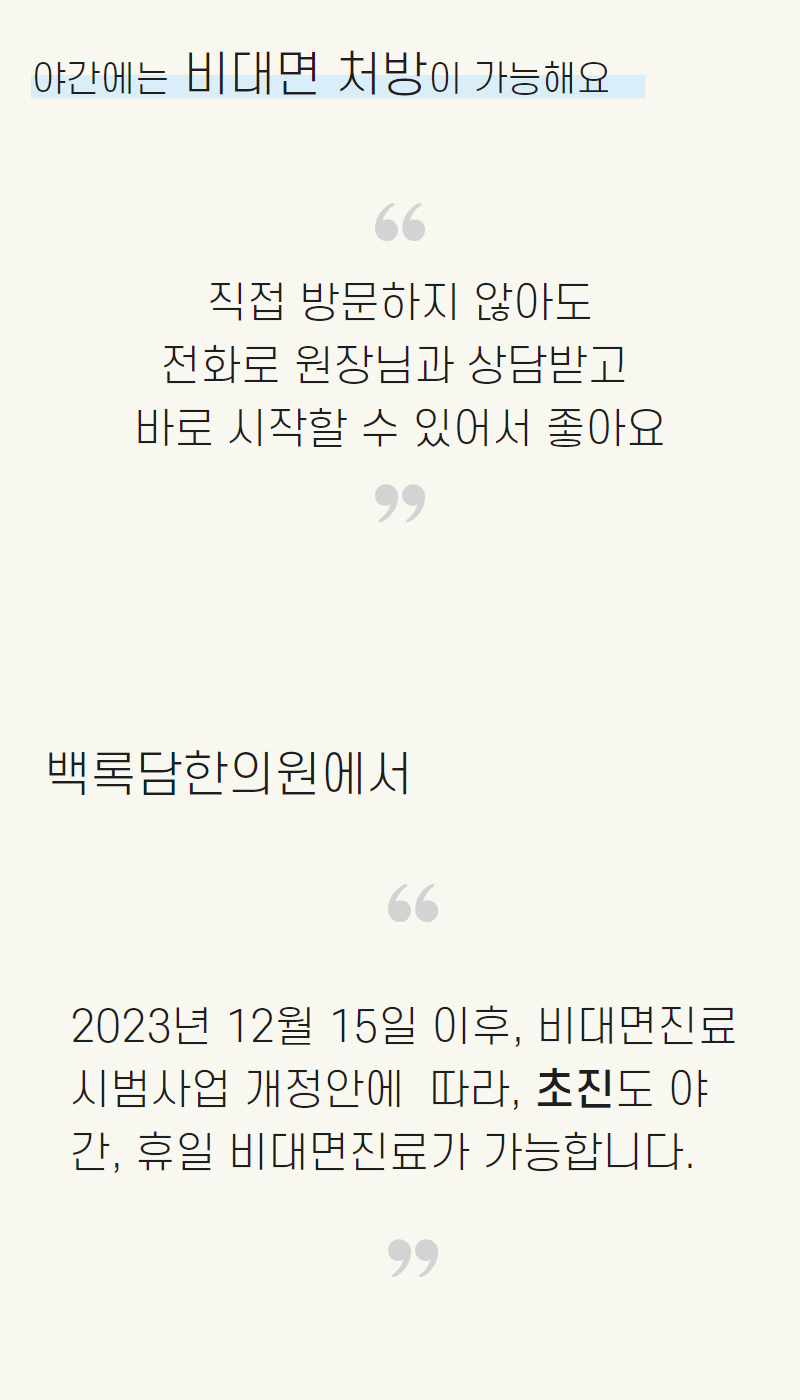
비대면 vs 대면
Q. I see a lot of remote prescription options these days. Is there really a difference between visiting a clinic in Jeongeup in person and just getting a prescription over the phone? Isn't the medicine the same?
A.
While remote consultations offer convenience, Traditional Korean Medicine is fundamentally a practice centered on direct human interaction. In-person visits allow the practitioner to perform pulse diagnosis and abdominal palpation to listen to your body's specific needs. While remote options are a practical choice for busy schedules, an in-person consultation is a precision-driven process aimed at identifying and treating the root cause of your health concerns.
📝 Detailed Answer
Hello, I am Director Choi Yeon-seung of Baekrokdam Clinic. I understand the courage it takes to visit a clinic after a long day, and the temptation of a simple phone call is completely natural. However, Traditional Korean Medicine (TKM) relies on the 'Four Diagnostic Methods' (Mang-mun-mun-jeol): Inspection, Listening and Smelling, Inquiry, and Palpation. Remote consultations rely almost entirely on inquiry. In contrast, seeing you in person allows me to capture subtle physical signals that words alone cannot convey.
For instance, determining whether weight gain is caused by 'Damyum' (phlegm-fluid/metabolic waste) or 'Qi Stagnation' (blocked energy flow) requires accurately checking the pulse and inspecting the tongue. Particularly for those with 'Spleen Deficiency' (weakened digestive function), medication dosage must be adjusted with extreme precision—a level of refinement that is only possible through face-to-face consultations.
Comparison of Services:
1. Diagnostic Method: In-person involves comprehensive Mang-mun-mun-jeol, while remote is limited to video or voice inquiry.
2. Precision: In-person uses pulse and abdominal diagnosis to determine constitution, whereas remote relies on survey-based estimation.
3. Customization: In-person allows for immediate reflection of your daily condition in the prescription, while remote focuses on standardized adjustments.
4. Care Level: In-person allows for supplementary treatments like acupuncture and moxibustion, which are unavailable remotely.
Regaining health or losing weight is not just about willpower; it is about restoring your body's internal balance. If you are near Jeongeup, I strongly recommend visiting for a proper diagnosis. It is often the fastest shortcut to achieving your health goals.
#comparison
#comparison-table

Expert Verified
Dr. Yeonseung Choe
Chief Director