BMI & Obesity: Formula, Normal Ranges, and Criteria

Table of Contents
There is a question patients often ask me in the consultation room: "Doctor, am I actually overweight, or is it just in my head?" I understand that feeling of uncertainty when you're standing in front of the mirror or looking at the numbers on the scale. In these moments, the first tool I turn to is calculating the obesity level. While it isn't a perfect indicator, it is a solid starting point for getting a big-picture view of where your body currently stands. Today, I’ll walk you through the official standards used by public health centers—how to calculate it and how to interpret the results—just as if I were sitting right next to you at my desk.
How is the obesity level calculated?
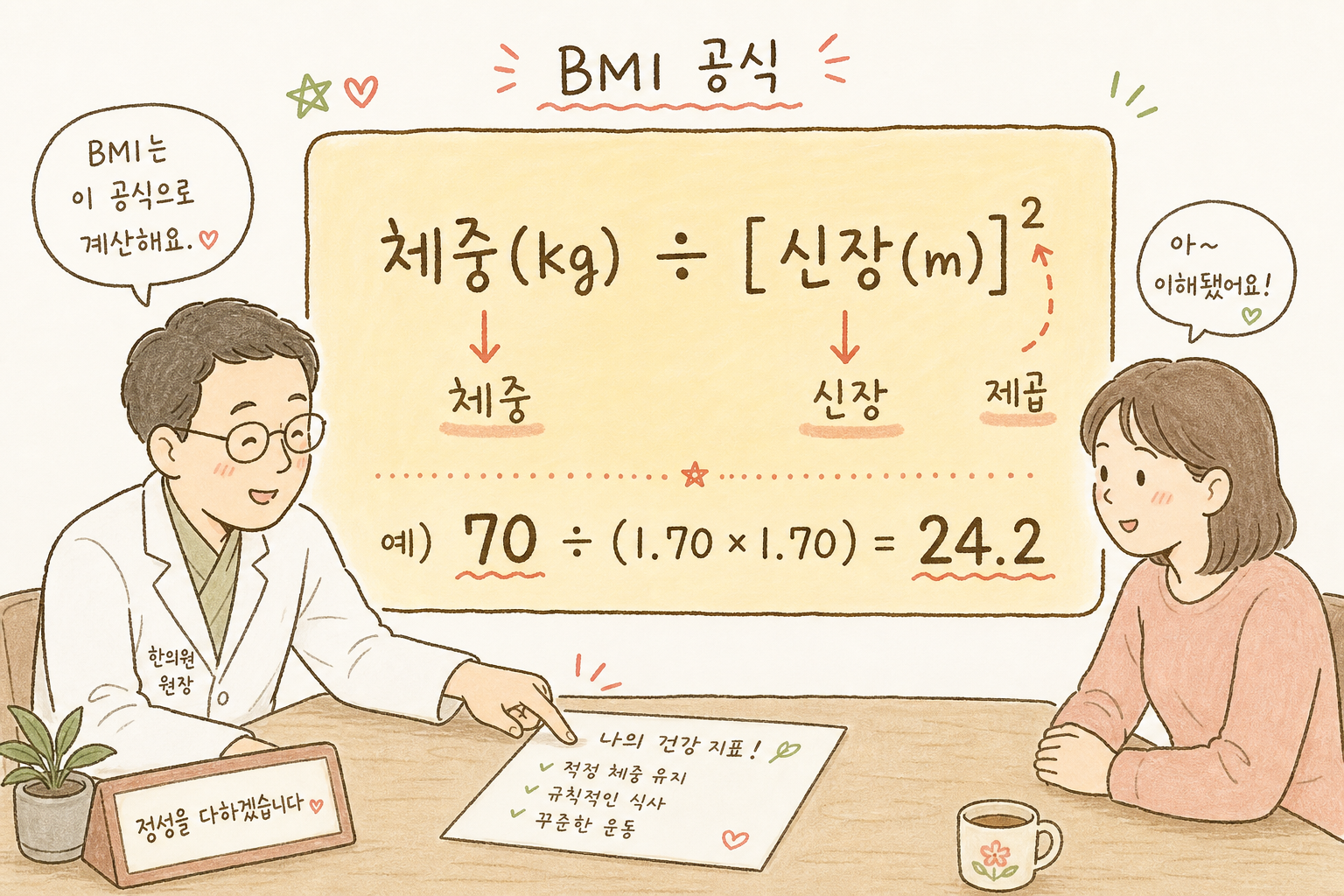
The most widely used metric is the Body Mass Index (BMI). The formula is simple: divide your weight (kg) by the square of your height (m). Written out, it is BMI = weight (kg) ÷ [height (m)]². The key is to use meters instead of centimeters. For example, 170 cm becomes 1.7 m, and 165 cm becomes 1.65 m. You can simply plug this into a calculator or use the automated devices found at health centers or Korean medicine clinics. Some people might find the formula too simple to trust, but both the Ministry of Health and Welfare and the WHO Asia-Pacific standards use this one-line formula as their starting point. Because it is so intuitive, it’s the first thing we look at in the clinic. You don't need to memorize anything complex—just remember: "Weight divided by height squared."
Let’s try a sample calculation
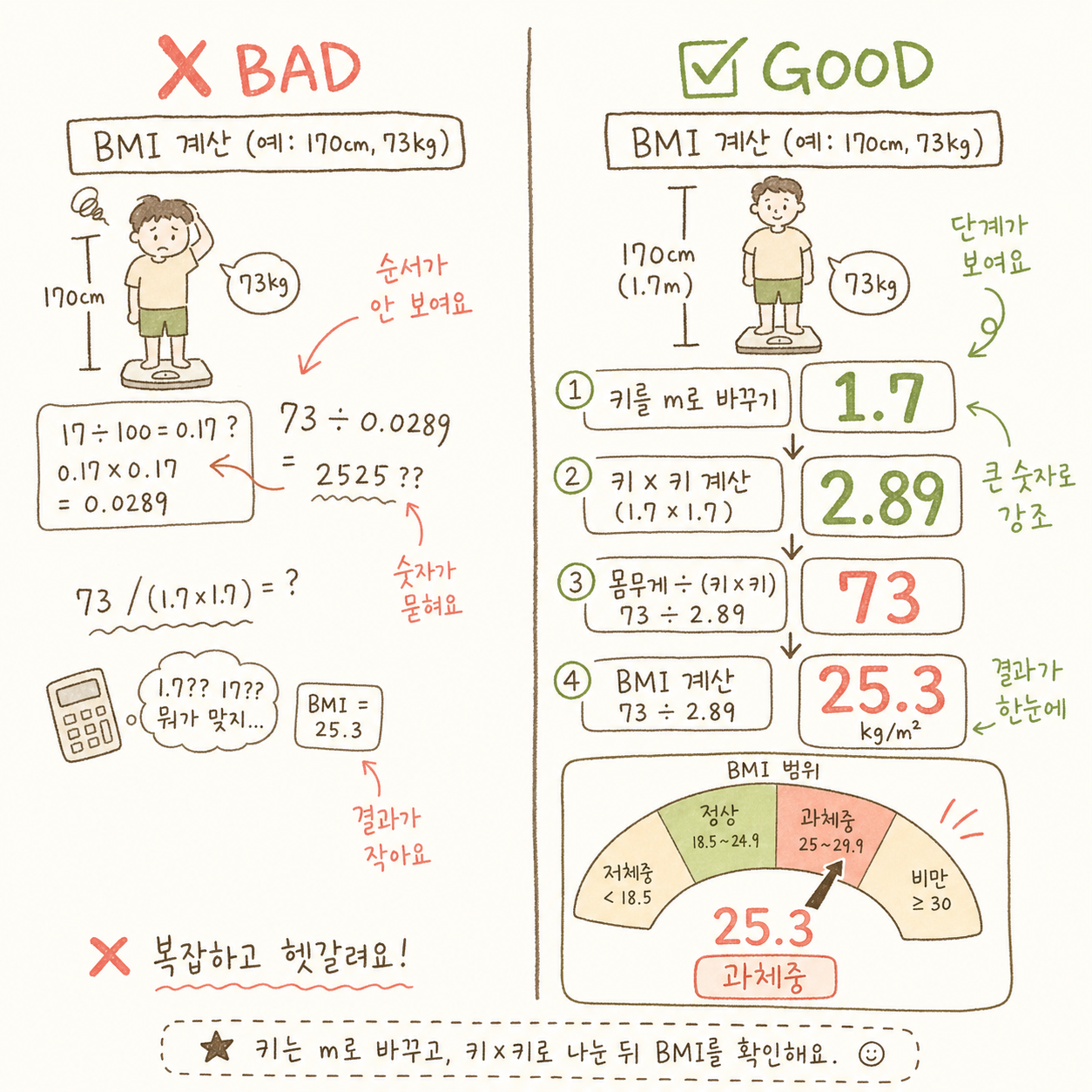
Since numbers can be abstract, let’s use a real example often found in public health materials. Suppose someone is 170 cm tall and weighs 73 kg. Converting the height to meters gives 1.7 m, and squaring that results in 2.89. Dividing the weight of 73 by 2.89 results in a BMI of approximately 25.3 kg/m². According to public health standards, this value has just crossed the line from overweight into Class 1 obesity. Many patients are surprised by this, saying, "Oh, I didn't realize I had gained that much weight." If the weight were lower for the same height, the score would drop into the 22 range (normal); if heavier, it would move up a level. The calculation is quick, but the moment of facing the result always feels heavy. That’s why I tell patients not to take even a simple number lightly. Once you note your BMI, the supplementary indicators we’ll discuss next will become much more meaningful.
How should you interpret the results?
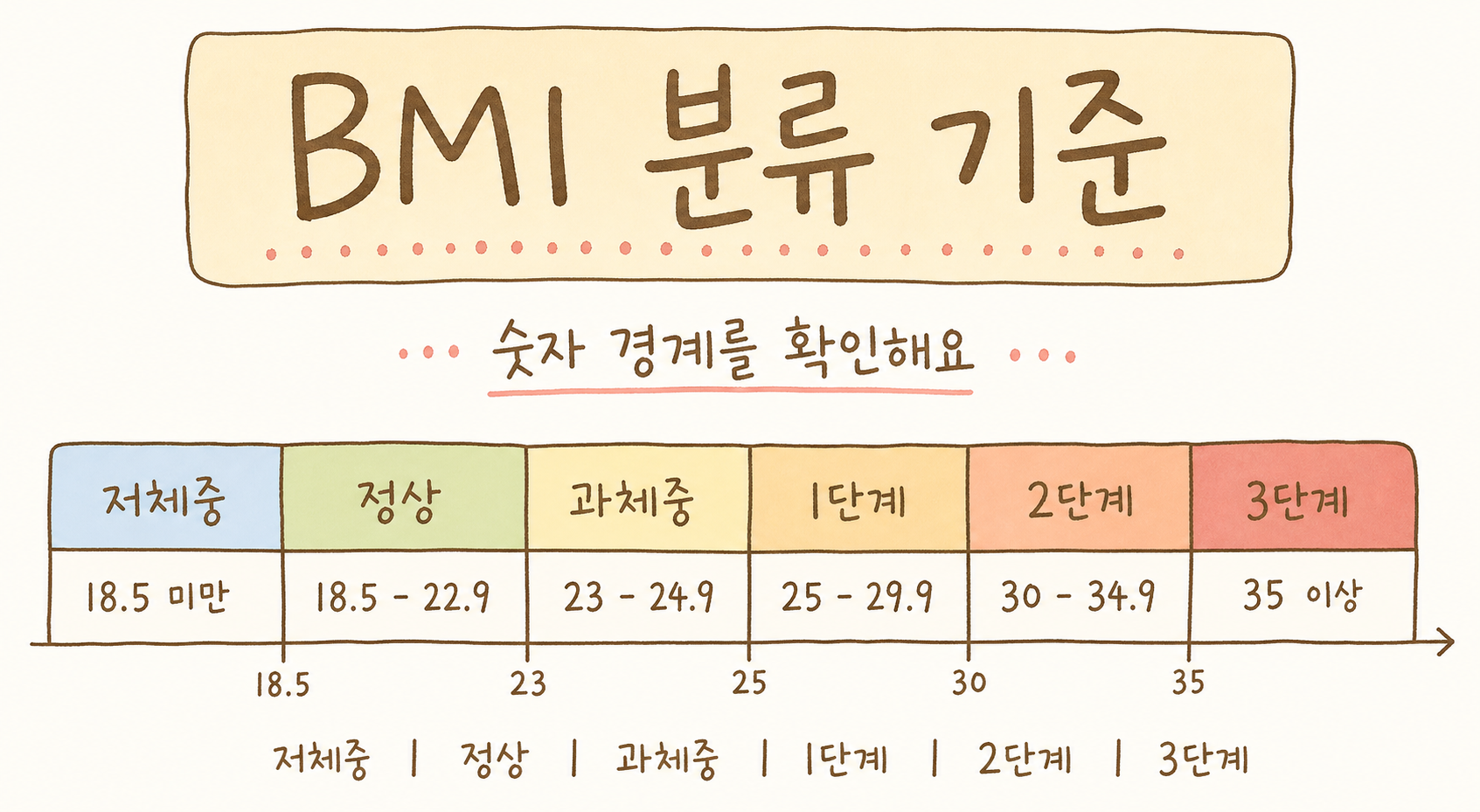
For Korean adults, the Ministry of Health and Welfare and local public health centers use the same chart. Here is the breakdown for those who find it confusing:
A BMI under 18.5 is Underweight.
18.5–22.9 is the Normal range.
23–24.9 is Overweight (also classified as pre-obesity).
25–29.9 is Class 1 Obesity.
30–34.9 is Class 2 Obesity, where health risks significantly increase.
35 or higher is Class 3 Obesity.
Because we follow the WHO Asia-Pacific standards, these numbers differ slightly from the Western standard where a BMI of 25 is often considered normal. You may have heard that Koreans tend to accumulate more visceral fat even at the same BMI, which is why stricter cut-offs are applied. Some local health centers might still use older criteria that define 20–24 as normal. Therefore, depending on where you get your results, the classification might shift by one level. While being in the normal range doesn't mean you can ignore your health entirely, if you are under 22.9, you can breathe a sigh of relief for now.
When the formula might not be accurate
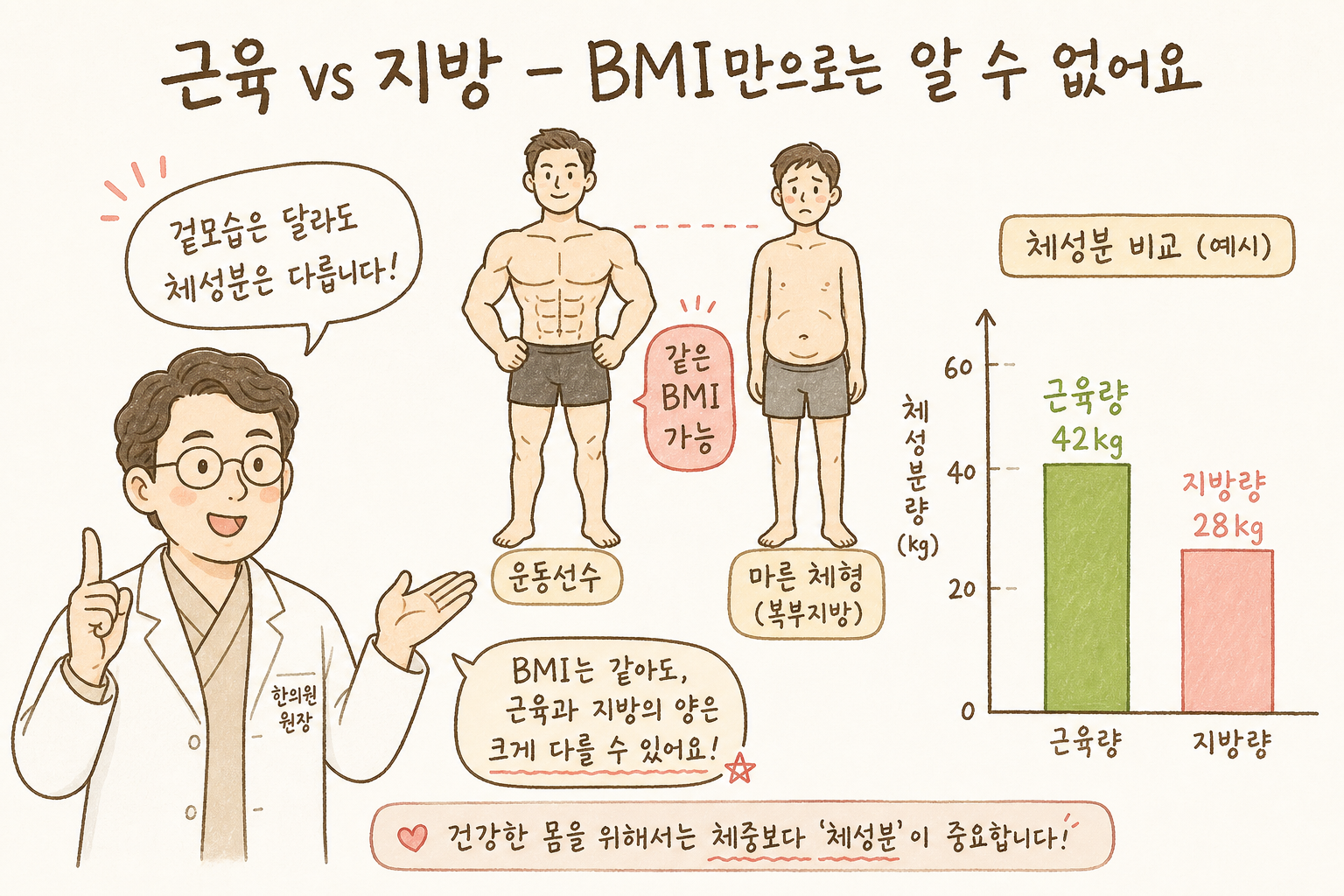
This is the important part. BMI is a tool that calculates based only on height and weight; it cannot distinguish between muscle and fat. Therefore, people who exercise regularly and have high muscle mass, like bodybuilders, may be flagged as "obese" based on BMI alone. Conversely, someone who is light but has very little muscle and high fat—often called "skinny fat" or normal-weight obesity—might show up as "normal" on the BMI scale. I see this often in the clinic. Patients say, "But my BMI is normal," yet their body fat percentage is well over 30%. It is also difficult to evaluate pregnant women, growing adolescents, and the elderly using this simple formula alone. In the elderly, muscle loss (sarcopenia) can progress rapidly, meaning that even if weight decreases, the fat ratio may actually increase. For adolescents, growth charts must be used instead. BMI is a starting point, not the finish line. Don't let one number dictate your mood; look at the supplementary indicators in the next section.
Supplementary indicators to consider
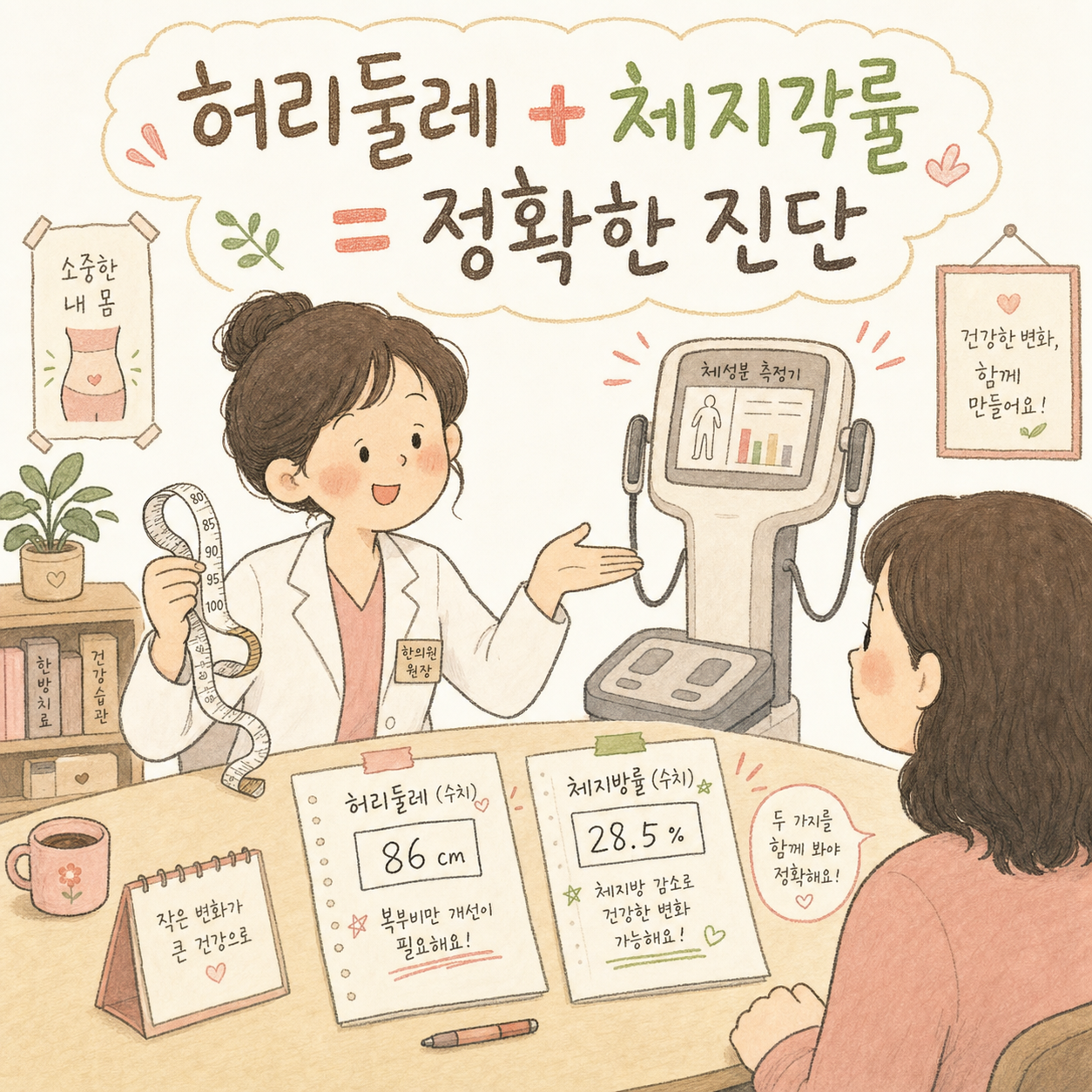
This is why public health centers always look at other metrics alongside BMI. Waist circumference is the first. For men, 90 cm or more, and for women, 85 cm or more, indicates a significantly higher risk of obesity-related complications and comorbidities. Since you only need a measuring tape to check this at home, it’s a method I frequently recommend. The second is body fat percentage. Regardless of BMI, a person is classified as obese if their body fat is over 25% for men or 30% for women. This can be measured with body composition analyzers like InBody, and many public health centers offer this service for free. For children and adolescents, the criteria are different. According to the 2017 standard growth charts, they are considered obese if they are at or above the 95th percentile or if their BMI is 25 kg/m² or higher. This is why adult standards should never be applied to children. You need to look at BMI, waist circumference, and body fat percentage together to get a three-dimensional view of your body. Focusing on just one number means you'll always miss part of the picture.
In Korean Medicine, we believe that even for the same type of obesity, the underlying cause differs for everyone. Some gain weight because of a weak digestive system, others due to persistent edema (swelling), and some because their Qi (energy) is not circulating properly. Therefore, we don't prescribe based on a single number. We examine the patient's overall physical condition and lifestyle patterns together.
The management principles recommended by health centers are straightforward: aim for a slow weight loss of 0.5–1 kg per week, perform aerobic exercise for 30 minutes at least 3 times a week, and reduce food intake by 20–30% while increasing vegetables and fruits. It’s about eating a little less at each meal and staying away from high-calorie foods and alcohol. Losing weight too quickly inevitably leads to the yo-yo effect. At our clinic, we build upon these principles by assessing the patient's constitution and digestive health, supporting them with Baengnok Gambi-jeong. If the BMI you calculated today is weighing on your mind, don't blame yourself. Come by the clinic for a chat, and let’s work through it together, step by step.