
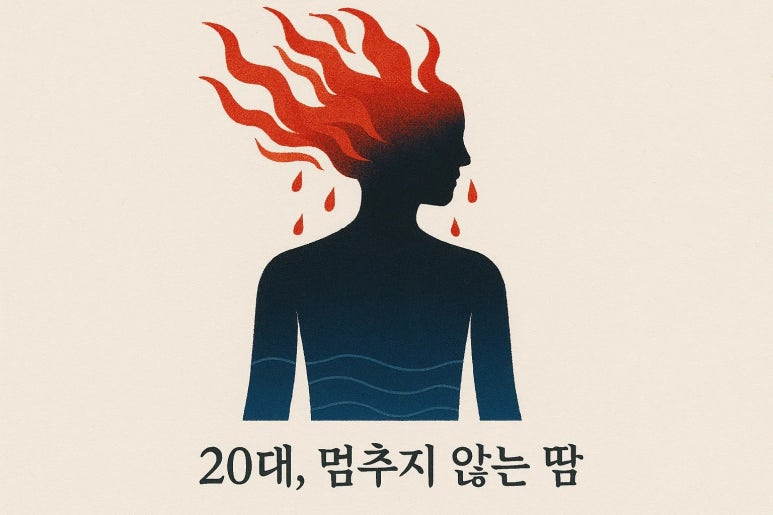
20s, Unstoppable Sweat | Incheon Hyperhidrosis

For those in their 20s, unceasing sweat. Could it be that my body's 'CPU' is overheating?
If our body were a sophisticated computer, hyperhidrosis should be seen not as a cooling fan's performance issue, but as an 'overheating CPU' problem.
No matter how good a cooling fan (sweat gland suppression) you install,
if the CPU (our body's regulatory system) itself continues to overheat, the problem will remain unresolved, much like in a computer.
| [CASE] A 20-something Designer's Account Patients in their 20s whom I see in my clinic often confide these difficulties. I recall the story of one designer who was constantly anxious that sweat from her hands would drench her materials whenever she gave a presentation to clients. |
| "In situations where I have to shake hands, I don't want my sweaty palms to be noticed, so I instinctively wipe them on my clothes. This only intensifies my hyperhidrosis-related stress." |
The common thread among them is clear.
Even in non-hot environments,
for example, in a cool meeting room, if their tension rises, they invariably experience excessive hand sweating.
They had already tried sweat inhibitors like Driclor from pharmacies,
but the effects were temporary, or consistent use was difficult due to skin irritation.
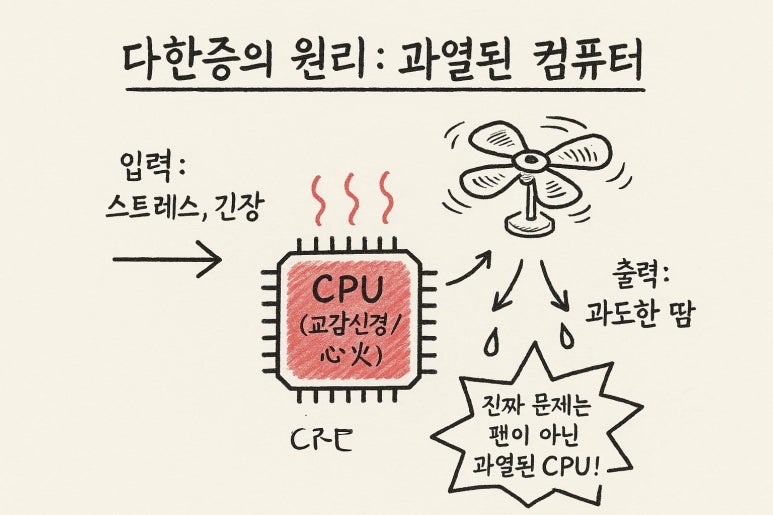
| [Key Limitations to Note] Here, the 'limits' of existing treatments are revealed. Physically blocking sweat pores can temporarily reduce sweat, but it doesn't answer the fundamental question: 'Why does my body produce so much sweat?' On the contrary, forcibly blocking sweat on the hands can lead to 'compensatory hyperhidrosis,' where sweating increases in other areas like the back. This is akin to heat from an overheating CPU escaping through other vents. In other words, the underlying cause, the state of sympathetic hyperactivity, remains unchanged. |
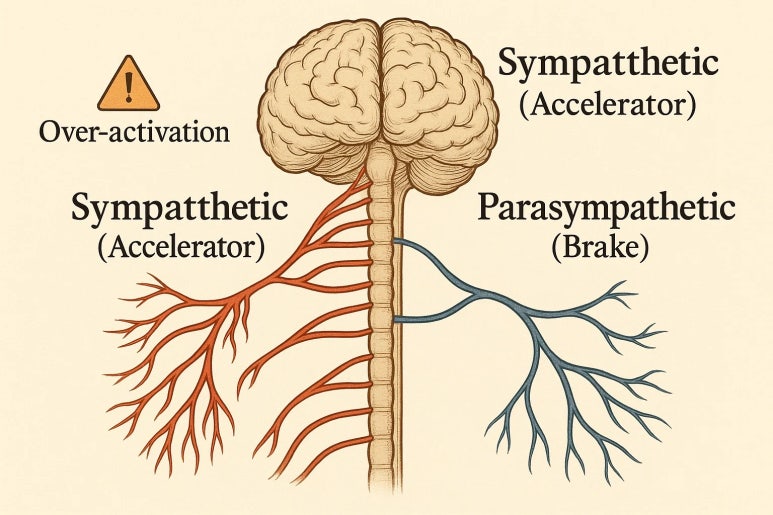
Therefore, we must shift our perspective and focus on the 'autonomic nervous system' – our body's 'overheated CPU'.
| [Traditional Korean Medicine Perspective: 心之液爲汗] From ancient times, Traditional Korean Medicine (TKM) has interpreted the issue of sweat as deeply connected to the heart (心). The *Huangdi Neijing* (Yellow Emperor's Inner Canon) stated that 'the fluid of the Heart becomes sweat (心之液爲汗),' a profound insight that excessive stress and tension accumulate heat in the heart, and this heat expels vital fluids out of the body as sweat. This is one of the representative symptoms of autonomic nervous system dysfunction. |
This 'unceasing heat' is called 'Heart Fire (心火)' in TKM, and the body's 'cooling water' that quenches it is referred to as 'Kidney Water (腎水)'. A healthy state is characterized by the smooth circulation of Su-seung-hwa-gang (水升火降), where cool water (水) rises to cool down hot fire (火).
Hyperhidrosis is an urgent signal from our body that this delicate balance has been disrupted, where the flames continue to rise while the cooling water below has dried up.
Have you, too, been thinking of sweat merely as an 'enemy to be eliminated'?
| [Beginning a New Inquiry] Now we can ask the real question. Not, 'Which medicine should I use to block my sweat pores?' but, 'How can I turn off my body's overheated engine and restore the broken balance of water and fire?' Starting treatment at a hyperhidrosis traditional Korean medicine clinic is a journey to find the answer to this very question. At the end of this journey, we can finally be free from sweat. |