
Hand Hyperhidrosis in 20s, Why Does It Occur? | Incheon Hyperhidrosis

Hand Hyperhidrosis, You Are Not Alone.
Among the many people I meet in the clinic, there are not a few women in their early 20s who suffer particularly from `hand hyperhidrosis`.
Listening to their concerns, I deeply empathize with the pain where even small moments of daily life feel like huge obstacles beyond simply sweating a lot.
\"Am I really strange?\" \"Why am I the only one sweating like this on my hands?\" \"Because of my hands, I’m so nervous about shaking hands, holding hands, even paper getting wet during exams.\" \"I’m afraid people will be displeased looking at my hands, so I keep shrinking back.\" \"I think this is even making my personality passive.\"
Whenever I face such concerns, my heart aches. I know too well the weight of psychological stress that shakes a person’s confidence, social life, and overall interpersonal relationships, which cannot be dismissed as just ’sweating a bit.’
Hand Hyperhidrosis, Why Does It Occur?
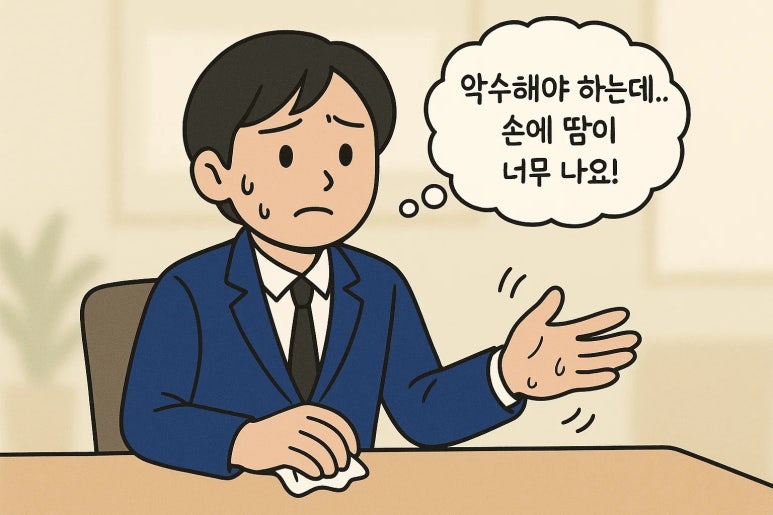
Hand hyperhidrosis medically refers to `a state where sweat is excessively secreted without a special cause`.
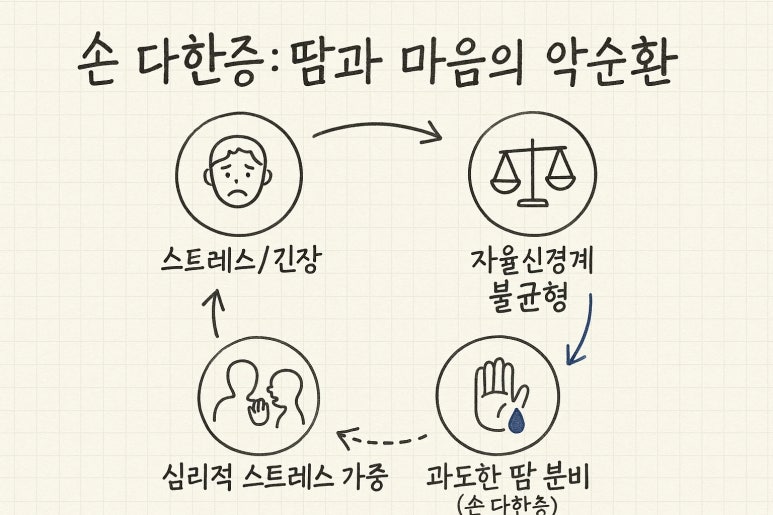
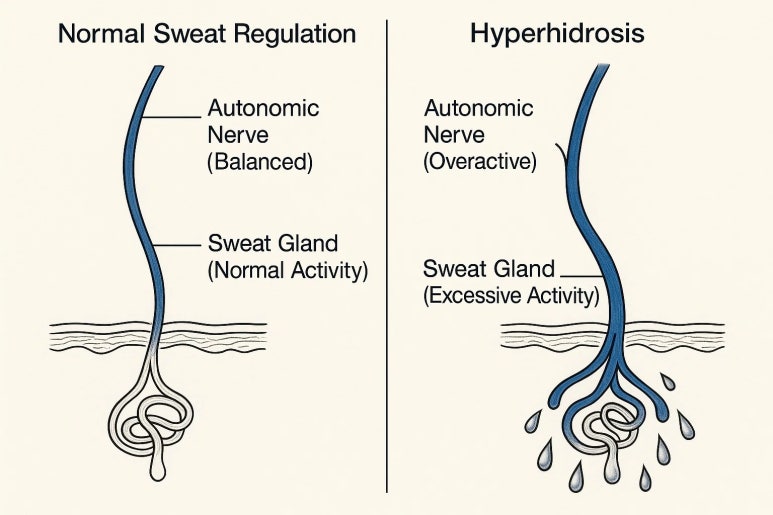
Our body’s `autonomic nervous system` regulates sweat glands, and as this balance breaks, sweat comes out excessively.
`It is like the accelerator of a car reacts too sensitively and gains speed regardless of the driver’s intent.`
Such sweat secretion tends to worsen particularly in emotional stress or tense situations.
So even the moment of shaking hands when meeting a new person, or even holding hands with a lover while ahead of an important presentation, comes as enormous psychological stress to them.
Common Misconceptions: Is It ‘Just Because There is a Lot of Sweat’?
Many people find information on the internet or hear stories around them and make rash judgments.
Sometimes they consider extreme methods like surgery or Botox procedures first.
However, according to what I experienced in clinical practice, hand hyperhidrosis was a problem where overall body balance and mental stability had to be looked after together beyond simply reducing sweat.
It’s easy to think hyperhidrosis is a problem occurring ’just because there is a lot of sweat.’ So there are many cases where they think lightly as in ’applying deodorant’ or ’wiping frequently.’
However, hyperhidrosis is not simply a superficial hygiene problem. `Autonomic nervous system imbalance` inside the body is the main cause, and this problem is not fundamentally solved by simply suppressing symptoms seen on the surface.
Particularly, some have the misconception that ’it must be operated on to be cured,’ but surgery is a `non-reversible method of cutting the sympathetic nerve`, and the risk of side effects such as `compensatory hyperhidrosis` clearly exists. Therefore, it should be seen as one of the options to be carefully considered rather than an unconditional solution.
My Clinical Treatment Principles
The treatment I pursue starts from closely looking at each patient’s body state.
Patients often let me hear voices of patients such as \"I sweat because I have a lot of heat,\" \"I think it’s because my heart is weak.\"
Each and every one of such sensory expressions becomes an important clue to me.
In addition to traditional Korean medical diagnosis methods such as feeling the pulse, looking at the tongue, and abdominal examination, I comprehensively grasp daily life patterns and the degree of interpersonal relationship stress during social life.
Some people sweat more when stress is severe, and some tend to have moist hands when digestive function is weak.
Like this, reading the unique pattern of each patient is important.
My role is to gather these clues to interpret the principle of hyperhidrosis as in solving a puzzle, and establish and verify a hypothesis suitable for it.
Frequently Asked Questions (Q&A)
Then how can we actually manage and treat it?
Q1: Do I have to have surgery or get Botox injections to get better?
A: No. Surgery or `Botox` can be effective methods, but side effects and limits clearly exist. After sympathetic nerve resection, ’`compensatory hyperhidrosis’ where sweat comes out more in other areas besides hands appears, and Botox has the hassle of having to get it periodically. I aim for giving the power to regulate sweat by oneself by regaining body balance rather than such temporary suppression.
Q2: Can hyperhidrosis really get better with herbal medicine?
A: `Herbal medicine` treatment helps regulate sweat secretion by balancing the body’s `autonomic nervous system`, regulating stress reaction, and improving imbalance of internal organs such as gastrointestinal function. This is a process of helping the patient recover a generally more comfortable and healthy state beyond simply suppressing sweat. According to research, `traditional Chinese medicine (CHM)` was shown to `increase pregnancy rate` compared to Western medical methods in infertility treatment. This research is not a direct comparative study on hyperhidrosis, but can be referenced as a case showing that `herbal medicine can be effective in regulating overall body functions and regaining balance`.
Q3: Is there any self-management method I can try myself in daily life?
A: Of course. Since hand hyperhidrosis is closely related to stress, stabilizing the mind is important. `Relaxation exercises` such as regular meditation, deep breathing, and yoga are helpful in balancing the autonomic nervous system. Also, it is good to reduce foods that can stimulate sweat glands such as caffeine or spicy foods, and get sufficient sleep. Carrying a handkerchief with good absorbency or using gloves of natural fiber material can also be helpful in reducing practical discomfort in daily life.
Patient B’s Story: Confidence Blooms as Sweat Dries
The story of Patient B, a woman in her early 20s whom I treated, comes to mind.
B was losing sleep at night because of hand hyperhidrosis ahead of an interview.
\"Just imagining shaking hands with the interviewer makes sweat pour from my hands like rain.\" \"I’m worried if note-taking won’t go well because the hand holding the pen is also moist,\" she said.
I listened to B’s voice of the patient and carefully heard her sensory expressions in the interview situation.
Looking at the pulse, the heart beat was irregular due to tension and digestive function was also weak.
Based on these complex clues, I prescribed `herbal medicine` that stabilizes heart and stomach functions and regulates stress reaction, and informed her of self-management methods such as meditation and deep breathing.
One month later, B told me the news that she passed the interview with a bright face.
\"Thanks to the director, I didn’t shed a single drop of sweat on my hands in the interview room.\" \"Above all, I gained confidence as I no longer pay attention to my hands.\" This word was a great reward to me.
B no longer felt psychological stress in interpersonal relationships or social life and enjoyed daily life much more actively than before.
Your Hands Are No Longer Anchors
Hand hyperhidrosis is a problem that can cast a shadow on your mind and life beyond simply physical symptoms of sweating a lot.
However, that shadow can be sufficiently cleared.
The important thing is the effort to listen to the body’s voice and understand the principle of why sweat of such a pattern comes out rather than being buried in the symptom itself.
And it is to meet a companion who will sincerely listen to your story and find a solution together in that process.
I hope you gain comfort from this post that \"I am not the only one suffering like this\" and at the same time find a small hope that \"I too can change.\"
If you pay attention to your own body and mind and actively find `treatment and management` methods suitable for you, `the mind that was stifled as much as the moist palms will surely be able to dry out boisterously again`.
I sincerely support your hands no longer being anchors but becoming a `link to face the world confidently`.