Recovering Slowly: Is Overcoming Bell’s Palsy Aftereffects Possible in Your 30s? | Incheon Bell’s Palsy

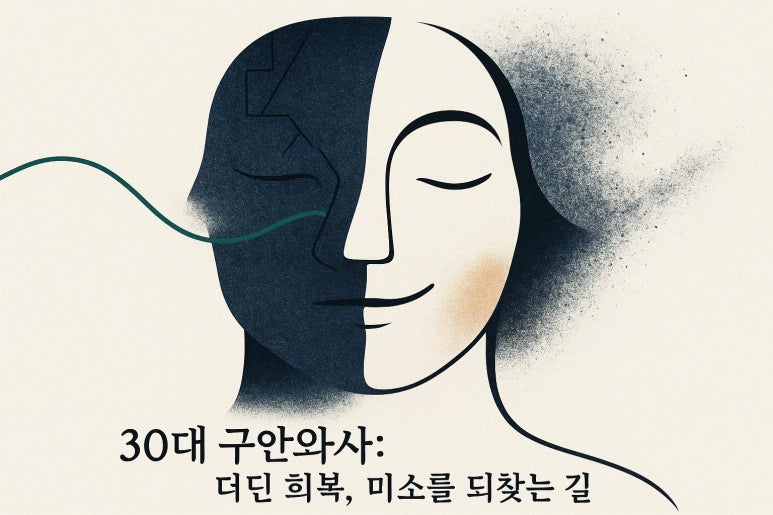
Recovering slowly, is overcoming Bell’s palsy aftereffects possible in your 30s?
Why does Bell’s palsy in your 30s feel uniquely slow and difficult?
Patients in their 30s whom I meet in the clinic often ask these questions.
“Director, am I the only one who is this slow?”
“Why does the area around my eyes or mouth keep twitching?”
“I’m so scared of meeting people.”
At first, you might have thought of Bell’s palsy as just ‘paralysis symptoms that suddenly arrived.’
However, many people are greatly affected not only in their daily lives but in their social lives overall as recovery is slower than expected, or as aftereffects like subtle facial asymmetry and strange discomfort remain even after time passes.
At this time, patients suffer from deep psychological anxiety and social withdrawal, going beyond simple physical pain.
Facial paralysis aftereffects suffered at a young age particularly deal a huge blow to self-esteem and make one afraid of standing in front of people.
I also want to listen to these voices, deeply understand their essence based on the wisdom of classical medicine and modern clinical experience, and find practical solutions together.
Can Bell’s palsy aftereffects really be overcome?
With what mindset and in what way should we navigate this time?
Beyond Visible Symptoms, the Weight of Invisible Aftereffects
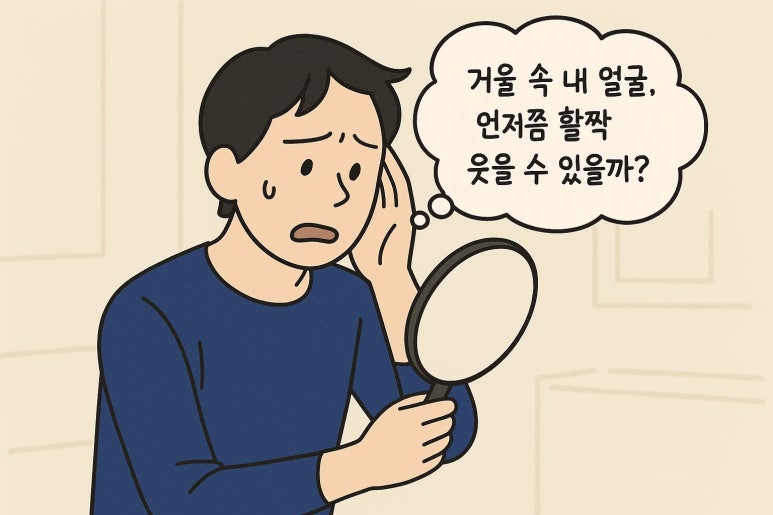
Bell’s palsy aftereffects hold a complex meaning beyond simply having awkward facial movements.
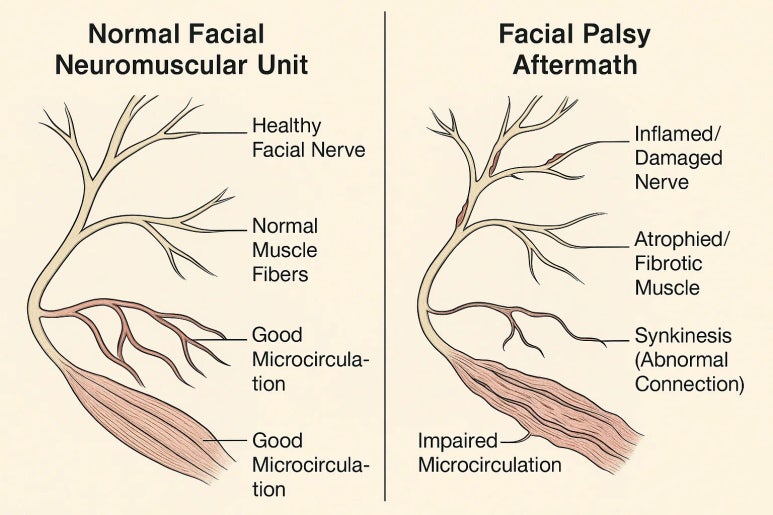
Here, a deeper pain that suffocates the patient’s life resides, besides physical symptoms like facial asymmetry or synkinesis (`synkinesis`, for example, the phenomenon where the corner of the mouth moves when closing the eyes) that we commonly talk about.
A female office worker in her 30s, Patient A, whom I met, confessed her concerns like this.
“I just sigh every time I look in the mirror. My friends comfort me saying I ‘look okay,’ but in my eyes, it still looks uneven… I keep worrying about how others see my face when I’m in a meeting, so I’m cautious even about speaking. I can’t even dream of smiling broadly like before. I’m scared I might have to live like this for the rest of my life.”
Patient A’s story represents the voices of many patients with Bell’s palsy aftereffects in their 30s.
Even if it’s a subtle change on the outside, it is a serious problem for the person involved that shakes their quality of life to its core.
According to research, appearance changes like facial paralysis can increase the possibility of a depression diagnosis by 39% and an anxiety disorder diagnosis by 31%.
In fact, it has been reported that 70% of patients feel embarrassed about their condition and more than 58% experience feelings of depression.
These figures are clues showing that Bell’s palsy aftereffects go beyond physical pain and are an essential problem that deepens the patient’s psychological distress and social withdrawal.
At this point, I ask the question, ‘What is really making them this tired?’
Is it simply because the nerves haven’t recovered?
Or is there another invisible principle at work internally?
Finding the Way in Classics, Seeking the Answer in Clinics: The Power of an Integrated Approach
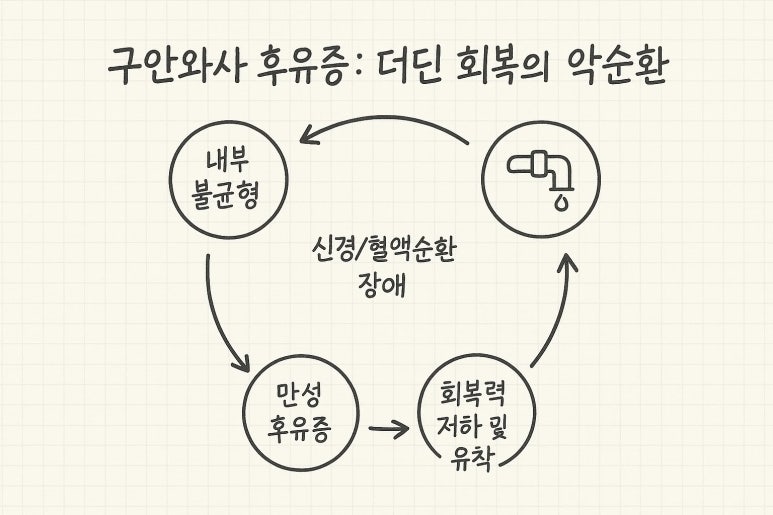
I find the reason why recovery from Bell’s palsy aftereffects is slow in a ‘state where the body’s balance is broken.’
In old medical texts, facial paralysis was called ‘Gu-an-wa-sa (口眼喎斜),’ and it was seen as not just being due to external factors (Wind).
It was interpreted that the body’s ‘Vitality (正氣)’ had weakened, or waste products like ‘damp-phlegm (痰飮)’ or ‘blood stasis (瘀血)’ blocked the communication of the meridians, affecting facial muscles and nerves.
From a modern medical perspective, this can be thought of in connection with nerve inflammatory reactions, blood circulation disorders, muscle atrophy and fibrosis, and imbalances in the autonomic nervous system.
Particularly, many patients in their 30s have lower recovery power due to stress, irregular lifestyle habits, and overwork.
In such situations, nerve damage cannot recover properly, and the damaged area instead overreacts or creates new patterns, such as adhering to surrounding muscles.
This is the essential reason why Bell’s palsy aftereffects feel ‘slow’ and ‘subtle’ discomfort continues.
Patient B, a man in his 30s who recently visited me, complained of severe stress due to synkinesis where the corner of his mouth subtly rose whenever he blinked, despite having received good acute treatment early on. Upon examination, Patient B had severe indigestion and chronic fatigue, and many nights he couldn’t sleep well. While examining Patient B’s facial muscle state, I also conducted herbal prescriptions and acupuncture treatment to improve overall Qi and Blood circulation and organ function. Particularly, I delicately performed acupuncture treatment to retrain the nerve circuits that control subtle facial movements. A few weeks later, Patient B showed a faint smile, saying, “The corner of my mouth definitely feels like it’s being pulled up less when I blink. My night’s sleep has also deepened.” The integrated approach of balancing the entire body contributed to the fundamental improvement of subtle aftereffects.
The principle of ‘harmony inside and outside the body’ presented by classical medicine is importantly applied in modern clinical practice as well.
It is the key to increasing self-recovery power by normalizing the entire body’s circulation and function, beyond simply stimulating the paralyzed nerve area.
This is like a garden maintenance analogy.
Just because a specific flower in the garden has withered doesn’t mean you only give fertilizer to that flower; you make the overall environment of the garden healthy, including soil nutrients, sunlight, amount of water, and whether there are pests.
Our bodies are the same.
Helping nerve cell regeneration, reducing inflammatory reactions, relaxing hardened muscles, and stabilizing the autonomic nervous system unstable with stress are essential principles in managing Bell’s palsy aftereffects.
This Bell’s palsy management is even more effective when performed through a multi-faceted approach including herbal medicine, acupuncture, and physical therapy.
Particularly, herbal medicine can help change the body’s environment and restore balance, rather than just suppressing simple symptoms.
Standing Tall as an Agent of Recovery: The Way to Reclaim Your Life
To be honest, Bell’s palsy aftereffects are a journey that requires patience.
However, I emphasize that patients in this journey should not be ‘passive treatment targets’ but ‘active agents of recovery.’
Treatment does not just mean the herbal medicine I give or the acupuncture I provide, but the entire process in which the patient understands and cares for their own body and mind.
In that case, what can we do to effectively overcome and manage Bell’s palsy aftereffects?
1. Listen to your body’s voice: Carefully record changes like subtle facial twitching, pulling, or stiffness and share them with medical staff. This becomes an important clue for setting the treatment direction.
2. Finding psychological stability: Stress and anxiety are the biggest enemies hindering recovery. Find a stress relief method that works for you, such as meditation, yoga, or light walking, and if necessary, consulting a mental health professional is also good.
3. Consistent self-management: It is important to consistently practice stretching, massage, and exercises guided by medical staff every day.
4. Nutrition and sleep: A balanced diet and sufficient sleep that help the body’s recovery are essential for nerve regeneration and boosting immunity.
5. Find a trustworthy companion: Meet medical staff who will look beyond just symptom relief, understand your entire life, and be with you from a long-term perspective.
The most important message I want to give to those having a hard time with Bell’s palsy aftereffects in their 30s is that ‘you are not alone’ and ‘there is hope.’
What I focus on is exactly the recovery power within you.
The body always has an amazing ability to heal itself.
Our role is to create an environment where that ability can be exercised and provide necessary help.
Facial paralysis aftereffects do not stop your life but can be an opportunity to briefly look back at the direction. Through an integrated approach that touches not only the visible discomfort but also your mind and daily life hidden behind it, we can walk this path together.
Ultimately, reclaiming a bright smile again and communicating with the world with confidence—that is the rightful life you should enjoy and the true meaning of recovery.
I sincerely hope this post becomes a small lamp on your recovery journey.