

Panic Disorder in My 30s: My Heart Sinks When I Fly | Incheon Panic Disorder

Every time I board a plane, my heart sinks… What's crashing isn't the plane, but your body.
Our body's anxiety system is like a 'fire alarm'.
When there's an actual fire, it rings to protect us, but sometimes it blares loudly even at winter steam, startling everyone. Flight-related panic disorder is precisely this 'malfunctioning fire alarm'.
Even when there's no actual danger, the brain sends an emergency signal throughout the body, saying, 'I could die right now.'
| [CASE] The Skies Grounded for 5 Years Mr. A, a consultant in his early 30s, was facing an important overseas project. However, he hadn't been able to board a plane even once since experiencing his first panic attack on a flight five years ago. Any place unreachable by KTX might as well not have existed in his world. |
| "When the plane door closes and it races down the runway for takeoff, my heart pounds as if it's about to explode, and I can't breathe. My hands and feet grow cold, my whole body trembles, and all I can think is, 'The plane will crash, or I'll die right here.'" |
Many people mistake these symptoms for precursors to a heart attack or stroke, but the reality is different.
The onset of all these dramatic changes stems from a very subtle 'change in breathing'.
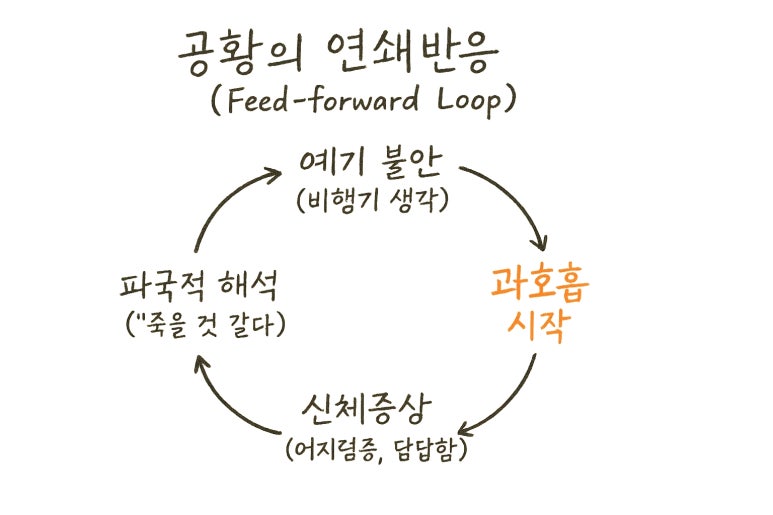
| [It's Not a Matter of Willpower] Simply advising 'have willpower and endure it' is powerless in this situation. This is because it's not a matter of willpower, but a state where your body is caught in a physiological storm of autonomic nervous system malfunction. It's like shouting 'power through it with mental strength' at a blaring fire alarm. |
The real cause lies in the alarm itself, that is, our body's anxiety regulation system. The enclosed space of an airplane and the thought 'I can't escape' stimulate the brain's amygdala, hyper-activating the sympathetic nervous system.
At this point, our body unconsciously enters a state of 'hyperventilation'.
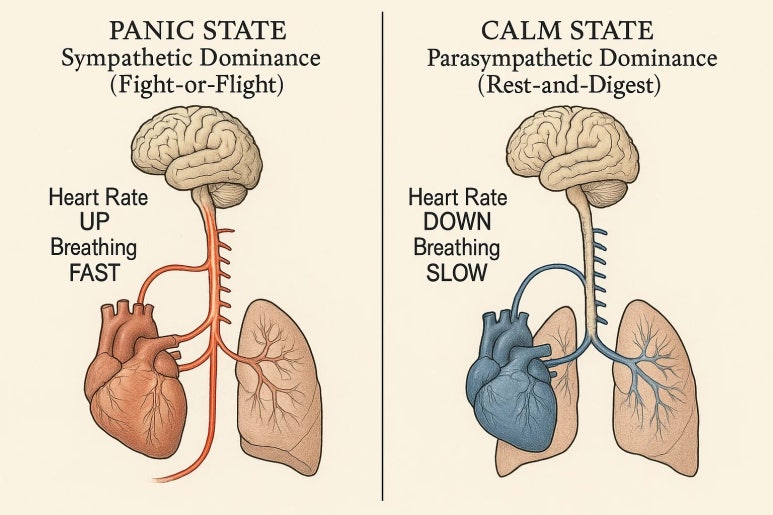
| [Physiological Interpretation: The Paradox of Hyperventilation] Hyperventilation symptoms refer to the phenomenon of shallow, rapid breathing when anxious. When breathing, normally 12-20 times per minute, rapidly increases to over 30 breaths, the concentration of carbon dioxide in the blood sharply decreases. Carbon dioxide plays a vital role in properly dilating blood vessels and smoothly supplying oxygen to the brain. When it becomes insufficient, cerebral blood vessels constrict, and peculiar physical symptoms such as dizziness, tingling in hands and feet, and chest tightness appear in a cascade. This is the core physiological mechanism behind claustrophobia-related flight symptoms. |
Ultimately, the feeling of 'being suffocated' is not due to a lack of oxygen, but paradoxically, a 'carbon dioxide deficiency' caused by breathing too much.
The fear of death Mr. A experienced was, in effect, a sophisticated 'physical illusion' created by this hyperventilation.
So, what's the most effective way to turn off a blaring alarm?
It's to inform the system that the alarm reacted to 'steam'.
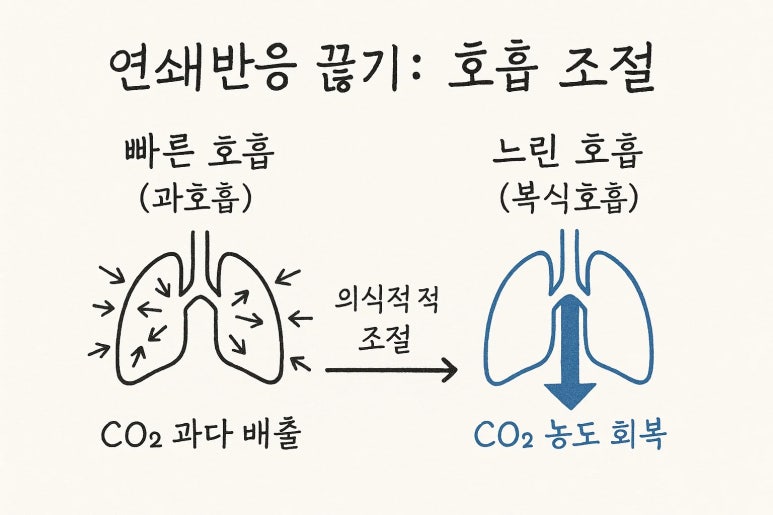
| [Reclaiming the Cockpit of Your Body] Now, what we need to do goes beyond blindly repeating 'the plane is safe'; it's to recognize our body's 'hyperventilation' and learn how to consciously control it. This means internalizing the relaxation therapy effect of slowly exhaling to restore the carbon dioxide concentration in the blood. This is the true first step in managing flight-related panic disorder, moving beyond the terrifying illusion of 'a crashing plane' and taking the pilot's seat in your own body. |