
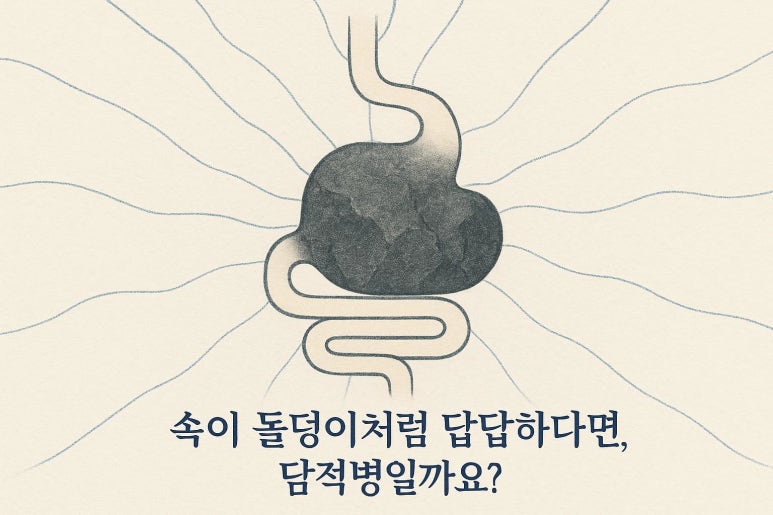
Self-Diagnosing Damjeok Disease? Is This Your Story?

“My stomach feels heavy and blocked, like a stone, causing discomfort.” Have you ever said something like this?
Many patients I see in my clinic often complain of chronic indigestion, abdominal bloating, and a heavy sensation in the epigastric region.
Typically, they attribute these symptoms to stress or poor eating habits, dismissing them as minor everyday discomforts and not feeling a strong need for a professional examination.
However, I emphasize that these symptoms might not just be fleeting discomforts, but rather signals of a hidden internal problem: ‘Damjuk disease’.
I particularly frequently observe this pattern of Damjuk disease in highly stressed working professionals and homemakers in their 30s to 50s.
Through this post today, I humbly aim to guide you on what Damjuk disease is and what self-diagnosis criteria might help you understand your own condition.
Damjuk disease, could this be your story?
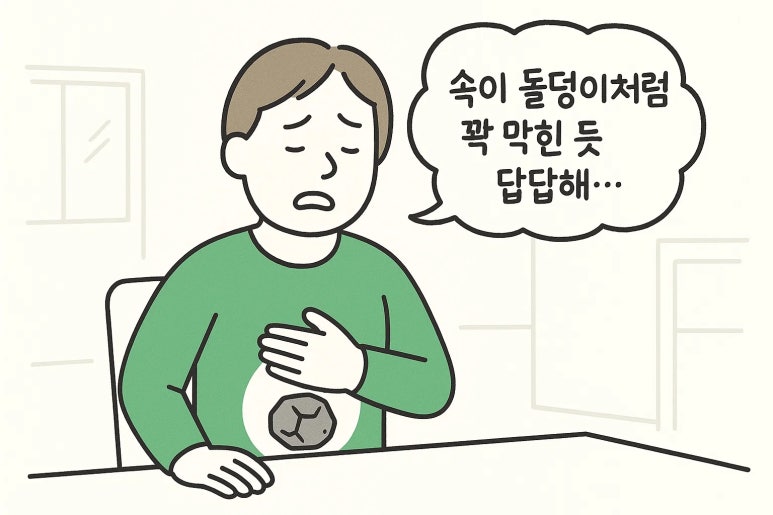
| Min-jun (pseudonym), a working professional in his 40s, had suffered for several years from frequent bloating and gas. After meals, his epigastric region would feel heavy and blocked, like a stone, causing discomfort, and even frequent burping brought no relief. Min-jun initially attributed this to excessive work stress and overtime, intermittently taking stomach medicine or digestive aids. However, the relief was always temporary; the symptoms would recur over time, consistently diminishing his vitality. When he eventually came to see me, I was able to uncover a clinical clue – 'Damjuk' – hidden behind his long-standing indigestion. |
What is Damjuk disease, and what signals does my body send?
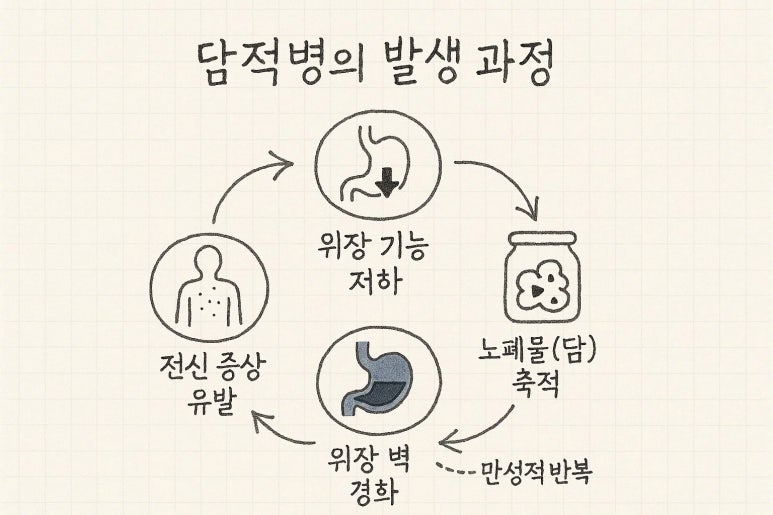
So, what exactly does Damjuk disease refer to?
In Korean traditional medicine, Damjuk disease refers to a pathological state where 'Dam' (痰), metabolic waste products resulting from impaired gastric function, accumulate and harden in the stomach wall.
To help understand this, I often use the following analogy:
| Even a healthy tree will eventually sicken if the soil around its roots becomes too hard, preventing it from absorbing water properly, no matter how much good water is provided. The same applies to our body's stomach. When impaired digestive function persists, digestive fluids and food residues generated within the stomach cannot be processed properly. These waste products (Dam-eum) then accumulate and harden in the stomach wall and surrounding tissues. This phenomenon is precisely 'Damjuk,' and it not only reduces the motility of the stomach itself but also spreads throughout the body, causing various chronic symptoms. |
I always emphasize that this Damjuk is not merely a stomach issue but rather indicates a systemic imbalance.
In my clinic, when speaking with patients, there are several important clues I look for when Damjuk disease is suspected.
These clues can serve as the starting point for 'Damjuk self-diagnosis', helping you understand your body's condition.
After meals, you frequently feel bloated and gassy, and your entire abdomen often feels distended.
Your epigastric region always feels heavy and pressed, like a stone, or you feel a sensation of something stuck or foreign, even without pain.
Even after eating a small amount, your stomach feels full quickly, and you tend to eat less.
You often feel nauseous or queasy without any particular reason, and sometimes you feel like vomiting.
You experience recurring constipation and diarrhea, or your bowel movements feel unsatisfying and sticky.
You have symptoms of a heavy head and dizziness, or your entire body always feels tired and sluggish, and sleep doesn't feel refreshing.
You experience unpleasant breath, and your tongue has a severe yellow or white coating that is difficult to remove.
Your shoulders and neck often feel stiff and achy, and you frequently experience chronic pain throughout your body.
| These symptoms can be a clue to a systemic problem that goes beyond simple gastrointestinal discomfort. Specifically, chronic indigestion, abdominal bloating, and epigastric heaviness are core symptoms of Damjuk disease, representing a pattern that emerges when gastric dysfunction persists for a long time. If you exhibit several of these Damjuk symptoms, I clinically interpret this as a potential imbalance originating deep within the body. |
Consult with a professional rather than self-diagnosing
These self-diagnosis criteria serve as an important first step in recognizing and understanding your symptom patterns.
However, I always emphasize that all of this is merely 'self-diagnosis', and a definitive medical diagnosis must be made through examination by a professional.
Healthcare professionals, including myself, listen attentively to the patient, and through careful palpation, pulse diagnosis, and other physical signs, we uncover clues suggesting Damjuk, formulate a hypothesis, and then verify it to propose a personalized treatment plan.
| The self-diagnosis criteria presented in this article are solely for the reader's understanding, and self-diagnosing Damjuk disease and arbitrarily choosing treatment methods is highly dangerous. Symptoms such as abdominal bloating or indigestion can be signals of various gastrointestinal diseases other than Damjuk disease, therefore, consultation and examination by a professional medical team are absolutely necessary. Especially if you are suffering from chronic gastritis or similar conditions, it is crucial to thoroughly understand your current state and establish an appropriate treatment plan. |
How was that?
I hope you now have a deeper understanding that the discomfort you are experiencing is not simply a matter to be dismissed as your 'natural constitution' or 'stress', but rather an important signal from your body.
The process of finding meaning in the chronic discomfort you experience and, through it, restoring your body's overall balance will certainly not be easy.
However, I am ready to be your companion on that journey, helping you to become an 'active participant in your own recovery'.
So, please gather your courage and reach out to a professional.
I sincerely support you on your journey to healthy recovery.