
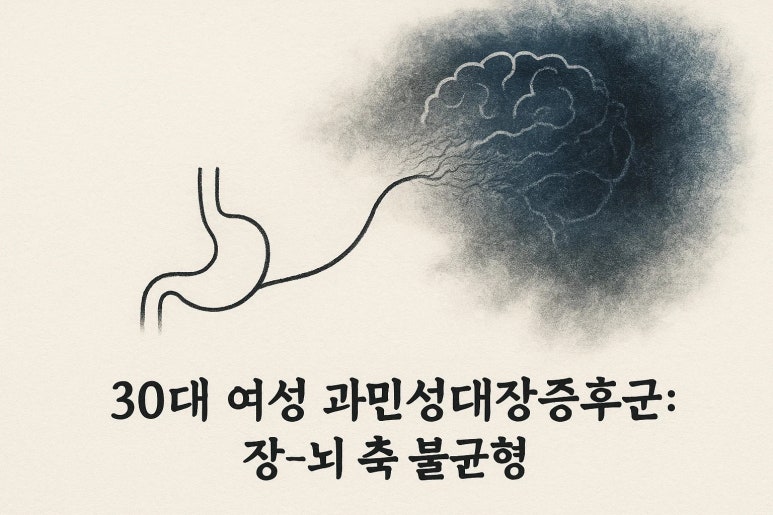
Irritable Bowel Syndrome (IBS) Cured? Still Running to the Bathroom Right After Eating

Complete Cure for Irritable Bowel Syndrome? Always Rushing to the Bathroom After Eating
“Sudden Abdominal Pain, I Dread the Restroom” | Chronic Irritable Bowel Syndrome in a Woman in Her 30s
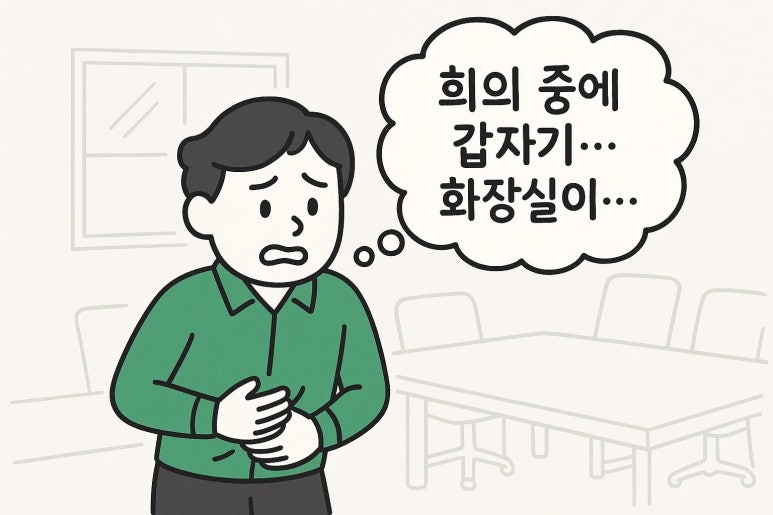
“Doctor, I feel like I might suddenly have to rush out because of abdominal pain, even during a meeting.”
“I get very anxious if I can't see a restroom during a date.”
Many women in their 30s whom I see in my clinic complain of such suffering due to Irritable Bowel Syndrome.
Although they appear to lead active daily lives, unpredictable abdominal pain, diarrhea, and constipation, which are symptoms of chronic indigestion, shake their lives to the core.
This chronic discomfort, which is difficult to explain simply by saying 'the gut is sensitive,' why does it occur?
And can we truly escape these persistent symptoms and reclaim a healthy life close to a 'complete cure'?
Chronic Irritable Bowel Syndrome is Not Just a Simple Functional Disorder
Many people tend to dismiss Irritable Bowel Syndrome (IBS) as merely a 'stress-induced' or 'functional' disorder.
However, based on what I observe and interpret in my clinical practice, it is a sign of an imbalance in our entire body, going beyond simple gut functional issues.
This condition, which is 1.5 to 3 times more common in women, particularly those aged 20 to 40, has complex causes that cannot be viewed as solely a gut problem.
In fact, according to the international diagnostic criteria, Rome IV criteria, IBS is diagnosed when recurrent abdominal pain occurs at least once a week over the past three months and is associated with defecation or a change in the frequency or form of stool.
However, these diagnostic criteria alone are insufficient to fully explain the profound suffering of patients.
Ultimately, it means we must accurately read the signals the body sends, and find and resolve the clues that lead to imbalance.
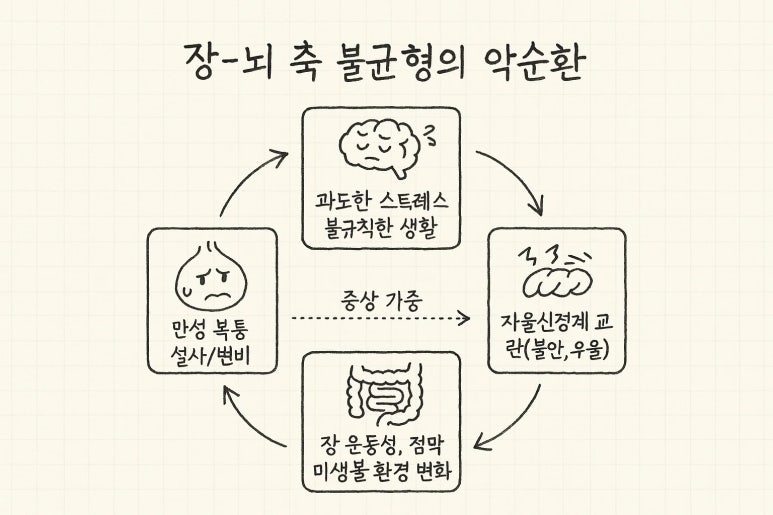
| "I hesitate to make important plans because I'm afraid my stomach will hurt, and I get tired from constantly worrying about every single food item at company dinners. I'm afraid I might even develop a panic disorder like this." These complaints contain not only physical discomfort in the gut, but also a deep underlying deterioration in quality of life, anxiety, and depression caused by it. A study shows that 76% of Irritable Bowel Syndrome patients are affected in five or more areas of their daily life, and the rate of experiencing anxiety and depression is twice that of the general population. Because the gut and brain are connected by a constantly communicating 'gut-brain axis,' problems with overall gut health often lead to mental issues, and mental issues, in turn, contribute to gut problems, forming a vicious cycle. |
The Body's Fundamental Environment and Neuro-Constitutional Imbalance, the Path to Recovery
So, how can we break this vicious cycle?
I do not simply view Irritable Bowel Syndrome as 'gut inflammation' or 'a sensitive gut'.
Rather, I interpret it as an overall neuro-constitutional imbalance in our body affecting gut function.
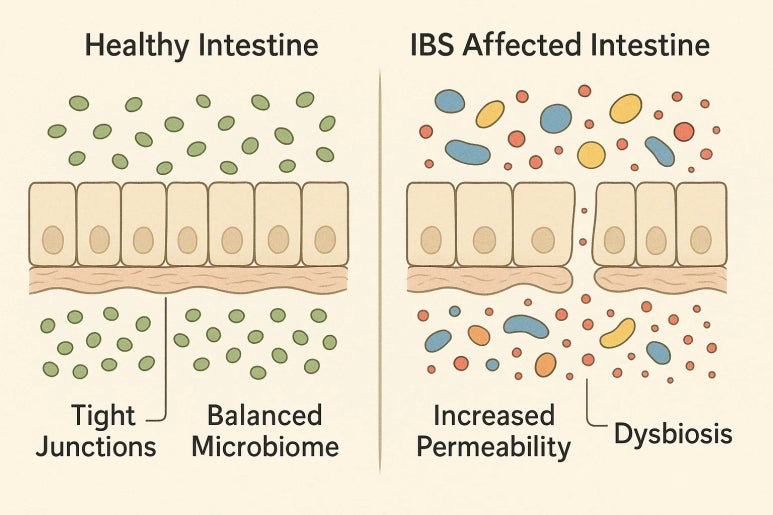
Excessive stress, irregular lifestyle habits, poor diet, and prolonged sleep deprivation all affect the body's autonomic nervous system, which in turn causes negative changes in gut motility, intestinal mucosal permeability, and the gut microbiome environment.
| The Path to Irritable Bowel Syndrome Recovery: Observation → Principle/Mechanism → Application 1. Observation: We comprehensively assess the patient's vivid symptoms, psychological state, lifestyle habits, gut tension through abdominal palpation (bokjin), and the overall state of qi and blood circulation through pulse diagnosis (maekjin). 2. Principle/Mechanism: The core of Irritable Bowel Syndrome lies in dysfunction of the gut-brain axis and autonomic nervous system imbalance, rather than direct gut problems. In traditional Korean medicine, it is interpreted as 'Liver Qi Stagnation (Gangiulkyeol)' leading to Qi Stagnation (Giche), phlegm retention (dameum), and damp-heat (seopyeol) due to weakened Spleen and Stomach function. Micro-inflammation of the intestinal mucosa and gut microbiome imbalance are also key mechanisms. 3. Application/Solution: We help restore autonomic nervous system balance and promote intestinal mucosal recovery through herbal medicine prescriptions tailored to the individual's constitution and symptom patterns. For example, herbal remedies such as Tongsayobang have been shown in studies to alleviate smooth muscle contractions and improve visceral hypersensitivity. Additionally, we focus on improving the body's fundamental environment by combining acupuncture treatment with lifestyle and dietary adjustments. |
The Story of Ms. A, an Office Worker in Her 30s: Towards a Daily Life Where the Bathroom is No Longer Feared
| For Ms. A, an office worker in her mid-30s, going straight to the bathroom every morning became her routine after taking on an important project. She often broke out in a cold sweat on the subway during her commute due to sudden abdominal pain and diarrhea, and at work, she developed a habit of always checking the restroom's location first. When under severe stress, she experienced constipation accompanied by a feeling of her stomach 'drying up' with pain, which would then repeatedly shift to severe diarrhea. She was diagnosed with Irritable Bowel Syndrome at the hospital and took medication, but feeling that it only provided temporary relief, she sought me out. Listening to Ms. A's story, I particularly noted her hot flashes when anxious, cold hands and feet, irregular meals, and difficulty managing stress. This I viewed as a typical pattern in traditional Korean medicine where 'Liver Qi Stagnation' and 'Spleen and Stomach dysfunction' are complexly at play. I primarily prescribed herbal medicine for Ms. A to relax her tense intestines, promote the circulation of stagnant qi in her gut, and aid her weakened digestive function. At the same time, I recommended regular meals and light exercise for stress relief. Three months later, Ms. A was able to have peaceful bowel movements every morning, and her anxiety about sudden abdominal pain significantly decreased. Seeing Ms. A smile brightly, saying, “Now I can concentrate during meetings without worrying about my stomach,” I once again felt that this treatment was not merely about symptom relief, but about the recovery of life itself. |
The Journey Towards a 'Complete Cure,' and a Promise as a Transparent Companion
Although Irritable Bowel Syndrome is sometimes considered an 'intractable' disease, I believe that a recovery close to a 'complete cure' is possible through consistent herbal medicine treatment and lifestyle improvements.
Here, 'complete cure' means more than just the disappearance of symptoms; it signifies a state where patients can proactively manage their body's balance and lead a healthy daily life themselves.
Herbal medicine treatment focuses not on short-term symptom suppression, but on changing the body's fundamental environment and restoring neuro-constitutional balance.
I strive to be a companion who walks the journey with patients by transparently explaining the origin of medicinal herbs, the treatment process, and the expected progress.
| IBS requires consistent management even after symptom improvement. If treatment is immediately stopped or lifestyle habits are neglected again simply because symptoms have improved, the risk of relapse is high. Even after the gut-brain axis balance is restored through herbal medicine treatment, a balanced diet, regular exercise, sufficient sleep, and stress management must be continuously maintained. This is an extension of treatment and an essential investment for a healthy life. |
| Self-diagnosis or relying on only one method is dangerous. Many patients attempt self-imposed dietary restrictions or consume specific health supplements based solely on internet information, only to experience nutritional imbalance or worsening symptoms. Because Irritable Bowel Syndrome varies greatly among individuals, it is crucial to consult with an experienced medical professional to devise a personalized treatment plan suitable for one's body. Even if it's not me, please find a medical professional who carefully examines your entire body. |
Chronic Irritable Bowel Syndrome is certainly a painful condition.
But there is no need to despair.
I will listen to your suffering voices, and together, we will discover the clues to recovery within them.
Because our bodies possess an amazing capacity for self-healing.
I will gladly accompany you on the journey to awaken that ability and reclaim a healthy daily life.
Your gut, perhaps like your heart, might be waiting for warm attention and delicate care.